

This 2016 Steven Spielberg Box Office Bomb Streaming On Disney+ Deserves A Second Look
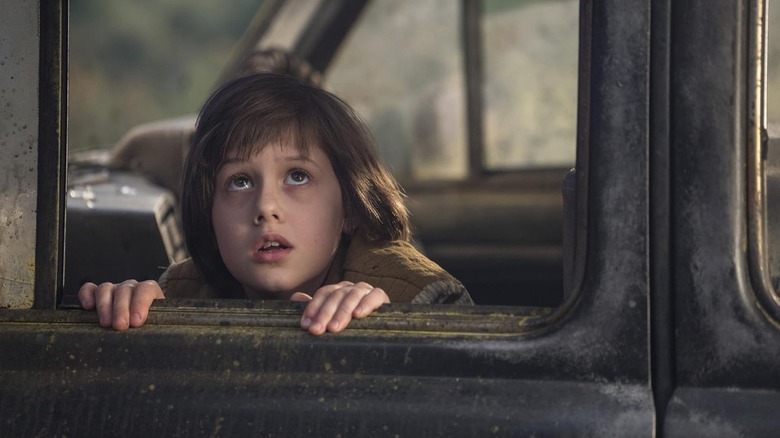
Roald Dahl's 1982 novel "The BFG" is one of his most unusual tales. It's about Sophie, a young orphan who, while awake one night, spies a mysterious, building-sized giant stalking through the streets of London. The giant realizes that he's been seen, kidnaps Sophie, and takes her back to a very, very distant land where giants live; he can run supernaturally fast, so the land may be anywhere on Earth. The bulk of "The BFG" involves Sophie learning about this giant and what his life is like. The giant, whom she nicknames the BFG (for Big Friendly Giant) works as a distributor of dreams. He travels out into a mystic plane and captures dreams in jars. Dreams are wild, living puffs of colored smoke. He then sneaks off to London and blows dreams into children's head with a specialized vuvuzela.
At home, the BFG eats disgusting vegetables called snozzcumbers and drinks a whimsical soda called frobscottle. Frobscottle induces magically powerful farts. The BFG is also bullied by the other giants of his country, as he is the smallest and most mild-mannered of the lot. Beyond that, the BFG cannot read and speaks in a very peculiar patois. Naturally, Sophie teaches him about humans and being civilized.
In 2016, Steven Spielberg released a film adaptation of "The BFG," using motion-capture and CGI to transform Mark Rylance into the title creature. The young actor Ruby Barnhill played Sophie, and, like in the book, she spends the film learning about the ins and outs of the BFG's life, including the means by which he distributes dreams. Spielberg includes his trademark sense of wonder, as well as his skills in constructing magical visuals, yet he retains Dahl's down-home British peculiarities. Although it bombed in theaters, it's actually quite good and worth streaming on Disney+.
The BFG is good, actually
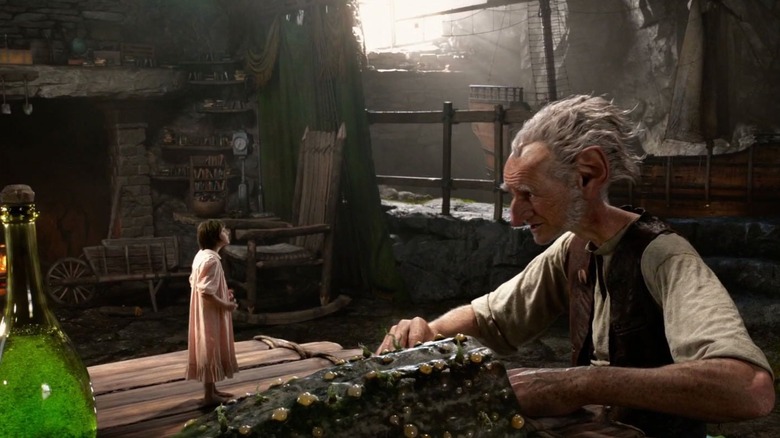
Since the start of the 21st century, Spielberg has seemed more interested in directing adult dramas that comment on the politics of the day, rather than the adventurous blockbusters that defined the early parts of his career. Spielberg films like "Munich," "Lincoln," "The Post," and the historical spy thriller "Bridge of Spies" seem to get a lot more thought and directorial attention than effects-based trifles like "The Adventures of Tintin" or the abysmal "Ready Player One." "The BFG" has proven to be an exception to that rule, as it is an effects-driven fantasy picture, based on a beloved children's novel, but is also rich and textured and intriguing. A lot of the effectiveness of "The BFG" comes from Rylance's performance as the title character. The BFG is visualized with motion-capture, but he was also designed to keep a lot of Rylance's actual facial features, making the giant all the more expressive.
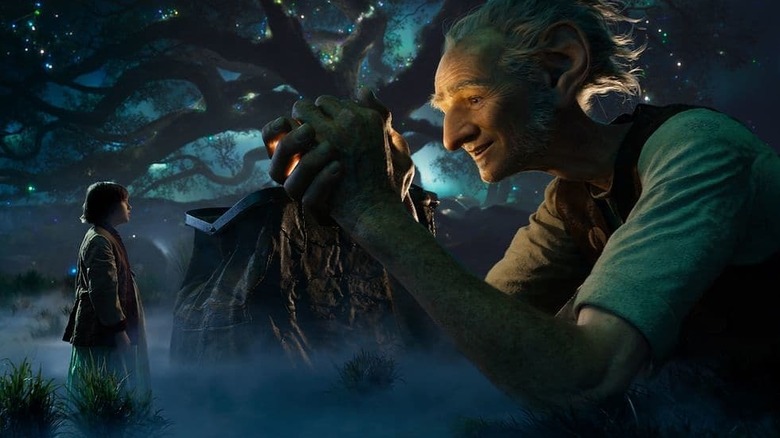
Spielberg couldn't resist, of course, making "The BFG" more, well, Spielbergian. In Dahl's book, the BFG captures invisible dreams out of the air in a distant prairie. In the movie, he sinks into an alternate reality where dreams dance, already colored, around a massive, magical tree. That sequence feels like the director was indulging himself a little bit.
Overall, though, Spielberg retains the original novel's weird sense of humor. Indeed, it's worth noting that "The BFG" features the director's first fart joke — specifically, during a scene where Queen Elizabeth II (Penelope Wilton), looking her 1950s best, tries some frobscottle and farts herself to ecstasy. Meanwhile, her corgis fart so hard that they skitter across the floor of Buckingham Palace. This is something that actually occurs in an expensive Disney movie. One has to admire Spielberg's temerity.
The BFG bombed pretty badly
"The BFG," however, was not a box office hit. Instead, it was a very costly movie that failed to capture the public's attention. Its failure could, in part, be due to the fact that it had to compete directly with the Pixar film "Finding Dory," which opened only a few weeks before. Family audiences, perhaps unsurprisingly, went with the "Finding Nemo" sequel over "The BFG." In the end, because it cost a whopping $140 million to make, "The BFG" went down as one of 2016's biggest flops. Not only that, but when you adjust for the inflation of ticket prices, "The BFG" might just be the biggest money loser in Spielberg's career.
Critics generally liked "The BFG," though. The film currently holds a 74% approval rating on Rotten Tomatoes, based on 308 reviews. Matt Zoller Seitz, writing for RogerEbert.com, enjoyed the movie's overall gentleness. He acknowledged that many viewers may take issue with its lack of plot and action, but he liked that its monsters are kind of whimsical and silly. Not everyone loved it, of course (Richard Roeper, for example, deemed the film "listless and tedious"), but the overall impression was positive.
It's possible that Barnhill's career was derailed a bit by the failure of "The BFG," seeing as she's mostly only taken on voice roles since its release. (Then again, she's still very young, so perhaps she's still figuring out what she wants to do as a career.) As for Spielberg, he followed "The BFG" up with "The Post" (which is one of his best movies), so he certainly wasn't hurting for work. His films, however, haven't been as reliably successful as they were in the past, with his "West Side Story" and "The Fabelmans" both bombing. But don't hold that against them.