

Scientists Say Star Trek's Enterprise Design Is Accurate For A Warp Speed Spaceship
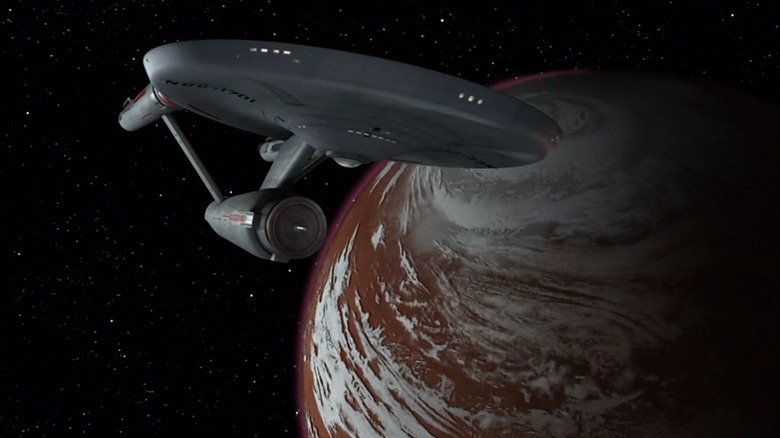
"Star Trek" creator Gene Roddenberry once wrote four cardinal rules for the design of the many Starfleet-constructed starships seen on "The Original Series." For one, he said that the ships' warp nacelles — the cylindrical engines that extend from either side of the central hull — should come in pairs. Secondly, the nacelles should never be sticking out at a 180-degree angle from the hull; rather, they should be angled in such a way that they would have a line of sight with one another. Those nacelles also needed to be visible when looking at the ship from the front; they should not be obscured by any other part of the vessel. And finally, the ship's bridge should be on the top of the ship, right in the center of its saucer section.
These kinds of commandments assured that there was a certain degree of visual consistency across the franchise. If one saw a two-engine ship with a flat saucer section, they would instantly be able to identify it as a Starfleet vessel. Later on, tech nerds and expanded-universe-obsessed Trekkies would posit that Roddenberry's two-engine design also served a practical purpose. The engines needed to be unobscured because the red "caps" on the end (called Bussard ramscoops in the show's mythology) scooped up errant space particles and gases and transformed them into energy. The twin engines were required to form an entire warp field around a ship.
As it so happens, though, Roddenberry's starship designs might have been just as scientifically sound as aesthetically pleasing. According to a new paper published on the IOP Science website (and covered by Fast Company), an actual faster-than-light starship would indeed require widely-spaced engines to create a field of warped space around a vessel.
Faster-than-light travel might require widely-spaced warp engines (like those seen in Star Trek)
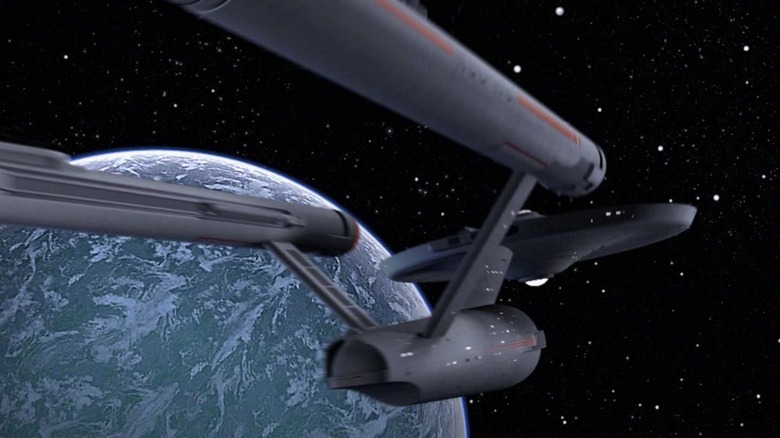
To bring any laypeople up to speed, the fictional engines for the ships in the "Star Trek" franchise operate by "warping" space around the ship, as opposed to propelling the ship at faster-than-light speeds. "Star Trek" has always liked to keep one finger on the reality of actual physics and understands that the law of relativity prevents objects from traveling faster than light. As such, its propulsion "bunches up" space around the ship, travels across a smaller distance at sub-light speeds, and then re-stretches space back to normal, allowing it to traverse great distances without having to ever go faster than light. It's all very technical, even in the many fictional technical manuals that've been written about the property. As stated, the reason the warp engines are so far apart is because a field needs to be formed around the entire ship, and the field can more easily be generated from two engine arrays on the outer edges of the ship.
It seems that a mechanical engineer named Harold "Sonny" White has been working on similar "warp" technologies at NASA's Jet Propulsion Laboratory, and he's proposed a device that could theoretically travel faster than light. By coincidence, it happens to look a lot like the U.S.S. Enterprise, notably because it sports two widely spaced warp nacelles. And, yes, White noticed, writing:
"The resemblance to the twin nacelles of the U.S.S. Enterprise is not merely aesthetic, but reflects a potential convergence between physical requirements and engineering design, where science-fiction architectures hint at practical pathways for real warp-capable configurations."
Essentially, any travelers on a light-speed-capable spacecraft would have to inhabit a "safe zone" inside a geometric "bubble" surrounded by an engine-created field. That's pretty close to the Enterprise.
Star Trek is inspiring real-world technology ... again
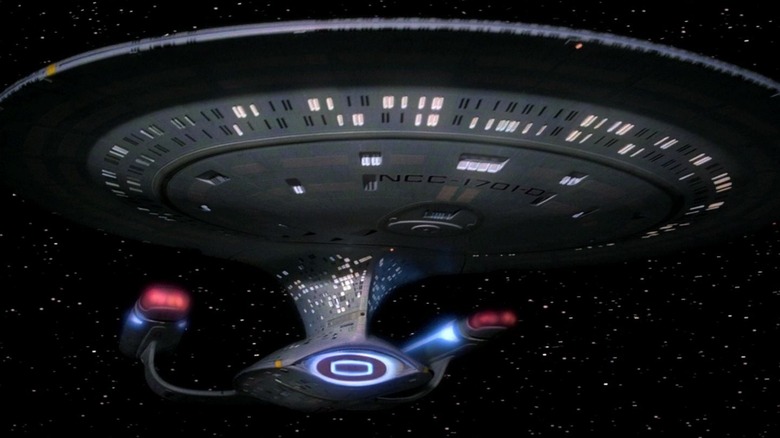
As it happens, a lot of the models White was working with were actually inspired by "Star Trek." The idea was that a faster-than-light ship would require a torus-shaped field of continuous "negative energy" that would, like antigravity, pull space apart for a ship to pass through. This torus model was considered back in 1994 (as "Star Trek: The Next Generation" was finishing its seventh and final season) when a physicist named Miguel Alcubierre was watching the show and pondering if the Enterprise would be possible in real life. It seems, though, that Alcubierre couldn't get the physics to work on the page. A torus (that is, a donut shape) was too difficult to calculate, so the project remained theoretical.
White, however, took a look at Alcubierre's calculations and figured that a more discreet geometry might work. What if the craft had two cylindrical fields instead of a torus? What if, like the Enterprise, it had two warp fields on either side? I can't quite wrap my mind around the physics of it as I am no physicist, but I trust the math. The whole thing has to do with the geometry of warp bubbles, a very advanced science that one needs a degree to understand. It seems that, for White, calculating the energy fields of two cylinders was way more practical ... and potentially even doable. "I knew it should be possible," White wrote, "to construct warp bubbles based on a nacelle-like topology."
This wouldn't be the first time "Star Trek" inspired a real-world technology. After all, cell phones were pre-dated by the communicators on "Star Trek," as was screen-to-screen communication. All we need are food replicators and faster-than-light engines, and we may be able to enter a true tech utopia.