

All 7 Isaac Asimov Movies And TV Shows, Ranked
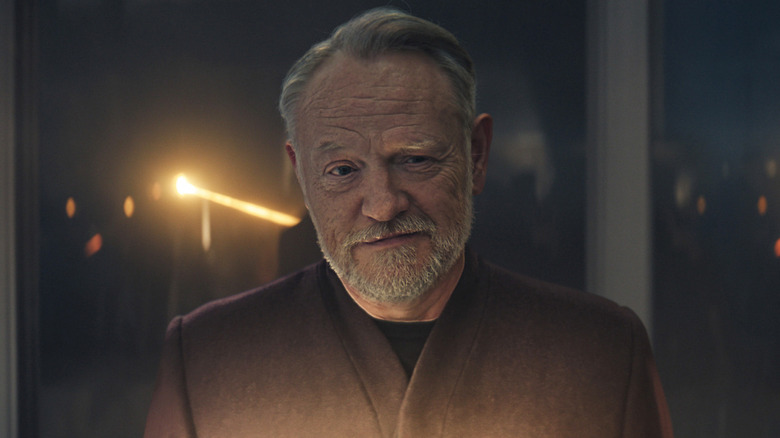
Compared to seminal genre authors like Philip K. Dick and Stephen King, Hollywood has largely left Isaac Asimov's work alone over the decades. The science fiction luminary has his share of adaptations, sure, but for a man with over 500 books to his name, the list of adaptations is surprisingly sparse. And when you take away shows that aren't exclusively about the author's work — say, the forgotten sci-fi anthology series "Out of the Unknown," which adapted some of Asimov's best stories — the list is even shorter.
In all fairness to Hollywood, Asimov's unique combination of big ideas and a logical, deliberately austere and expository writing style does not necessarily lend itself well to the action-hungry trappings of live-action sci-fi. Despite this, and to their credit, the following seven movies and TV shows have attempted to tackle the prolific author's work over the years. Let's see how each of them fared at the task, and which one did the best job at adapting the source material.
7. Nightfall (1990)
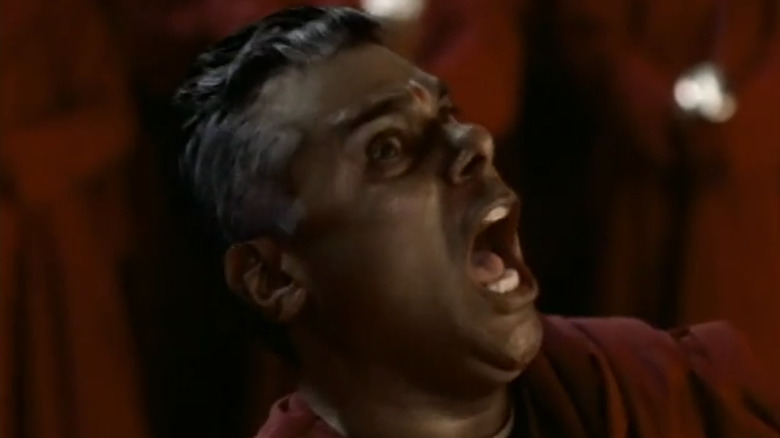
As this list will soon prove, no other work of Isaac Asimov has been as consistently mangled and mistreated by adaptations as "Nightfall." Spoilers for an 80-year-old story ahead: In 1941, Asimov's short story about a planet with six suns and no surface darkness was released. This pulpy premise hides an intricate story about the potential effects of darkness on people who have evolved to live in constant daylight, as an impending eclipse that will fulfill an ancient prophecy sends the planet in a brief period of night — which induces apocalyptic madness, chaos, and a societal collapse. It also turns out that this has happened many times before, and the thing that drives everyone insane when the eclipse comes is seeing the stars (and thus realizing the true vastness of the universe) for the first time.
Amazing stuff, right? The Science Fiction Writers of America certainly think so: In 1968, they chose "Nightfall" as the greatest sci-fi short story written before the Nebula Awards were established in 1965. Unfortunately, Roger Corman associate Gwyneth Gibby's 1990 straight-to-video adaptation of the story is considerably less amazing. It was produced by Corman himself, but you won't find it on any list of best Roger Corman films. The movie is cheaply made and frankly poor, struggling to capture the existential terror that serves as the story's throughline. Instead, there are lots of snakes and large swords.
Still, there's value in finding positive things about every film. If nothing else, this iteration of "Nightfall" serves as a handy pub quiz answer to the question, "What was David Carradine up to in 1990?"
6. Nightfall (1988)
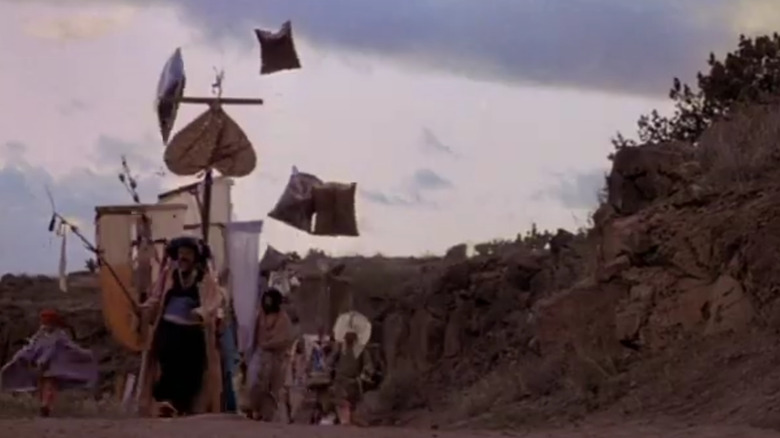
Yes, "Nightfall" conquers not just one but two bottom rungs of this list. It's not hard to understand why the arguably best-regarded short story in Asimov's sizeable back catalog has warranted multiple live-action adaptations. However, it is difficult to wrap my head around the fact that they were not only both awful, but separated by just two years.
Really, the main reason this 1988 adaptation of "Nightfall" lands higher on the list than the 1990 version is by virtue of being the first to give it a shot. Don't take that to mean that it's any good, though: It's a half-realized vision that, like the 1990 film, hails from Roger Corman's immediate orbit. To its credit, however, the movie did come from a place of good intentions. Corman's wife, Julie Corman, produced this version. In 2010, she told TV Tango that it was the one movie she would have loved to pour more money into, if she had the opportunity:
"A project called 'Nightfall,' which is from a short story by Isaac Asimov that was voted the best science fiction story of all time by the Science Fiction Academy. So it's about a planet that only sees darkness every 2000 years or so and so the people being unused to darkness go mad in the night. And yes, on a low budget, it was kind of hard to create that world."
5. Robots
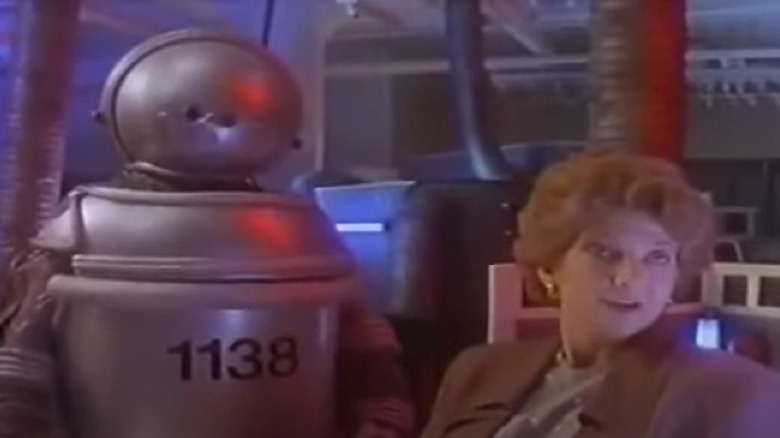
It really is a testament to the lack of decent Isaac Asimov adaptations that "Robots" even has a place on this list at all. Released in 1988 and directed by Doug Smith and Kim Takal, "Robots" is an interactive movie that doubles as a VCR crime mystery game based on Asimov's "Robot" series. It takes place in the city of Spacertown, where tensions between humans and robots run high and an attempt on leading roboticist Han Fastolfe's (John Henry Cox) life has been made. Police Commissioner Julius Enderby (Larry Block) has one day to find the culprit ... and the viewer better take notes.
"Robots" is a multiple-choice mystery film with a cliffhanger ending that prompts the viewer — who's inserted in the events as Data Center and tasked to pay attention to the proceedings — to use their wits to find out who attacked Fastolfe. The end result is a fun party game that offers lighthearted entertainment for Asimov fans, but it still remains solidly on the lower end of the Asimov adaptation spectrum, if only for its format.
4. The End of Eternity
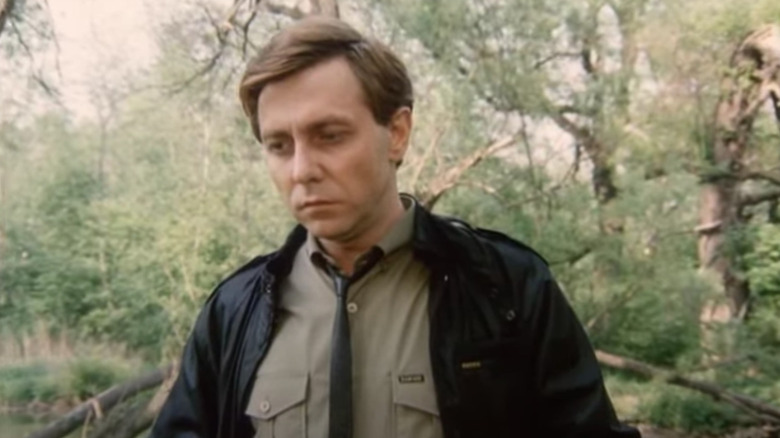
Admittedly, being the best live-action Isaac Asimov adaptation of the 1980s is like being the best dachshund in a pole vaulting contest. Nevertheless, the honor falls on "The End of Eternity." The finest Asimov-adjacent live-action project that the decade gave us is a Soviet film directed by Andrei Yermash. It focuses on an eternal, timeless, and spaceless organization known as Eternity, which meddles with our planet's events and history and recruits new "Eternal" agents as needed. This is not far from the events depicted in Asimov's 1955 novel of the same name, though, of course, the source material ventures far deeper into that concept than a movie could ever hope to.
Judged by its own merits, "The End of Eternity" is ... surprisingly fine, actually. Granted, you're not going to mistake it for an Andrei Tarkovsky joint any time soon, but as Asimov adaptations go, it still gets the surprisingly rare ranking of "perfectly watchable."
3. Bicentennial Man
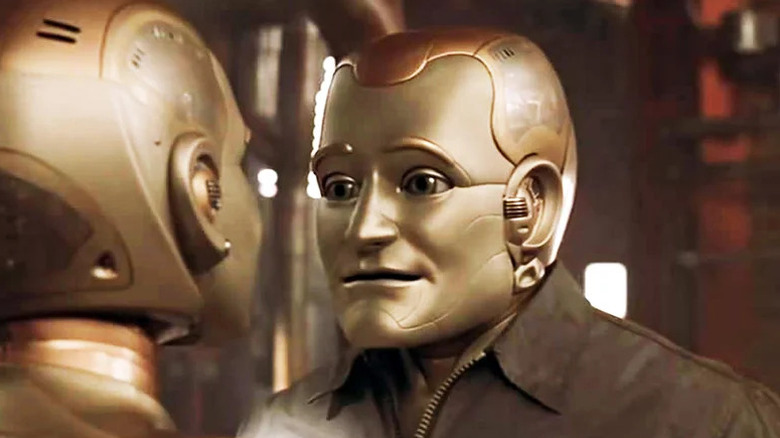
"Bicentennial Man" isn't the best Robin Williams movie by a long stretch, to put it politely. Based on Isaac Asimov and Robert Silverberg's 1992 novel "The Positronic Man" (itself an expanded version of the 1976 Asimov novelette "The Bicentennial Man"), the 1999 film has plenty of things going for it ... at least, on paper. The late, great Williams was a wondrous dramatic actor, backed here by a talented cast that includes Sam Neill, Embeth Davidtz, Wendy Crewson, and Oliver Platt. One of the producers was Wolfgang Petersen, known at the time for quality work like "Das Boot," "The NeverEnding Story," and "In the Line of Fire."
Unfortunately, there's a flip side to the coin. Instead of an ambitious drama like those names might suggest, "Bicentennial Man" is a comedy-drama directed by Chris Columbus. Neither is a bad thing, per se. Columbus has an admirable résumé, and Williams isn't exactly bad at comedy. However, the genre choice confines both the star and the movie in a very specific box that's not exactly helped by main character Andrew's (Williams) cutesy robot design. What's more, the script, from Oscar-nominated screenwriter Nicholas Kazan ("Reversal of Fortune"), was widely panned. The end result is a film that tries to explore some of Asimov's loftiest concepts and occasionally succeeds, but ultimately is simply too dull to make the author's ideas shine.
2. I, Robot
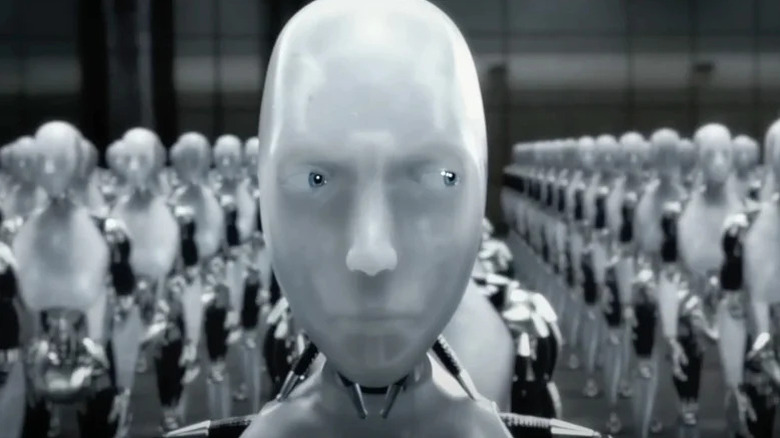
Alex Proyas' "I, Robot" (2004) is ostensibly based on Isaac Asimov's 1950 collection of short stories that gave it its name. Primarily, it focuses on the author's famous three laws of robotics, which stop robotic entities from harming humans. The rest of it has been Will Smith-ified to oblivion.
In "I, Robot," the mysterious death of a robotics boss (James Cromwell) leads detective Del Spooner (Smith) to believe that a particular robot called Sonny (Alan Tudyk) has learned to circumvent the rules, thus acquiring the ability to kill. The rest of the movie explores the truth behind the situation and the nature of a robot's free will, which is Asimov enough. The problem is that the movie's philosophical conceits exist within the trappings of a turn-of-the-millennium Will Smith actioner, with all the usual pros and cons that come with that. Still, while the critical response for the film was lukewarm, "I, Robot" has the decency to be a reasonably entertaining blockbuster that at least skims Asimov's ideas, which is more than can be said for any other film on this list.
Weirdly enough, if you combine "I, Robot" and "I Am Legend" (which adapts Richard Matheson's iconic 1954 post-apocalyptic novel), Smith has cornered the very peculiar micro-niche of creating big budget semi-adaptations of iconic 1950s genre works. History may be kinder to these projects than critics have been, but at least they express good taste in source material.
1. Foundation
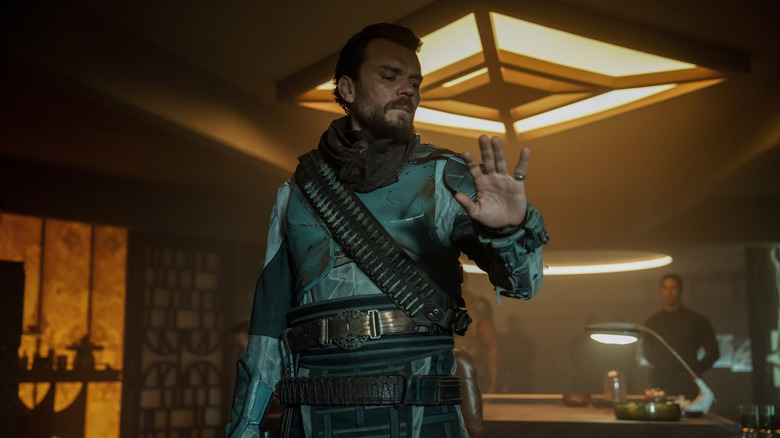
When one end of Isaac Asimov adaptations is filled with obscure Roger Corman-adjacent fare and the other has a cast full of folks like Jared Harris, Laura Birn, and Lee Pace, the odds are more than a little bit stacked in the latter's favor. Still, Asimov was due for a truly excellent adaptation, and David S. Goyer and Josh Friedman's Apple TV+ juggernaut "Foundation" finally provided it in 2021.
"Foundation" is the best-known Asimov series out there, and also one of those sprawling "Dune"-style works that was considered unadaptable until someone with sufficient talent, motivation, and budget simply went ahead and adapted them anyway. The end result and great reviews speak for themselves: "Foundation" is doing a spectacular job of bringing the source material's esoteric scientific fields, genetic clones, heretic planets, and dangerous Mentalics to life.
"Foundation" manages to captivate audiences through a clever combination of an amazing cast and gorgeous visuals. Its plot remains faithful to the source material's big beats, but isn't afraid to make deviations to best serve the story and the medium. Even in a field of tighter competition, this approach would be enough to crown it the best Asimov adaptation out there.