

Dune Author Frank Herbert Didn't Mince Words When Star Wars: A New Hope Came Out
Frank Herbert published his seminal sci-fi novel "Dune" in 1965, creating a vast and detailed socio-political sci-fi mythology so complex that it required a glossary. For many years, "Dune" attracted a subset of very attentive readers, happy to get lost in Herbert's massive space opera. "Dune" was set many tens of thousands of years in the future, where various galactic sects and royal families wrestled for control of a rare spice only located on the planet Arrakis. The spice was a hallucinogen that was also necessary for space travel. The plot and characters of "Dune" are legion, and the entire multi-book political/religious saga is too complex to get into here. Luckily, the basics are all common knowledge thanks to a 1984 film adaptation of "Dune" by David Lynch, and a pair of adaptations from Denis Villeneuve in 2021 and 2024.
By 1977, Herbert had written two additional sequels to "Dune," called "Dune Messiah" and "Children of Dune," and the mythology had only expanded that much more. It was at this point in his career that "Star Wars" hit theaters. It shouldn't need reiterating that George Lucas' space opera, inspired by the corny sci-fi serials Lucas watched as a kid, was a gigantic industry-rattling game-changer. Its success caused all of Hollywood to pivot more heavily toward sci-fi in particular, and toward special effects in general. "Star Wars" wasn't the same flavor as "Dune" — Lucas' film was simpler and more kid-friendly — but it was a new sci-fi mythology introduced into the pop firmament.
In a 1977 interview with the Daily News, however, Herbert felt that Lucas was ripping him off. Indeed, Herbert felt that "Star Wars" had "borrowed" so much from his novels that he was briefly considering legal action.
Frank Herbert considered suing George Lucas for ripping off Dune
Although the tone of "Dune" and the tone of "Star Wars" are very different, there are enough superficial similarities to give one pause. Herbert was asked by the Village Voice if he was considering legal action, and said:
"I will try hard not to sue. [...] I have no idea what book of mine it fits, but I suspect it may be 'Dune,' since in that I had a Princess Alia and the movie has a Princess Leia. And I hear there is a sandworm carcass and hood-dwellers in the desert, just like in Dune.'"
Herbert didn't end up suing Lucas, but one can imagine that he retained a small amount of animosity. Lucas was quoted in the same article, having been asked about his film's similarities to "Dune." To the matter, Lucas merely said that the only similarity between "Star Wars" and "Dune" is that "they both have deserts." Indeed, Lucas has spoken about his inspirations for "Star Wars" often, and he usually talks about "Flash Gordon" as well as the films of Akira Kurosawa. He modeled his robot characters after the leads of Kurosawa's "The Hidden Fortress," and took the film's final Death Star bombing sequence from the 1955 British film "The Dam Busters."
"Dune," meanwhile, was hardly ever cited as a source of inspiration, making its similarities likely coincidental. If Lucas did take inspiration from "Dune," it may have been subconscious; Lucas might have read Herbert's book and internalized some of it.
Wait, Star Wars and Dune actually have a lot of similarities
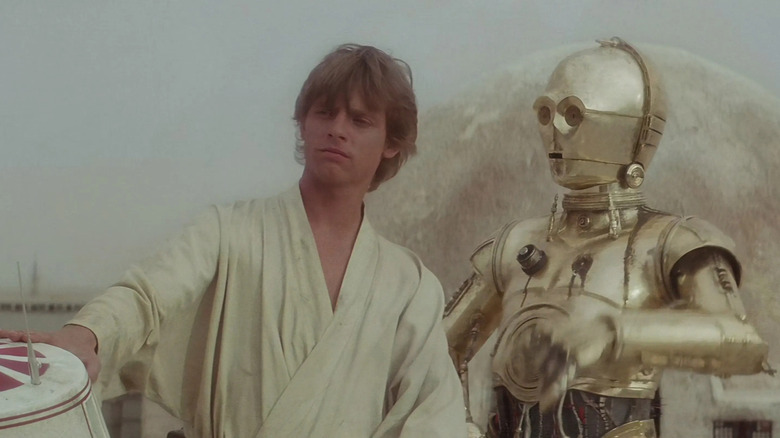
If Herbert had sued Lucas, would he have had a case? It's possible. He already pointed out that "Princess Alia" sounds a lot like "Princess Leia," but he didn't note that the characters are actually somewhat similar. They are both of royal lineage, yes, and both are the sisters of their respective saga's warrior protagonists. Also, they are both sensitive to a notable magical force in their galaxies. Leia can use the Force, while Alia has psychic abilities granted to her by the Water of Life.
"Dune" features a sect of witches called the Bene Gesserit who can notably manipulate the weak-willed using a hypnotic spell called The Voice. In "Star Wars," the old sage Obi-Wan (Alec Guinness) explains that the Force can be used in a very similar fashion. The desert settings are, of course, similar, although only "Dune" contains outsize sandworms that make the deserts uninhabitable. That is, until Lucas wrote his 1983 sequel "Return of the Jedi," which featured a sandworm-like creature called a Sarlacc.
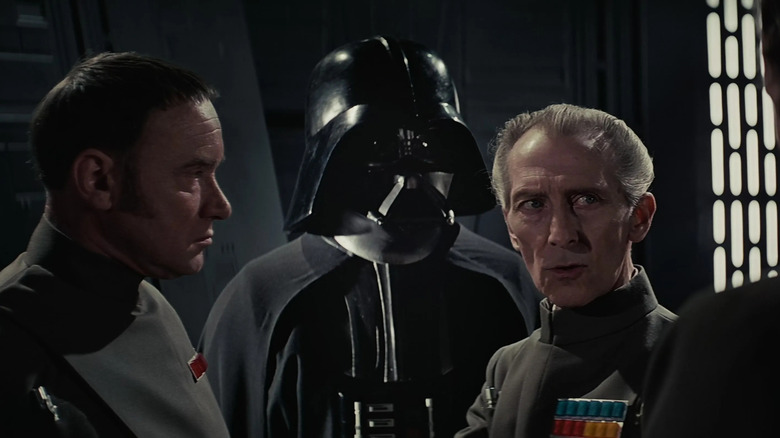
Also, in "Star Wars," the galaxy is ruled with an iron fist by an evil empire called, well, the Galactic Empire. This is eerily similar to the Imperium from "Dune," an imperial force that manipulates the various royal houses for their own benefit. The imperium aren't necessarily evil villains, but they certainly aren't a force for good in the galaxy. "Star Wars" has a hotshot character in the form of Han Solo (Harrison Ford) and "Dune" has a hotshot character in the form of Duncan Idaho.
And a deeper delve will only reveal more similarities. Could Herbert have won in court? Perhaps not, but one can understand why he'd be miffed.