

One Of M. Night Shyamalan's Worst Movies Began As A Bedtime Story For His Kids
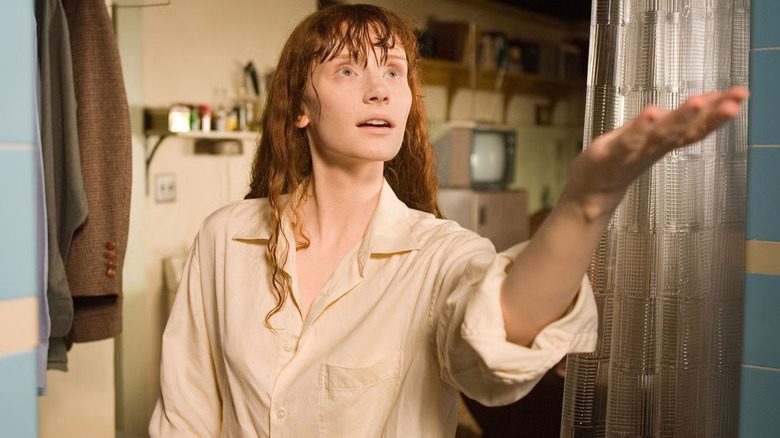
M. Night Shyamalan's 2006 fantasy "Lady in the Water" is a pretty terrible film. It's a mawkish fairy tale with a dripping, insufferable sense of self-importance. The mythology is dumb, and it feels like Shyamalan was making it all up as he went along. The story follows a character literally named Story (Bryce Dallas Howard) as she appears in the swimming pool of a Philadelphia apartment complex. She moves in with the apartment's super, Cleveland (Paul Giamatti), and he has to figure out her needs and her nature. It's obvious from the jump that Story is a naiad — a Narf — claiming to have come from "the Blue World" on a mission of the utmost importance.
Story's presence among humans has attracted a few evil magical beings as well. There is a pack of killer wolf-like plant monsters lurking in the bushes called Scrunts, as well as her defenders, a violent trio of ape-like monsters called, collectively, Tartutic. The terms "Narf," "Scrunt," and "Tartutic" are given to Cleveland by an elderly Chinese neighbor (June Kyoto Lu), even though those words don't sound Chinese. The apartment complex is lousy with eccentric kooks, one of whom is played by Shyamalan himself. Notably, one of the neighbors is a film critic named Farber, played by Bob Balaban. More on him below.
Anyone who has seen "Lady in the Water" won't be surprised to learn that it was based on a story that Shyamalan told his kids at night. It has the freewheeling, ever-shifting form of something that is constantly being added to. Only eventually did a mythology arise. Shyamalan talked about the origins of "Lady in the Water" a lot back in 2006, including in an interview with Time Magazine. He literally made it up as he went along.
M. Night Shyamalan wrote Lady in the Water after making it up for his kids
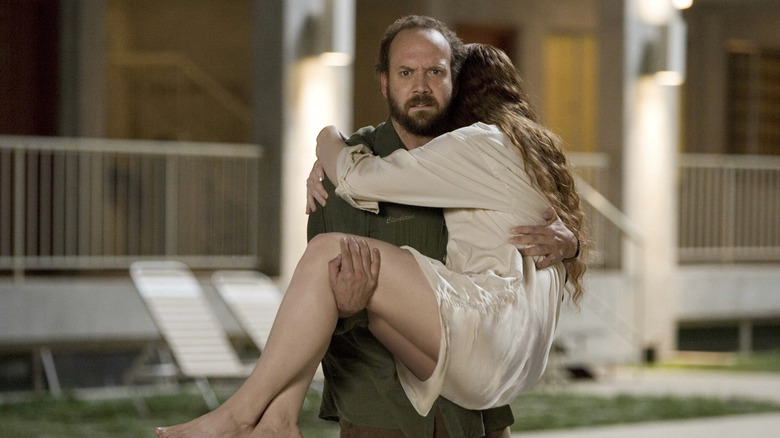
It seems that Shyamalan was in the habit of making up bedtime stories for his children. He said that, in the early 2000s, he had become preoccupied with a certain kind of fantasy story, as he (like the rest of the world) was reading the Harry Potter novels. He was also combing through fantasy classics by J.R.R. Tolkien, as well as the works of Roald Dahl. This was when his kids were 10 and 6 (his oldest is now in her 20s). The "Lady in the Water" story, however, was more expansive than his usual tales. "It had a kind of inexplicable magnetism about it that made it want to be bigger," he said. "We kept talking about it, and I told it again, which is not a normal thing, so it stood out as an anomaly."
The director said the story emerged gradually, explaining:
"Night after night for many, many nights. And then once it was done, there was a period where we just talked about it. I started flushing it out more. There was a real sense that I was following something and I didn't know why I was following it. Certainly, it could be a sign of mental instability. Or I guess the more popular belief would be a sign of someone becoming so idiosyncratic to the point of inaccessibility or irrationality, which is a possible future for an artist."
It's not surprising that Shyamalan began talking about the ambitions of an artist, given the final themes and events of his movie. Given that his Narf is named Story, one can rest assured that the very idea of storytelling is the linchpin of "Lady in the Water."
Lady in the Water hates critics

Shyamalan clearly saw himself as someone who was so creative, so daring, so idiosyncratic, that the world just couldn't handle it. If a critic rejected his ideas, it was the critic who was wrong, not him. He said that he was only reluctant to share his wilder ideas. In his highfalutin way, he continued by saying that "the fear of outsiders — and by outsiders I mean anyone that's not me — is that the first sign of being unorthodox is a symptom of this. That's one side of the argument."
Shyamalan plays a writer in "Lady in the Water," and Story has appeared from the Blue World to inspire him. Shyamalan, she explains, will write a book so significant, it will inspire a future president, and the president will change the world for the better. That's a pretty hearty self-pat on the back.
Additionally, the Farber character, a film critic, proves to be wrong time and time again about Story and the nature of her existence. Farber advises Cleveland about the tropes and trapping of cinema, insisting that good fantasy stories tend to move a certain way. When Farber is confronted by a Scrunt, his assumptions about what will happen next are so incorrect, he gets mauled to death. Shyamalan not only wrote a movie wherein his own writings will save the world, but also one in which a film critic gets killed for being wrong about him. "Lady in the Water" is a massive ego trip for a filmmaker who was, up to that point, a Hollywood darling.
Naturally, critics hated "Lady in the Water." It has a 25% approval rating on Rotten Tomatoes, based on 212 reviews.