

Godzilla's Voice Had A Cameo In A Classic Star Trek Episode
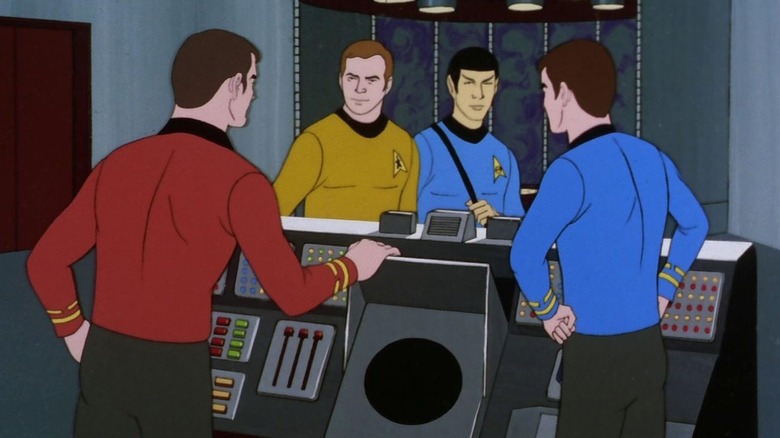
In the season 1 "Star Trek: The Animated Series" episode "Yesteryear" (which premiered in 1973), Captain Kirk (William Shatner) and Spock (Leonard Nimoy) return to the Guardian of Forever (James Doohan) — a living, sentient time portal — to conduct a series of careful time-travel experiments. They're not careful enough, however, as one of their dabblings somehow upsets the known "Star Trek" timeline. When Spock emerges from the Guardian, none of his Enterprise crewmates recognize him. When they check their computers, Kirk and Spock find that, in the new timeline, Spock died at age seven, attacked by a poisonous Vulcan desert cat called a le-matya.
Spock uses the Guardian to travel back in time to his own childhood, hoping to investigate his premature death. Posing as a visiting cousin named Selek, he finds that his younger self (Billy Simpson) is at a crossroads unique to a half-human, half-Vulcan such as himself. Should the young Spock pursue a life as a Vulcan and adhere to a philosophy of emotionless logic? Or should he become more human, pursuing his passions? To test himself, the young Spock takes a sojourn into the Vulcan deserts as a rite of passage. It's a dangerous journey, as the desert is prowled by le-matyas. The adult Spock knows that he must protect his younger self from such a beast in order to restore himself to the original timeline.
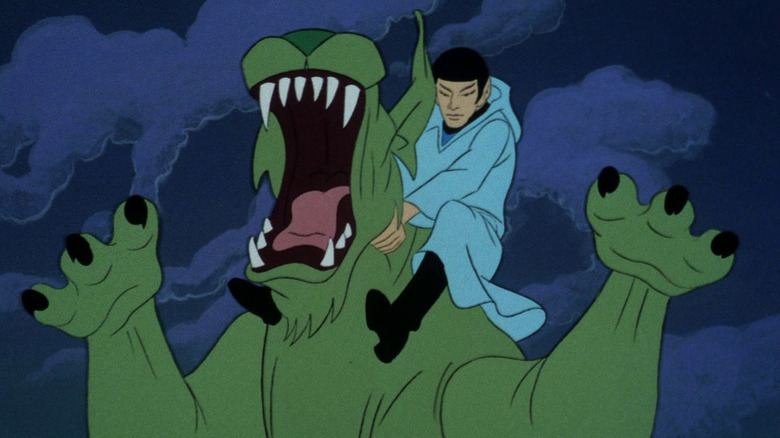
In the episode's climax, a le-matya does indeed attack, with Spock leaping onto its back to perform a Vulcan neck pinch on it. The le-matya roars and flails, exhibiting more movement and dramatic action than most characters on the notoriously stodgy "Star Trek: The Animates Series." As it so happens, the roar used by the episode's sound designers was a stock roar taken from Godzilla.
Star Trek: The Animated Series used Godzilla's roar for a a le-matya
Godzilla's roar is, of course, legendary. There was a brief period, back in 1954, when "Gojira" director Ishirō Honda and composer Akria Ifukube butted heads over whether the kaiju should make any noise at all. Ifukube thought the reptilian Godzilla should be silent. Honda got his way, though, reasoning that Godzilla is a mutant and possesses the qualities of many animals at once. The film's sound technicians, Ichiro Minawa and Hisashi Shimonaga, tried to mix together tiger and lion roars to invent an appropriately monstrous noise, but everyone thought that it sounded too natural. Ifukube ended up inventing Godzilla's roar by scraping away at a double bass using resin-coated gloves. The bass groan was then blended with some random stock animal sounds and processed to have reverb and echo. The result: one of the most recognizable sounds in cinema history. That "skree-onk" is unmistakable.
Although Toho owns the Godzilla roar, many other movies and TV shows have borrowed it without shame. Indeed, in 1958, the roar was used in the Steve Reeves vehicle "Hercules" for the voice of a dragon. It was also re-used for a lot of episodes of "Ultraman." However, "Star Trek: The Animated Series" was (seemingly) the first time Godzilla's roar was used in an American TV show.
The roar used in "Yesteryear" was indeed a version of the original roar from 1954's "Gojia," which was still being used for then contemporary Godzilla movies like "Godzilla vs. Gigan" and "Godzilla vs. Megalon." It's unclear if the makers of "Yesteryear" knew that they were using Godzilla or if they just found a stock roar in a box somewhere. Either way, it is now "Star Trek" canon that a le-matya and Godzilla sound exactly the same.