

Why It: Welcome To Derry's Season 1 Ending Was Far Superior To It: Chapter Two
This post contains spoilers for the "It" universe.
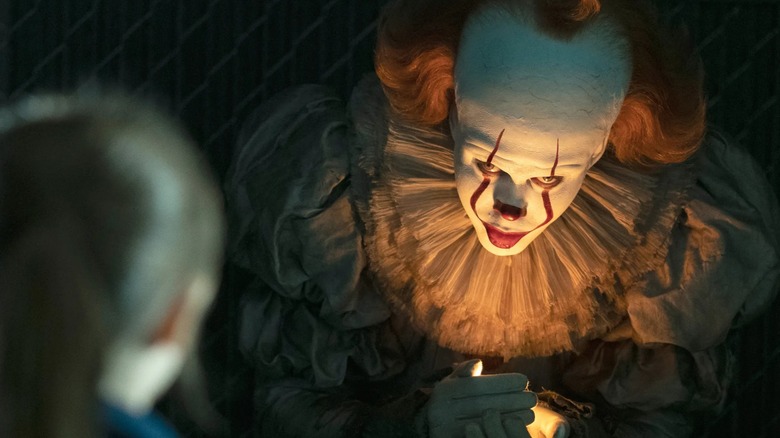
"It: Chapter Two" has its fair share of merit. Andy Muschietti's 2019 sequel to "It" boasts a stacked cast with great onscreen chemistry and some gnarly scares, but it is also an overstuffed mess and meandering in its approach to pitting the adult Losers Club against Pennywise (Bill Skarsgård). Although serviceable, the final confrontation lacks bite, as it is essentially the group ganging up against the clown to bully him to death. Of course, the rationale behind this is sound: the Losers need to turn their fear into anger and hurl insults at the creature to loosen its hold over them. Although the group eventually yanks out Pennywise's heart and crushes it, it doesn't have the same effect as the climax in Stephen King's book, where everyone beats, stomps, and dismembers the creature together.
This anticlimactic finale has loomed over "It: Welcome to Derry" since its premiere, as Pennywise's hauntings in the 1962 timeline feel more effective/aggressive than anything the Losers face in the "It" films. Unless we're given a lore-related reason for this, it opens up a troubling conundrum — why would Pennywise hold back on the Losers Club when he knows that they'll bring about his demise? Yes, the series finale reveals a lot about Pennywise's perception of time when he tells Marge (Matilda Lawler) that she will birth Richie Tozier in the future before attempting to kill her. Later on, Marge also makes a curious statement about time being a loop for an entity like him, where his death might also be his birth ... whatever that means.
All things considered, season 1 of "It: Welcome to Derry" dishes out a tense, high-stakes finale that feels much more impactful than Pennywise's actual death in "Chapter Two." Let's dive into it.
Welcome to Derry gives us an epic confrontation against Pennywise
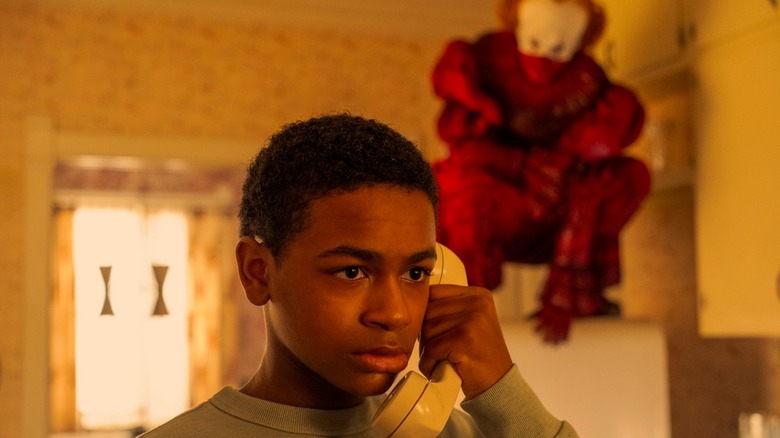
The series has done a fine job in making Derry feel like a real, lived-in place (so far), as it reflects real-life sociopolitics along with being a haunt for a primordial entity. The stakes in the series finale are also pretty high: Will (Blake Cameron James) has been kidnapped/exposed to the Deadlights alongside a dozen schoolkids, the military has destroyed (!) a star fragment confining the creature, and Pennywise has awoken from hibernation to do whatever he pleases. Lilly (Clara Stack), Ronnie (Amanda Christine), and Marge do their best to go after the creature, while Dick Hallorann (Chris Chalk) and co. follow suit to protect the children. It is a hopeless situation, as the sacred dagger resists whoever holds it, making it difficult for the children to reseal Pennywise inside Derry and put a stop to the madness.
Pennywise is also appropriately unhinged here, as he turns a part of Derry into a misty wasteland and feeds on everyone's fear with glee. The military's intervention only makes matters worse, as it stops the adults from doing anything substantial. This is a brilliant way to transfer the onus to the kids, who were always meant to be the ones to end this cycle. As Pennywise crawls and flies towards the struggling children to kill them, we see Rich (Amanda Christine) emerge from the afterlife and flip off the clown while rushing to help his friends. It's an intensely cathartic moment, as it cements "the power of friendship" trope with startling sincerity. Emboldened by Rich's phantom presence, the children plunge the dagger and re-trigger the creature's seal.
For the next 27 years, all will be (relatively) well. It's clearly the superior climax, despite not being the end.