

How Knives Out 3's Cinematographer Pulled Off Wake Up Dead Man's Boldest Visual Choice [Exclusive]
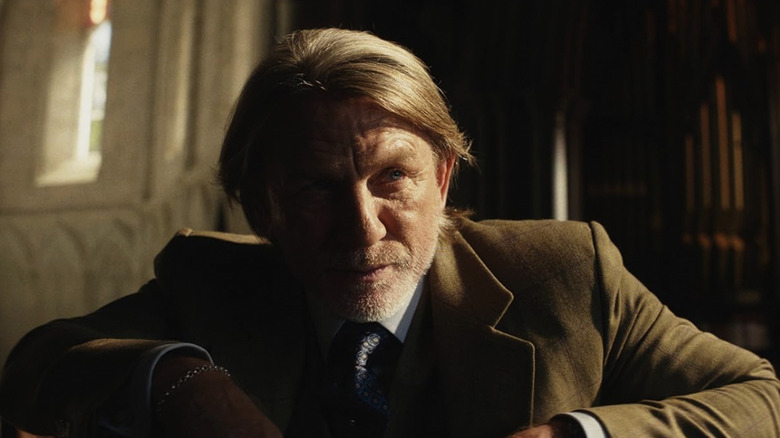
"Wake Up Dead Man," the third film in writer/director Rian Johnson's "Knives Out" franchise, features many of the same hallmarks as the first two movies: A spectacular ensemble cast, an intricate murder mystery plot, sharp social commentary, and a terrific Daniel Craig playing private detective Benoit Blanc. It also features the work of many of Johnson's longtime collaborators, including Steve Yedlin, the cinematographer who's shot all his movies to date.
Visually, this franchise has bounced from an autumnal look in its initial entry to a summery vibe in its first sequel, and now it's introducing a Gothic-inspired aesthetic. Johnson and Yedlin embraced more stylization this time around, with the camera occasionally peeking through colorful stained glass window panes and the lighting in an early flashback bathing a church, its surroundings, and its occupant in an almost otherworldly glow.
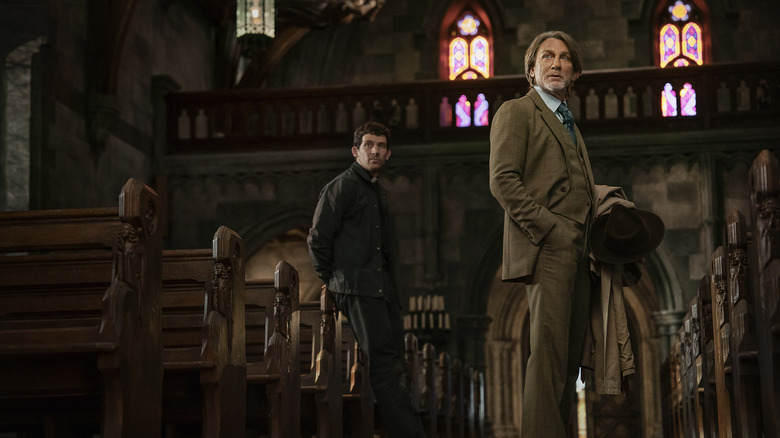
But ironically, the most daring visual moments of the film captures a commonplace occurrence: The sun going behind some clouds, and then popping back out again. Those who have seen the film will know that this effect happens multiple times, but is first used in the church to reflect the worldviews of Benoit Blanc and Josh O'Connor's Father Jud, illustrating their differing outlooks on life and faith. It's a wonderful collision between the heightened and the mundane, and in a recent interview ahead of the film's release on Netflix, Yedlin told me all about how he and his team accomplished that effect.
"One of the first things [Rian] told me when we did start talking about it is he really wanted to feel the weather and the environment like that coming into the church, where the sun goes behind the clouds and it gets really dark and then sun bursts out of the clouds," he explained. Here's how they did it.
Wake Up Dead Man's cinematographer used custom software to make the sun seem to disappear behind the clouds
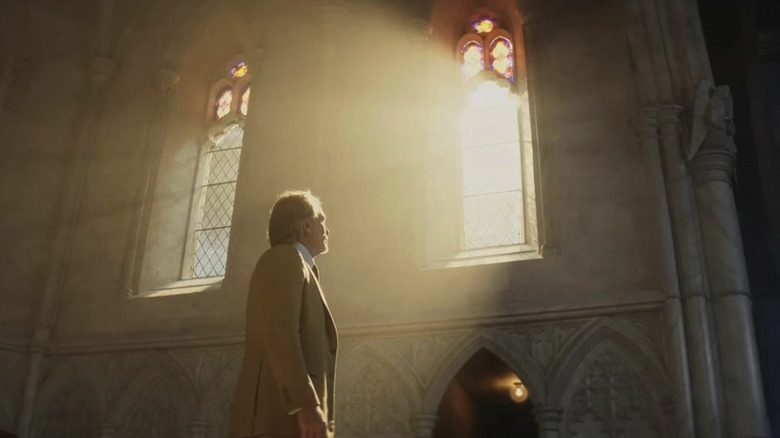
In addition to the physical rigging of the set, Yedlin utilized custom software so he could control the lighting directly, giving him the ability to dial up the various nuances necessary to achieve the optimal lighting conditions for the scenes in question.
"When the sun comes out, we have multiple 20Ks dimming on. The softboxes are changing color, the lights on the backings are changing. It's not just one thing coming on. All of this stuff is happening, and most of it is LEDs, but those huge 20Ks that [represent] the sun are incandescent, and you can't really change some of the character of the incandescent [lights]. It's very non-linear how first, it kind of comes on low and then it dims slow [...] In the scene when Blanc and Jud first meet, the sun first goes behind the clouds as Blanc gives his speech, and then as Jud gives his swelling speech, it comes back out slowly and it's flaring the lens. Those have to happen at a certain time in the scene, and they're very different durations. When the sun goes behind the clouds with Blanc, it's pretty quick. It's over maybe, like five, 10 seconds or something like that.
But then with Jud, [the sun comes out] very slow. It's over the course of his speech. It might've been 30 seconds [...] So not only do you have these long durations, but the different things aren't actually synced. For it to feel like it's 30 seconds long, the incandescent light might need to be 50 seconds long because you can't see some of the fade, and the LEDs are a different length. So what I'm doing is I'm setting it all software-based and adjusting it and testing it, making sure that what are actually different speeds feels like one thing."
Committing to that lighting effect presented an editing challenge
This effect was part of the plan from the beginning, so clearly Rian Johnson knew what he was doing. But that doesn't mean everything always goes perfectly according to plan — especially during the edit. Yedlin warned editor Bob Ducsay that he "might have a little bit of a puzzle because if you try to take lines out of a scene, but they're during the [lighting] change, it's going to jump from one to another." But as Yedlin clarified, that didn't dictate the final cut:
"They're obviously going to edit the movie to be the absolute best it can be. They're not going to make a scene boring so that the lighting cue doesn't jump, you know what I mean? And of all of those lighting cues, we really had maybe one and a half instances of that thing that I was worried about in prep, which is they cut some lines out and now there's a jump in it. The reason I say 'and a half' is that one was barely, like it needed a little bit of finessing. But the one where it really did happen, we just bridged it in the color grade where it starts to change."
"Wake Up Dead Man," in all of its Gothic-inspired glory, is now streaming on Netflix.