

You're Not A Sci-Fi Fan If You Haven't Seen This Classic '80s Miniseries
Kenneth Johnson began his career as a TV director, helming episodes of popular cop shows like "Adam-12" and "Griff" in the mid-1970s. He hit the big time in 1976 when he created "The Bionic Woman," a spinoff of "The Six Million Dollar Man," a series he wrote and produced. Johnson also developed the hit TV series "The Incredible Hulk," making him sci-fi royalty. Later on, in the 1990s, Johnson would also have a part in developing "Alien Nation" for TV.
In 1983, though, Johnson produced what might be his crowning achievement. Inspired by Sinclair Lewis' notorious 1935 antifascist novel "It Can't Happen Here," Johnson decided to make an antifascist sci-fi series wherein seemingly friendly aliens land on Earth and set themselves up — slowly and insidiously — as fascist dictators. The miniseries was called "V," and it became a milestone in sci-fi TV history.
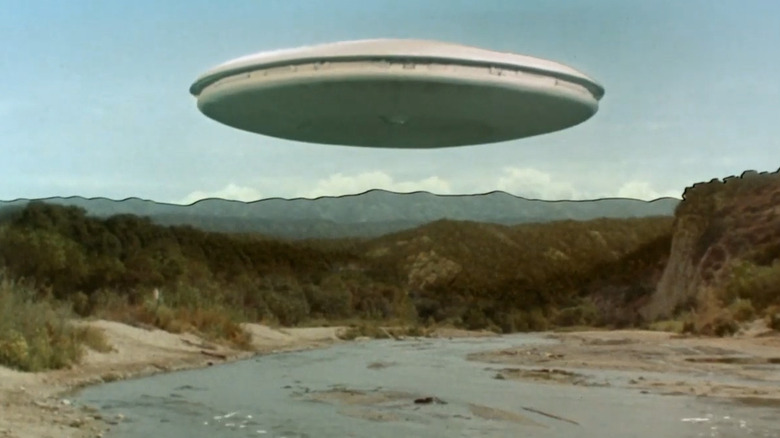
The story of "V" is gripping and terse. A species of aliens lands on Earth in massive, flat, flying saucers, and emerges looking just like humans. They have to wear outside sunglasses, as their sun is dimmer than ours, and they need special voice boxes to speak, giving their voices an eerie, mechanical sound. But otherwise, the aliens — called Visitors — seem helpful and peaceful. They claim to need certain minerals and chemicals, only available on Earth, to help their own ailing homeworld. Earth can do without the minerals, and Humanity will receive advanced alien technology in return. It sounds like a win-win.
No points for guessing that the Visitors are up to something terrible. Marc Singer plays the lead character in "V," and he finds that the Visitors require more than minerals. They need food. And guess what food is plentiful on Earth? Yup. Human meat.
V is a savvy look at the way fascism operates
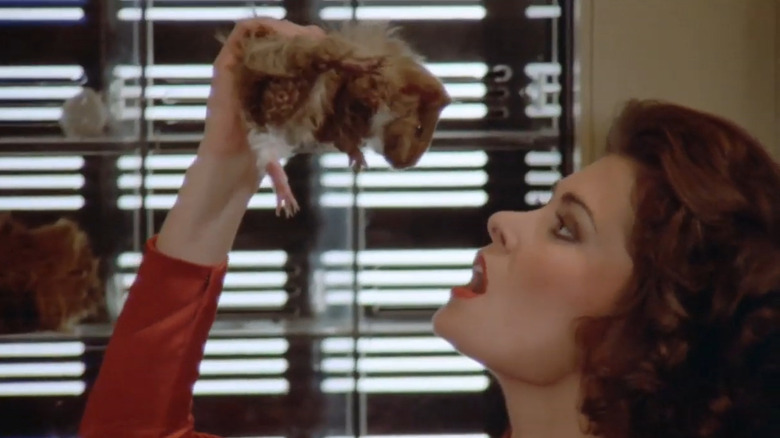
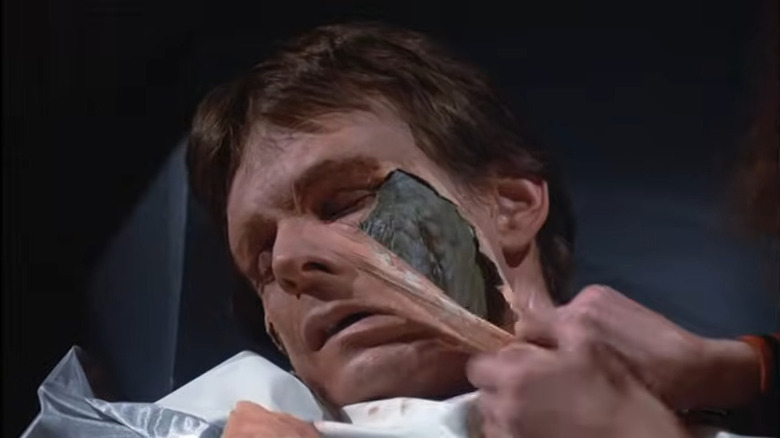
The Singer character, an investigative journalist named Mike Donovan, only discovers the truth in a fit. He manages to sneak into a Visitor hom base at one point and spies on two Visitors in their quarters. Shockingly, he seems them eating live mice and swallowing whole guinea pigs. Later in the series, someone will take a swipe at a Visitor's face during a disagreement and remove a chunk of their skin. It will be revealed that the Visitors are actually horrifying humanoid reptiles wearing human masks and human contact lenses.
But "V" is smarter than a run-of-the-mill, 1950s-style alien invasion story. It's actually about the rise of fascism, and how the citizenry tends to welcome their own oppressors. The Visitors move to Earth, and slowly begin — in the friendliest possible way — inserting themselves into every aspect of human life. Human scientists are pilloried and stripped of their authority, for one. The government begins instilling curfews, claiming that the increased population needs closer scrutiny and control. People who speak out against the Visitors are mysteriously "vanished." It's not long before the Visitors are calling the shots.
Not only that, but propaganda posters begin to appear, extolling the marvels of an interspecies society. Visitor police in bright red uniforms patrol the streets. Survivors of World War II can see what's happening. This is the rise of a regime that is secretly aiming to exterminate people. Reliable character actor Leonardo Cimino plays an elderly Jewish man who teaches the public that "V" stands for Victory. Red, spray-painted V's become a symbol of a growing resistance to Visitor invasion.
V was a big hit and spawned sequels and remakes
I shan't reveal any more about "V," as it should be seen. The slow discovery of the Visitors' Nazi-like tendencies is obvious to the modern eye, but salient in the 2020s, when fascism is once again on the march. "V" was made in the early days of the Ronald Reagan administration, so one can't help but assume Kenneth Johnson was making a comment on 1980s conservatism and Reagan's vaunting of American war powers. Ironically, though, "V" could also be read a xenophobic, instructing Americans to be wary of outsiders. It's certainly worth discussing.
"V" was a giant hit on TV and spawned several follow-up projects. A three-episode sequel miniseries called "V: The Final Battle" hit the airwaves in 1984, although Kenneth Johnson wasn't heavily involved, having left NBC over creative differences. "The Final Battle," as the title implies, is far more action-forward, taking place only months after the original series, and following the exploits of the human underground. There is a doomsday device involved, which should reveal the sequel's lack of creativity. "The Final Battle" was a hit, however, and inspired a short-lived "V" TV series. Johnson didn't return. It should be noted that Singer was involved throughout, as was a young, pre-"Nightmare on Elm Street" Robert Englund, who played an alien soldier. The "V" TV series lasted only 19 episodes over its single season.
In 2009, nostalgia reared its head, and Johnson rebooted "V" with a brand new miniseries. The new show was more about video propaganda and the fracturing of internet information, which only helped the fascist invading aliens. No matter how you look at it, "V" is an important and relevant commentary on our times. And the 1983 original miniseries remains pretty unassailable.