

Russell Crowe's Thriller With A 96% Rotten Tomatoes Score Is One Of The Best '90s Movies
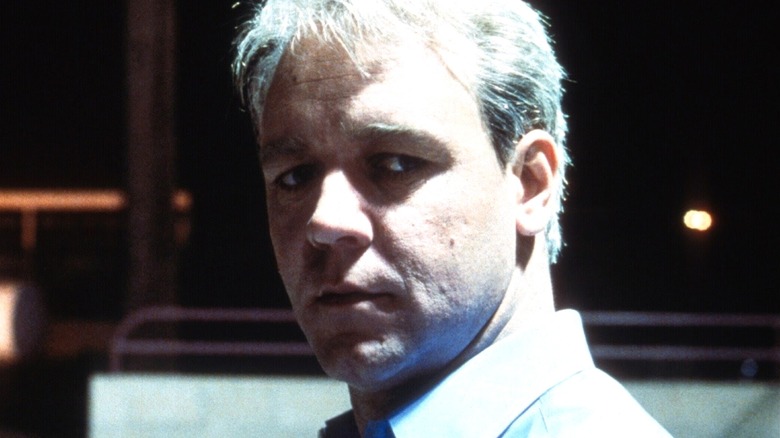
When Michael Mann's "The Insider" was released in 1999, he was fresh off the impressive commercial success of "Heat," which had also cemented him as a solid directorial talent. "The Insider" is a fictionalized account of a true story — namely, Marie Brenner's 1997 Vanity Fair article that examines tobacco industry whistleblower Jeffrey Wigand's controversial segment on CBS' "60 Minutes." Working closely with screenwriter Eric Roth, Mann wove together an electrifying tale about an enraged industry insider who helps expose the darkest corners of corporate America.
While Al Pacino takes on the mantle of CBS producer Lowell Bergman, Wigand is played by Russell Crowe (whose breakthrough role was in 1997's noir hit, "L.A. Confidential"). Crowe's layered performance is the beating heart of "The Insider," as it paints Wigand as a flawed hero who uses his righteous anger to stand up to corruption. Of course, Pacino is as brilliant as ever, injecting visceral dynamism into the unhurried, contemplative conversations that make up most of the film. These dual performances are enough to classify "The Insider" as a standout genre entry, but there's another reason why it emerges as one of the best films in 1999.
Mann's film doesn't counter conspiracy with flat-out defeatism, but with a sincere, spirited urge to uncover the truth. This might feel a tad simplistic on paper, but the Mann-Roth duo tackles this by closely examining the delusions fed to us by massive conglomerates and how easy it is for them to prioritize profit over public health. Such honest skepticism wasn't a welcome sentiment at the cusp of the millennium (a time that favored optimism amid anxiety), which explains why "The Insider" didn't do too well at the box office despite its blatantly obvious merits.
The Insider is an effective corporate thriller with powerhouse performances
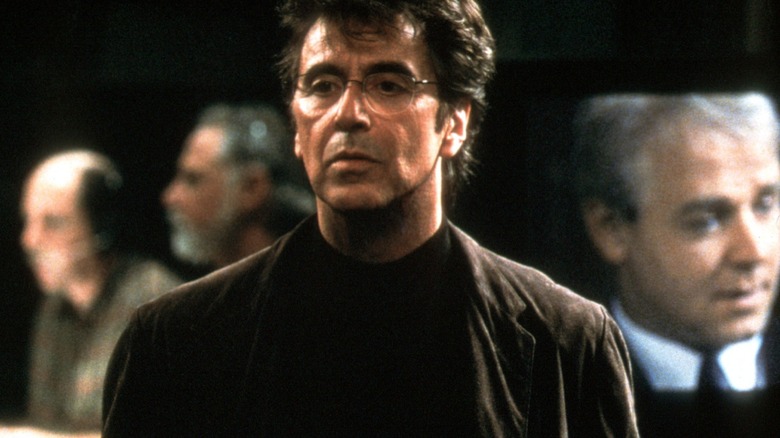
As reflective of real life, Bergman in "The Insider" is responsible for the Mike Wallace (played by Christopher Plummer) segments in "60 Minutes," and he does everything in his power to get Wigand's story live. Unfortunately, Wigand faces a massive amount of pressure and harassment in the meantime, and CBS falters in its stance once things get difficult. Wallace isn't depicted in the same vein as Bergman, as the former seems hesitant to topple a tobacco giant and is more than happy to leave behind a legacy that isn't tarnished by attempts to aid corporate whistleblowing. As expected, the real Wallace wasn't a fan of this less-than-ideal depiction, but other individuals involved with the situation (including the real Bergman and Wigand) maintain that "The Insider" is mostly accurate on all fronts.
It isn't helpful to look to "The Insider" for objective truth, of course, as Mann's fictionalization is crucial to its artistic merits, which often take the form of dramatic excess or choreographed suspense. What we should be looking closer at instead is Mann's ability to etch two characters fighting tooth and nail for justice, while making it clear that their commendable idealism is proving futile against monetary interests and systemic corruption. But Bergman and Wigand keep fighting the good fight, with the former leaking information and making strategic calls to ensure that the interview can be broadcast without legal constraints. The magic lies in these moments of artistic liberty, where objective truth is rearranged, altered, and slightly manipulated to heighten the climax of the end result.
"The Insider" isn't overlooked. But there's no such thing as overhyping a Michael Mann film, which is why it still deserves our attention more than 25 years after its theatrical release.