

Clint Eastwood Had To Fight For The Ending Of A Classic Western Movie
We may receive a commission on purchases made from links.
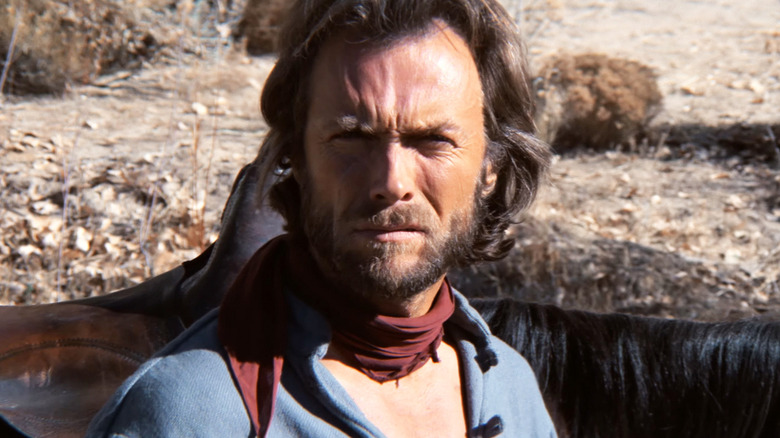
"The Outlaw Josey Wales" is one of Clint Eastwood's best movies, which is saying something considering the man is a screen legend. The 1976 revisionist Western is an adaptation of Asa Earl Carter's 1972 novel, "The Rebel Outlaw: Josey Wales," and stars Eastwood in the title role. Like many of the veteran star's projects, production on the movie wasn't without controversy, with the actor assuming directing duties from original director Philip Kaufman mid-way through shooting. That wasn't the last clash during production of "The Outlaw Josey Wales," either, as Eastwood would argue with his editor over the open-ended climax of the movie, which saw Wales riding off into the sunset. Evidently, the editor wanted to show Wales returning to his surrogate family at the end, while Eastwood thought it was enough to suggest as much with the more ambiguous final shot. He was right.
Eastwood's career started in earnest with "Rawhide," introducing the actor to mass audiences after he'd spent several years taking on bit parts in B-movies and portraying background characters (or what Sylvester Stallone once termed "atmosphere"). It was only after "Rawhide" made Eastwood a star that Sergio Leone and his legendary "Dollars" trilogy helped the young actor ascend to movie star status. By the mid-1960s, then, the world was witnessing the rise of a new Western icon.
Of course, Eastwood soon branched out from the genre, appearing in all-manner of projects. That included the buddy comedy "Every Which Way But Loose," which was a controversial choice at the time, not least because the "buddy" in question was a pet orangutan named Clyde. But he returned to the Western several times, and "The Outlaw Josey Wales" represented one of the more successful examples. It also required a lot from Eastwood, both in front of and behind the camera.
Clint Eastwood's tortured outlaw movie was a struggle from the start
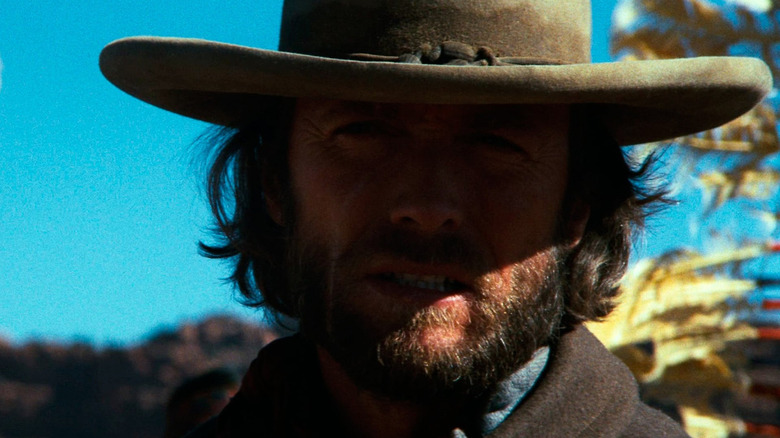
Originally adapted by Sonia Chernus and Philip Kaufman, "The Outlaw Josey Wales" was supposed to be directed by Kaufman. However, after he and Eastwood fell out during production, the star assumed directing duties. Alongside overseeing the whole production, then, Eastwood played one of his best roles ever as the titular outlaw, who starts off as a Civil War-era Missouri farmer forced to watch helplessly as pro-Union soldiers, led by Capt. Terrill (Bill McKinney), kill his wife and son. After that traumatic experience, Wales joins the Confederate Army, hoping to ultimately get revenge on the men who murdered his family. When the war ends, his fellow Confederates surrender, only to be massacred by Terrill and his men. Wales once again escapes and goes on the run, becoming a fully fledged outlaw in the post Civil War U.S. Despite trying to start over, Wales has to constantly look over his shoulder as he's pursued by both soldiers and bounty hunters.
While on the run, Wales rescues a young Navajo woman named Little Moonlight (Geraldine Keams), an elderly woman named Sarah Turner (Paula Trueman), and her granddaughter Laura Lee (Sondra Locke). He's then joined by Sheb Wooley's Travis Cobb and John Verros' Chato, essentially forming a surrogate family with his newfound allies. Soon after, Wales pursues and manages to get the best of Terrill, before eventually riding off into the sunset. But it seems the film's editor wanted to make it clear that Eastwood's outlaw was actually returning to his newfound family. The actor/director, however, remained convinced that the more open-ended conclusion was superior.
Clint Eastwood wanted to treat audiences as grown-ups
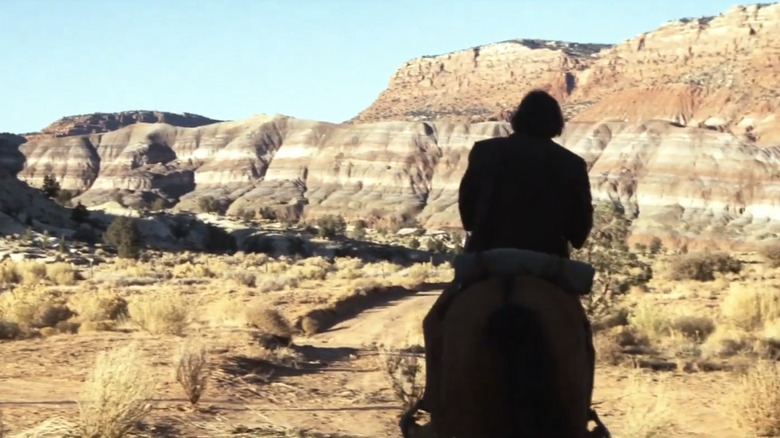
In 1980, Ric Gentry spoke to Clint Eastwood (via "Clint Eastwood: Interviews, Revised and Updated") and noted how the actor had argued with his editor about the open-ended ending to "The Outlaw Josey Wales." "He felt that I should literally show him returning to the girl and the group after he has that final talk with the chief," the actor recalled. "And I said, 'No, you don't need to show him going back. You see him riding off at sunrise and that's enough.' He said, 'Yeah, but how will the audience know that he's going back to the girl and the others?' And I said, 'Because they're willing him to go back there. The audience is taking him back there.'" Eastwood went on to say that in his opinion it was the audience's "imagination and participation that makes a film work," adding that you "don't have to tell them everything."
Clearly, given the film's reception, Eastwood was right. With "The Outlaw Josey Wales," he proved Westerns could still turn a decent profit. The movie made $31.8 million at the box office on a $3.7 million budget and debuted to strong reviews. Ever since, Eastwood has helped keep the Western on life support, most notably with 1992's "Unforgiven" (a spiritual sequel to the "Dollars" trilogy that had propelled him to movie star status).
But while many would argue that "Unforgiven" represents the pinnacle of his Western films, Eastwood once described "The Outlaw Josey Wales" as a career high. It's not hard to see why, given how well the film is regarded. Moreover, there's no doubt Eastwood felt a particularly strong sense of ownership over that specific Western, considering how much he had to fight for his vision.