

Why F1's Director Says The Way The Brad Pitt Movie Was Shot Was 'Pretty Reckless'
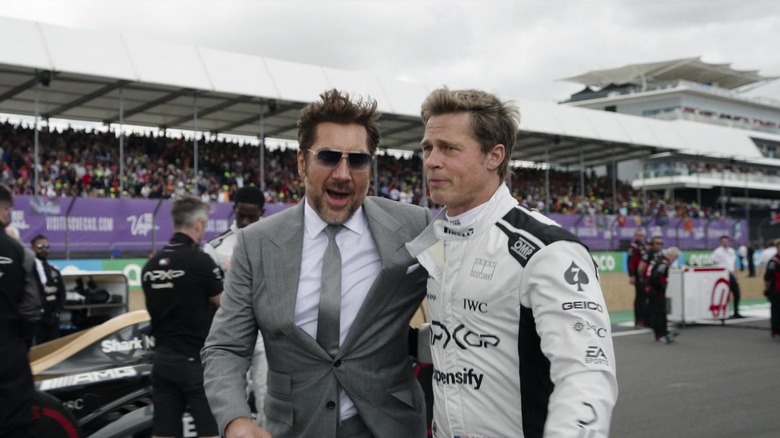
In the summer of 2025, filmmaker Joseph Kosinski and actor Brad Pitt teamed up to make "F1," a film about the high-drama world of Formula One car racing. In every regard, "F1" appeared to be a transparent effort to recreate the success of "Top Gun: Maverick," which Kosinski made with Tom Cruise in 2022. Both films were about aging, ultra-handsome movie stars in their 60s who played characters that represented the pinnacle of male-dom. Both Cruise and Pitt, in their respective films, could do no wrong, and the world's only mistake was not listening to them more closely. They both occupied a world of high-tech, high-octane, ultra-fast machines that required a great deal of skill to pilot.
Both films were huge hits, although "F1" made a relatively modest $631 million compared to the staggering $1.5 billion made by "Maverick." The latter, being a sequel, might have had nostalgia on its side. Regardless, "F1" was the highest-grossing film in Pitt's career. Most critics loved it, although here at /Film, we were less than impressed.
"F1" was also notoriously expensive, costing upward of $300 million. It involved a lot of real race cars on real racetracks. A lot of footage was captured at real-world Formula One events, and most of the driving stunts were captured on real film. Kosinski recently spoke with Variety and admitted that a lot of "F1" was pretty reckless, with many scenes being shot as quickly as possible. It seems that when one is shooting at a real-world Formula One event, one can't keep the millions of spectators waiting. As such, many scenes had to be shot without the benefit of time, leaving many setups truncated.
F1 had to shoot scene at real Formula One events
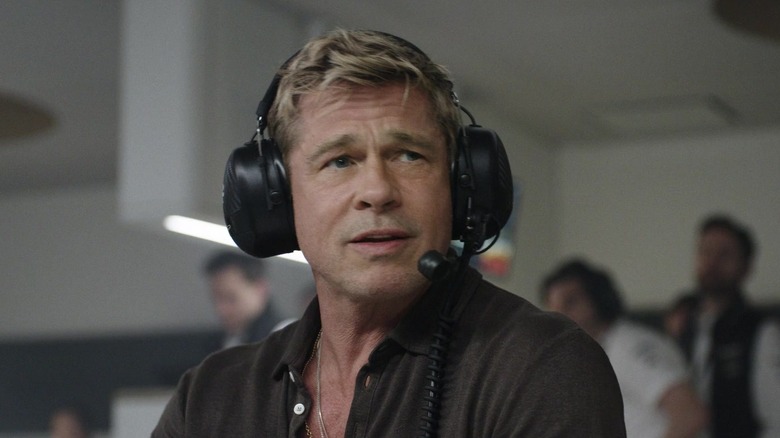
It's hard to picture a $300 million studio picture shooting guerilla style, but it seems that's what's required when you're at a real car race with real paying spectators in the stands. One does not have the luxury of three-hour rehearsals, nor can they stop and do 8 to 12 takes, as many as are needed. "Looking back," Kosinski said, "I think, 'God, that was pretty reckless.'" As the director described it:
"Normally, when you're shooting a scene, you have hours or days to shoot it, but because we wanted to shoot this film live at the Grand Prix while the events are going on, we'd often only get a few minutes. [...] So, there were times where I would tell Brad and Damson, 'We'll be lucky to get three takes at this,' especially that opening scene at Silverstone. We actually shot three scenes back-to-back in about 15 minutes."
Damson is, of course, Damson Idris, Brad Pitt's co-star in "F1." Silverstone, for racing neophytes, is a famous circuit in Northamptonshire, England, that has been in operation since the 1940s and still hosts high-profile Formula One races to this day. As Kosinski noted, the first big race of his movie was set at Silverstone. There were at least nine other major tracks involved in the shooting of "F1," including tracks in Las Vegas, Hungary, Belgium, the Netherlands, Japan, and the United Arab Emirates. The international shoot may be one of the main reasons why "F1" cost so much. It also explains why Kosinski had to shoot so quickly and recklessly. If one is jet-setting around the world with one of the world's biggest movie stars, one has to be quick to save time and money.