

Why Patrick Stewart Agreed To Star In X-Men After Turning Down The Movie At First
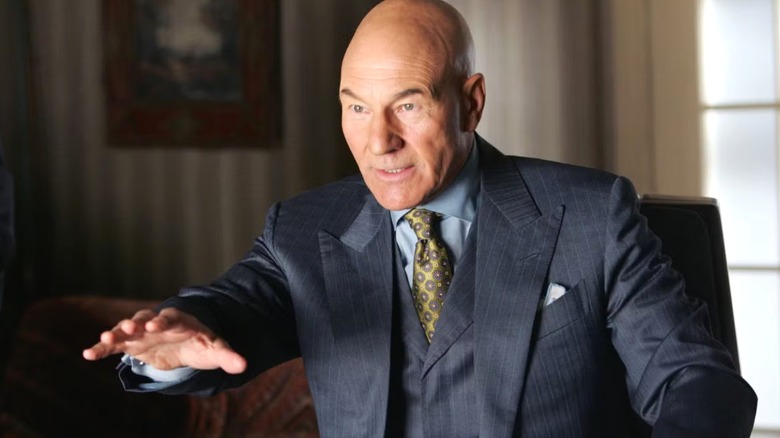
Professor Charles Xavier is more than just a formidable mutant telepath. He's an activist who founded the Xavier School for Gifted Youngsters, which serves as a home for young mutants while also providing them the opportunity to hone their abilities. His complicated dynamic with Magneto partially stems from his assimilationist tendencies, which clash with Magneto's more assertive, often violent brand of mutant pride. While Professor X has undergone several iterations across countless comics, his activism has always been an integral part of his character, even when his morality has leaned towards grey areas.
This key character trait is the sole reason why Patrick Stewart, who primarily portrayed Professor X in the "X-Men" franchise (and the Marvel Cinematic Universe), accepted the role. Speaking to Smithsonian Magazine, Stewart clarified that he only said yes after learning that the character rallied for peaceful co-existence while fighting for mutant rights:
"I turned that down when it was first offered to me, and the director, Bryan Singer, whom I had not met, said, 'Please meet with me. I want to talk to you before we move on and talk to someone else.' And he talked to me about what he hoped to achieve with the first of those films; how the subject matter would be examining the rights of those who are different from others and asking, because they were different, did they have the same rights as everybody else."
Being a lifelong advocate for social justice himself, Stewart was drawn to this aspect of Professor X's character, as it promised a more grounded examination of the strained human-mutant relationship. What's more, the actor's initial hesitation stemmed from the fact that Stewart didn't know who Professor X or the X-Men were before he accepted the role.
Professor X's well-meaning idealism is more complex than you think
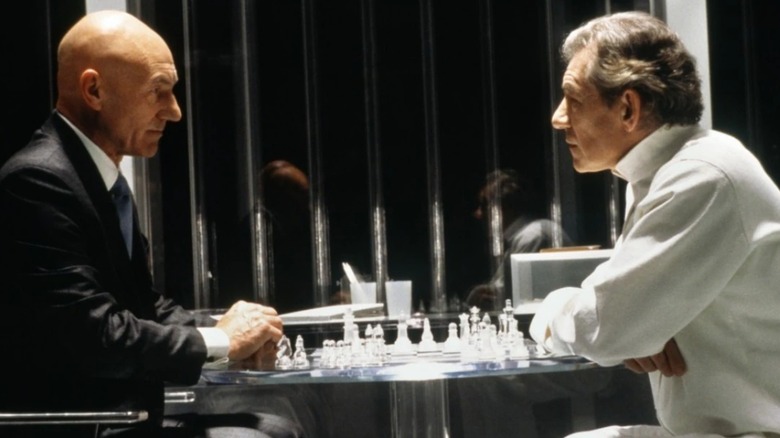
Singer was able to pique Stewart's interest in the character by positing a morally unambiguous clash between good and evil. Stewart went into further detail about the Charles-Magneto antagonism that was pitched by Singer, where Professor X is framed as "an active voice for the good guys:"
"And he [Singer] said in the film [2000s 'X-Men'] there will be two camps. There will be a camp led by Magneto, who believes that the only way in which the mutant world can protect itself is by fighting and destroying its enemies, and Xavier, who believes that there is [...] another route which is peaceful and involves discussion and exposure and conversation, and dialogue. And I saw it, I saw the point. So I happily signed on to be an active voice for the good guys."
There's no doubt that Magneto's motivations are traditionally antagonistic, despite being thematically complex — after all, it is easier to align with Professor X's values when Magneto exhibits unchecked resentment towards humanity as a whole. That said, the true nature of the X-Men cannot be perceived as completely idealistic, as the group isn't a monolith, and is as flawed/fallible as non-mutants.
In fact, in Kieron Gillen's "Immortal X-Men #10," Professor X ponders the existence of the X-Men and acknowledges that the group can be dangerous, and that his approach was less than ideal over the years. He ponders how he could've used his powers to help the disenfranchised, but was rather selective in his aid, picking and choosing who deserves it based on pragmatic strategy. Finally understanding why humans instinctively fear mutants, Professor X vows to do his best to mitigate every risk, which becomes an evolving goal that he dedicates his entire life to.