

Why Sylvester Stallone Set Rocky In Philadelphia Instead Of New York City
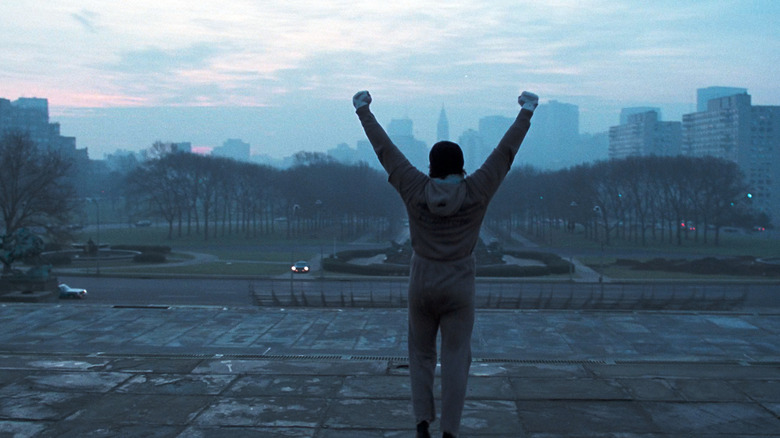
The Ghostbusters and New York. Philip Marlowe and Los Angeles. Paddington Bear and London. Some beloved fictional characters are so synonymous with the cities they call home that it seems unimaginable that they could live anywhere else. One such connection is Rocky between Balboa and Philadelphia, although the Italian Stallion's creator originally hails from Hell's Kitchen in New York. So why did Sylvester Stallone choose the City of Brotherly Love for his underdog boxing saga?
We've been rooting for the loveable slugger for almost 50 years since he got his first shot at the title in John G. Avildsen's "Rocky," which pulled off an unlikely victory of its own by beating the likes of "Taxi Driver," "Network," and "All the President's Men" to Best Picture at the Academy Awards. We cheered him to the heavyweight title as he beat the champ, Apollo Creed (Carl Weathers). We booed and hissed at Thunderlips (Hulk Hogan) and the ferocious Clubber Lang (Mr T) once he had the top spot. We were on the edge of our seats as he went up against Ivan Drago (Dolph Lundgren), the Soviet killing machine. Then we cheered again as he made an unlikely comeback in his 60s in the surprisingly poignant "Rocky Balboa."
Through it all, beloved characters have come and gone, but Bill Conti's rousing music and regular visits to the Rocky Steps outside the Philadelphia Museum of Art have always provided a nostalgic connection to Balboa's iconic early morning run in the original. And when it came to choosing the settings for his star-making movie, Stallone wrote about what he knew.
Sylvester Stallone knew Philadelphia well in his younger years
The "Rocky" franchise became steadily more glossy as the series went on, culminating in the bombastic excess of "Rocky IV." One thing that has remained constant, though, is the relatively lo-fi nature of Rocky's training routines, emphasizing his working-class background and providing a connection to the hard-working blue collar element of Philadelphia. While his fearsome opponents regularly enjoy luxurious hi-tech training facilities, Rocky makes do beating up on sides of beef, pounding metal in a scrapyard, and running through the rubbish-strewn streets of his hometown on the way to proving he's not just another bum from the neighborhood. The first movie feels particularly authentic in this respect, largely because Sylvester Stallone knew those streets so well. He told GQ:
"I lived in Philadelphia when my parents got divorced, and I quit school at 15, and I actually worked along the docks driving a forklift for my stepfather's company ... and I got to know that world very well. So for one year, I was this drop-out working along the docks [...] but when the time came to write 'Rocky' I said, 'You know Philadelphia, you don't really know New York anymore.'"
Although Stallone was initially inspired to write "Rocky" after watching journeyman Chuck Wepner almost taking Muhammad Ali the full distance in a 1975 championship bout, he based the character on Rocky Marciano and also channeled some of the gritty toughness of Philly fighters like Joe Frazier and Bernard Hopkins. When Stallone not only managed to sell his screenplay to a major studio, but also secure the lead role over more famous faces like Robert Redford, Burt Reynolds, and James Caan, he and director John G. Avildsen headed out to Philadelphia to make a gritty sports fairytale for the ages.
Rocky was filmed largely on location in Philadelphia
Filming on "Rocky" started in early January 1976 with locations split across Philadelphia and Los Angeles — somewhat disappointingly, the warehouse where the Italian Stallion works out on refrigerated meat was in the latter. Nevertheless, Rocky's neighborhood is in Kensington in the northern part of the city and you can still see his apartment building at 1818 East Tusculum Street. Another memorable location from the greatest training montage of all time is the Italian Market on 9th Street, which is a bit tidier but has otherwise hardly changed since Stallone and Avildsen were in town making the movie. "Rocky" was one of the earliest films to utilize Steadicam, capturing the flavor of the city as the actor ran along the docks and through the streets he was so familiar with.
Of course, the most famous site is the 72 steps leading up to the front of the Philadelphia Museum of Art. The worldwide popularity of the franchise has made the steps one of Philadelphia's favorite tourist attractions, drawing around 4 million visitors each year. On any given day, you're likely to see people emulating Balboa by scaling the steps and jumping around in celebration. Some are no doubt confused by the absence of the Rocky statue at the top; the bronze likeness of Stallone forged for "Rocky III" resides near the foot of the steps instead. As a fan of the movies since I was a little kid, this will be my first port of call if I ever make it to Philly — although with my level of fitness, I might walk up the steps rather than run up them!