

Matt Damon Appeared In A Star-Studded 2010s Sci-Fi Movie That Asked Big Questions
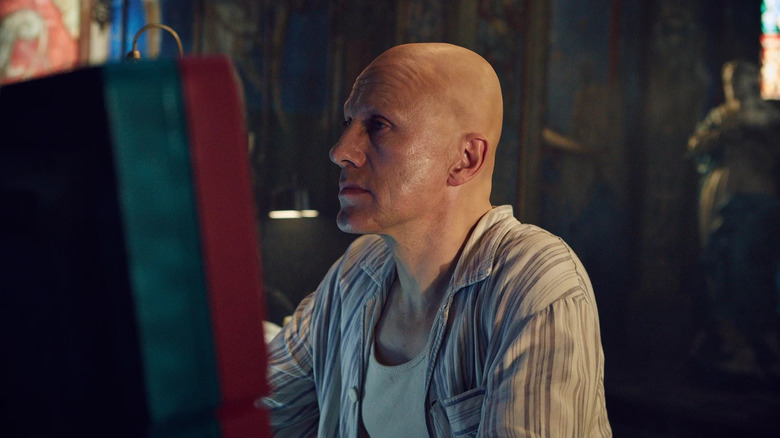
Terry Gilliam's star-studded 2013 film "The Zero Theorem" is cerebral and strange and difficult to describe. Like Gilliam's previous movies "Brazil" and "12 Monkeys," it takes place in a dystopian future wherein cold, calculating corporations rule everything, but this time around, everything is philosophically darker. It's the mid-21st century, and Christoph Waltz plays Qohen Leth, a mathematician and computer wonk who works for a mysterious and bloated entity called Mancom. His job involves "crunching entities" for the company's ontological research division, trying to prove the titular "zero theorem." In brief, he is asked to mathematically prove if life has meaning or not. It's all very heady and abstract.
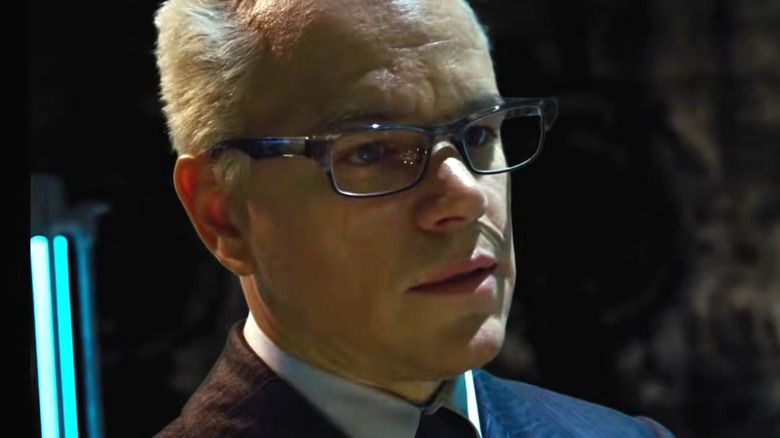
Matt Damon appears near the end of the movie as a Mancom representative who coldly, almost mockingly, gives Qohen an update on the zero theorem project, and to inform him that he is fired. Damon's performance is brief but important, grounding the movie and bringing a little bit of clarity to a chaotic world. Because this is a Terry Gilliam movie, you can rest assured that "The Zero Theorem" is bursting with visual chaos, so any calm moments are wholly welcome (even if those calm moments only exist to reinforce a general sense of absurd nihilism).
"The Zero Theorem" features multiple other recognizable stars as well. David Thewlis plays Qohen's supervisor Joby, while Tilda Swinton plays Dr. Shrink-Rom, an AI therapist that Qohen is required to consult. Elsewhere, Sanjeev Bhaskar, Ben Whishaw, and Peter Stormare appear as a trio of doctors, and the likes of Gwendoline Christie, Rupert Friend, and famed British percussionist Ray Cooper can be glimpsed shouting from the TV screens that are constantly yelling advertisements at people in the film's media hellscape.
What the heck is The Zero Theroem about?
"The Zero Theorem" was written by Pat Rushin, a creative writing professor, and he seems to have included snippets from every book he read during an intense college course on absurdism and existentialism. The overwhelming corporate coldness, along with Qohen Leth's struggles to find meaning within a labyrinthine bureaucracy, are clearly inspired by the works of Franz Kafka. Indeed, Leth is waiting for a mysterious telephone call from ... someone he accidentally hung up on in the past who will reveal to him the meaning of life. He waits and waits, and viewers are invited to think about Samuel Beckett's classic play "Waiting for Godot." Primarily, though, Rushin primarily evokes Albert Camus's "The Myth of Sisyphus."
Perhaps unsurprisingly, Rushin's screenplay had been circulating through Hollywood for years before it was filmed, and /Film even reviewed his "Zero Theorem" script way back in 2009.
The plot of "The Zero Theorem" surrounds Qohen's ever-more-difficult attempts to fulfill his bizarre work task to prove the titular theorem, and Mancom seems eager to placate and help him along the way. Joby, for instance, sends over Bainsley (Mélanie Thierry), a sexy maid who cleans up his place and treats him well. She also provides him with a V.R. suit that allows him to more actively work. His body is ailing, you see. Or maybe Qohen is a hypochondriac.
Most of the dialogue in "The Zero Theorem" is devoted to the meaning of life, and one gets the impression that each character merely represents a different viewpoint in the endless debate of meaning vs. absurdity. In other words, if the actual humanity of the characters seems weak, it's because they're all philosophical ciphers.
What did critics think of The Zero Theorem?
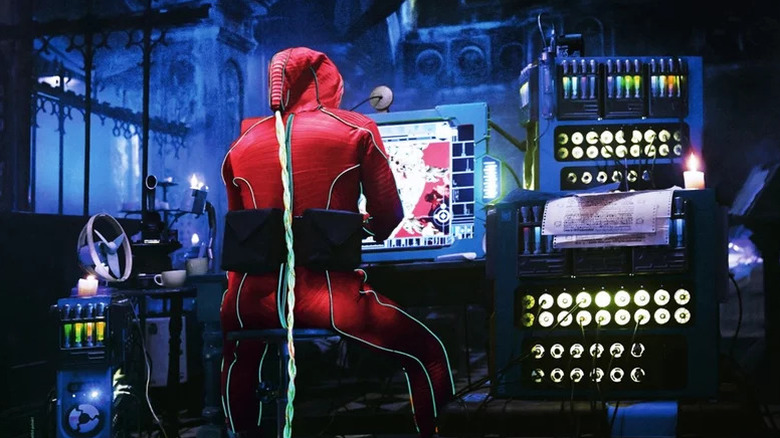
"The Zero Theorem" barely functions as a drama. It's more like a swirling, visually chaotic music video, with highfalutin existentialist conversations standing in for the music. Qohen, in waiting for his mysterious phone call, represents a man of faith. Matt Damon's character, meanwhile, explains very plainly that there's money to be made from uncertainty and chaos.
Critics were split on "The Zero Theorem." Matt Zoller Seitz reviewed the film for RogerEbert.com, and he gave it two-and-a-half stars (out of four), writing that "the movie's allegory-steeped plot [...] is a case of 'close, but no cigar." However, he did praise the chaotic, busy production design, noting, "There are usually four or five things going on in each shot, and they're always related to the film's main themes." Seitz ended his review by writing:
"In its better moments, 'Zero Theorem' does seem like the work of a brilliantly cranky cartoonist who's spent years obsessing over what the world has become, then finally sat down, opened a sketchbook and started drawing. The problem is, once you've watched 'Zero Theorem,' you'd rather go look at the sketchbook."
Other critics (like Stephanie Zacharek, writing for The Village Voice) liked the wild production design and little else. In general, it's usually ranked somewhat lower among Terry Gilliam's various movies.
Gilliam himself, at least, got what he wanted out of the film. Its original ending was more cathartic and Hollywood-happy, and that wasn't enough for Gilliam or for Christoph Waltz. The final ending is, instead, devoted to finding a scrap of dignity in an absurd world that has ruined you. If the movie has a message, that's it.