

One Of The Best Animated Movies Ever Made Is Based On A Classic '60s Sci-Fi Book
We may receive a commission on purchases made from links.
Brad Bird's 1999 animated sci-fi film "The Iron Giant" didn't exactly take the world by storm — at least, not at first. "The Iron Giant" was released in August, a month traditionally considered a post-blockbuster-season dumping ground for studios. Warner Bros. seemed willing to let the film slide into obscurity, perhaps smarting from the not-very-glowing reception to their 1998 animated picture "Quest for Camelot." Bird later told JoBlo that the studio "didn't have any hopes" for the movie and put minimal effort into marketing: "We only had one poster and it was a teaser poster. We never had a real poster, because they didn't make more than the teaser poster."
When "The Iron Giant" was finally released, critics loved it. Indeed, they urged people to rush into theaters to see this film, knowing that they might not have heard of it due to its lack of advertising. The film still only made $5.7 million its opening weekend. Eventually, though, "The Iron Giant" found an audience on home video, and its fanbase grew. Bird's movie started being hailed as one of the best films of its decade, and one of the best animated films of all time.
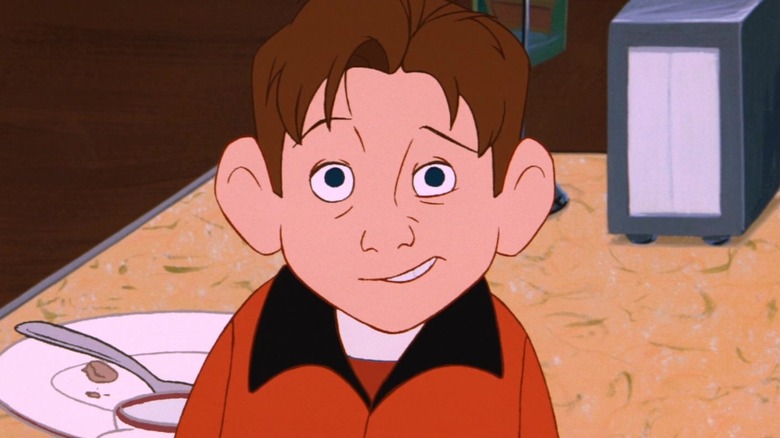
"The Iron Giant" was based on the 1968 children's novel "The Iron Man" by poet Ted Hughes, who later became the UK's Poet Laureate. "The Iron Man" has the same story as "The Iron Giant," but tells the tale from the robot's point of view. The movie is a more Amblin-inflected story of a young boy named Hogarth Hughes (Eli Marienthal).
The Iron Man tells the story of The Iron Giant from the robot's perspective
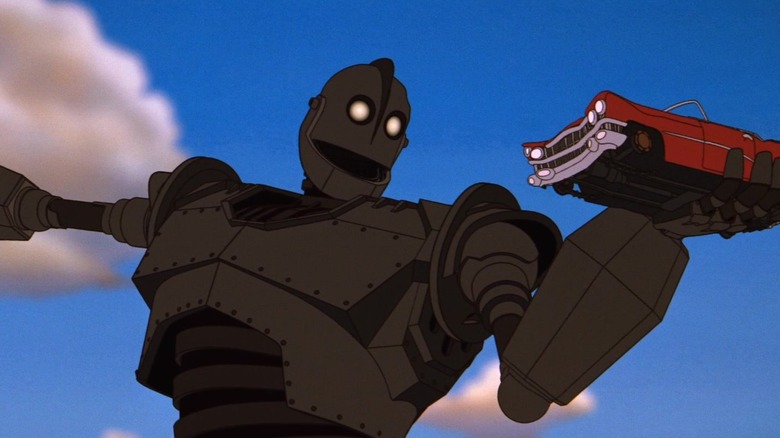
"The Iron Giant" is set in the late months of 1957 in the small seaside town of Rockwell, Maine. The world has already seen the launch of Sputnik, and there is a general fear of Soviet interference in American life. Into the sea crashes a 50-foot-tall metal robot, which wanders ashore and hides in the woods. It is discovered by a lonely, sci-fi-loving kid named Hogarth, and he is immediately enamored. He finds that the giant (voiced by Vin Diesel) eats metal and, thanks to a dent on its noggin, doesn't remember where it came from or what its mission is.
The giant, meanwhile proves to be kind and gentle and takes up residence in a junkyard under the eye of Dean (Harry Connick, Jr.), a local artist and beatnik. An anti-weapon message emerges as the giant, which itself is designed as a weapon, is saddened when it sees humans using guns to kill. "The Iron Giant" climaxes when the giant's self-defense measures are accidentally activated, and ... well, if you haven't seen it, I won't spoil it. Needless to say, the movie is ultimately a pacifist text.
Ted Hughes' "The Iron Man" is a gentle, short story that has fewer thrills and fewer characters than the movie. It is indeed about a 50-foot metal man falling from space, however, and the opening scenes of the book see the giant scouring the sea and local woods for body parts that broke off in his landing. Like in the movie, the giant eats metal and snacks on tractors, and meets a boy named Hogarth. In the book, however, Hogarth traps the giant with a net and buries it alive.
The Iron Giant strayed from the source material about halfway through
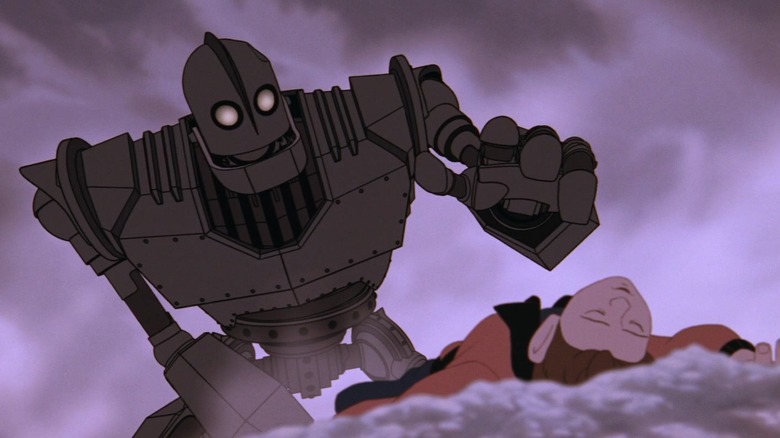
It's about there that "The Iron Man" and "The Iron Giant" begin to take different narrative paths. In the movie, the Giant is targeted by an angry, anti-Communist federal agent named Kent Mansley (Christopher McDonald), who thinks that the giant needs to be apprehended and destroyed. In the book, though, things take a turn toward Godzilla.
The next spring after the giant is buried alive, it gets up out of the dirt and is told by Hogarth to behave. He then becomes a member of the local community, with everyone kind of accepting him right away. The plot kicks in when a space dragon lands in Australia, threatening to take over the planet. The Iron Man is flown to Australia to engage the creature in a battle of strength that involves burning themselves alive. The Man withstands being set on fire, while the dragon is severely burned by flying into the sun. As the victor, the Iron Man orders the dragon to use its magical singing voice to pacify humanity and lead them into a more gentle, peaceful way of thinking. Yes, "The Iron Man" ends with a new age of world peace.
"The Iron Man" was a hit in England, and Pete Townshend of The Who eventually, in 1989, made a concept album based on it. Townshend, it should be noted, was also a producer of Brad Bird's "The Iron Giant," so the man clearly has an affinity for Ted Hughes' work. Hughes eventually wrote a sequel called "The Iron Woman" in 1993, which is all about toxic waste.
"The Iron Giant," meanwhile, became deeply beloved by animation fans everywhere, and Brad Bird went on to make hits like "The Incredibles," "Ratatouille," and "Mission: Impossible — Ghost Protocol."