

Clint Eastwood Was Floored By This Controversial John Wayne Western Performance
We may receive a commission on purchases made from links.
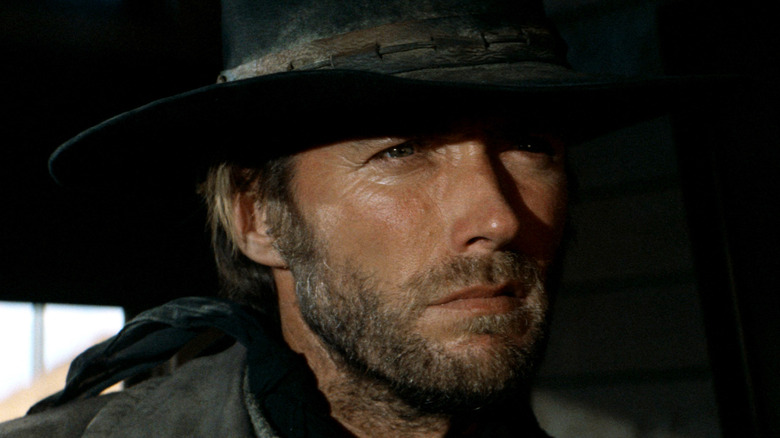
Clint Eastwood has been critical of John Wayne throughout his career, but he absolutely loved the Duke's performance in "The Searchers," which he called "brave." But while the film remains a widely celebrated classic, it also has a complicated legacy.
Eastwood and Wayne's relationship is difficult to define. Though these two cinematic legends ostensibly had it out for one another, there was always a mutual respect between them. In a way, it was impossible for Eastwood not to admire his forbear. He grew up in a culture that venerated the Duke, and he had much in common with the legend. As noted in Scott Eyman's "John Wayne: The Life and Legend," when Eastwood first transformed into a cowboy as ramrod Rowdy Yates on "Rawhide," he was playing a variation of Montgomery Clift's role in "Red River," a movie that also starred Wayne. When asked about that very film by Paul Nelson in the 1970s (per "Conversations with Clint"), Eastwood had good things to say. "John Wayne in his day, one of his better roles was 'Red River,'" he told Nelson. "Where he played a guy who had many faults."
Eastwood's next role was that of a man who was similarly flawed. His Man with No Name was originally named Ringo after Wayne's legendary Henry, the Ringo Kid from "Stagecoach," and shortly after he debuted as that laconic anti-hero, Eastwood — like Wayne before him — became symbolic of Westerns of the era. In that way, these two men seemed to have shared an almost cosmic link ever since Eastwood arrived on the scene. While you can find plenty of examples of the two disparaging one another, then, it's always nice to find more complimentary moments, such as when Eastwood commended Wayne on his performance in "The Searchers."
Clint Eastwood thought John Wayne was 'brilliant' in The Searchers
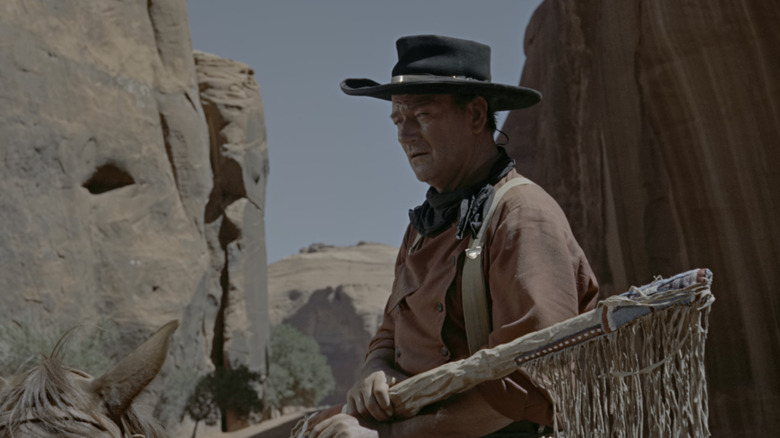
In 1956, John Wayne re-teamed with his longtime director John Ford (who made him a star with 1939's "Stagecoach") for "The Searchers." Based on Alan Le May's 1954 novel, the film stars Wayne as Ethan Edwards, a Confederate Civil War veteran who sets out alongside his adopted nephew Martin Pawley (Jeffrey Hunter) in search of his niece Debbie Edwards (Natalie Wood) after she's abducted by Comanches. Clint Eastwood loved it.
In an interview with Film Comment, Eastwood was asked about the moment in "The Searchers" when Wayne's character returns from finding the body of his niece's older sister and says, "Never ask me what I saw." "That's one of his brilliant performances and brave, because he wasn't afraid to play the flat-out racism," Eastwood replied. "And when you look at his eyes at that moment you know it wasn't something good that he saw. And you'd almost resent it if he started explaining it."
"The Searchers" has received widespread and enduring acclaim ever since its theatrical release. Frequently cited as one of the best Western ever made, the movie was met with almost unanimous praise upon its debut and continued to impress critics even decades later. As Roger Ebert wrote in his perfect review, "John Ford's 'The Searchers' contains scenes of magnificence, and one of John Wayne's best performances." But Ebert also noted how "at its center is a difficult question, because the Wayne character is racist without apology." Still, the critic seemed to agree with Eastwood's assessment of casting Wayne as being "brave." "I think it took a certain amount of courage to cast Wayne as a character whose heroism was tainted," wrote Ebert. Of course, subsequent generations haven't been as impressed with the views of Ethan Edwards.
The Searchers has a complex legacy
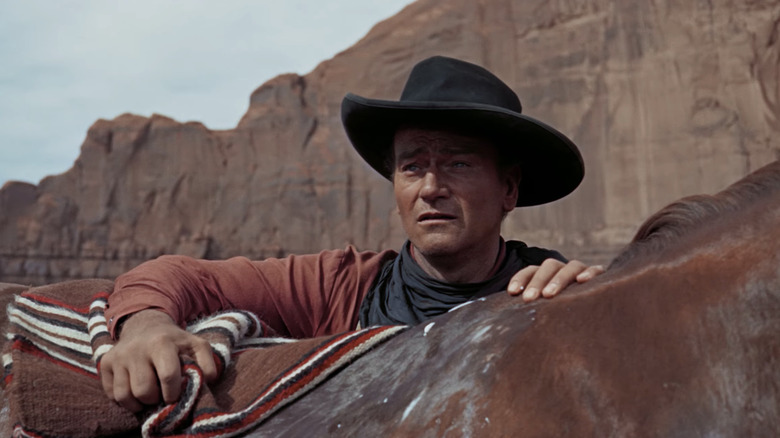
"The Searchers" is a dark film, not least because Ethan Edwards is depicted as unequivocally racist He's at best uncomfortable with Jeffrey Hunter's Martin Pawley simply due to the fact he's one-eighth Comanche. "Hell, I could mistake you for a half-breed," Edwards says upon meeting him. But Roger Ebert asks the crucial question, "Is the film intended to endorse [its characters'] attitudes, or to dramatize and regret them?" For the critic, John Ford had done enough to make it clear that it's the latter. "In the flawed vision of 'The Searchers'," wrote Ebert, "we can see Ford, [John] Wayne and the Western itself, awkwardly learning that a man who hates Indians can no longer be an uncomplicated hero."
But not everybody is convinced. Over on Letterboxd, many contemporary viewers simply can't abide Edwards' racist views of Indigenous Americans. "We're supposed to root for John Wayne as he searches obsessively for his niece," writes one user, "and as modern-day viewers, ignore his blatant racism in the name of art." But even here, the comments argue against such an interpretation, with one user responding, "Ford doesn't canonize Ethan Edwards: He showcases him as a tragic figure, necessary to found a world to which he can no longer belong."
That said, there's absolutely no doubt Wayne himself held some abhorrent views, most of which he elucidated in stunning detail during a 1971 Playboy interview wherein he criticized the Civil Rights movement and Indigenous Americans. As such, the subject of racism remains an important one to bring up within the context of "The Searchers." It should be said, however, that there are plenty of movies starring the Duke that make no effort to interrogate their characters' racism, so it clearly wasn't that aspect that appealed to Clint Eastwood.