

A Star Trek: First Contact Actor Joined The Movie Because Of Their Real-Life Extraterrestrial Studies
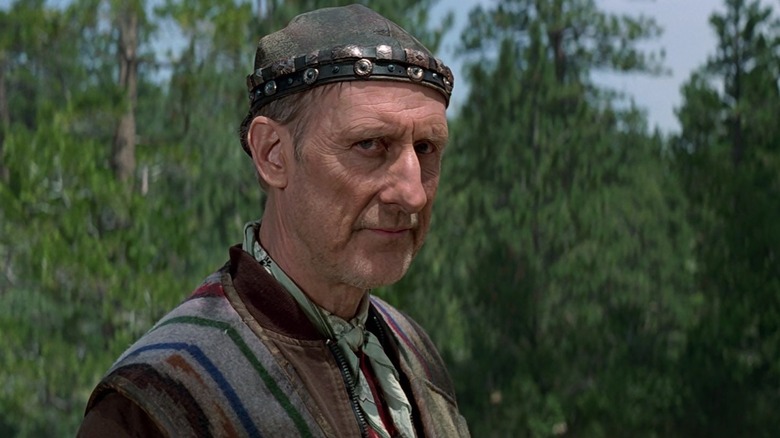
Veteran actor James Cromwell began his association with "Star Trek" in the 1990 "Star Trek: The Next Generation" episode "The Hunted." In that episode, he played Nayrock, the Prime Minister of Angosia III, a world that hoped to join the Federation. Cromwell was less recognizable in his second "Next Generation" appearance, in the two-part 1993 episode "Birthright." Buried under makeup and prosthetics, he played a Yridian trader who has something very valuable to Worf (Michael Dorn). Cromwell also appeared in the 1995 "Star Trek: Deep Space Nine" episode "Starship Down," playing a Karemma named Hanok. His DS9 appearance came just after Cromwell appeared in the movie "Babe," for which he would receive an Oscar nomination.
In the summer of 1996, Cromwell was cast as Zefram Cochran in Jonathan Frakes' feature film "Star Trek: First Contact." Trekkies can tell you all about this character, as he is a key figure in the "Star Trek" universe: He was the man who invented the warp engine, allowing humans to actually start making star treks in the first place.
The plot of "First Contact" centered on humans' first contact with alien life. In the world of "Star Trek," meeting aliens brought humans together, uniting Earth under a single banner and ushering in a post-capitalist utopia devoted to science, study, exploration, and diplomacy.
It was notions of first contact with alien life that Cromwell found the most interesting about appearing in "First Contact." He clearly didn't mind returning to the "Trek" franchise, but, as he admitted in a 1996 issue of Cinefantastique Magazine, he was more interested because of his work with the Center for the Study of Extraterrestrial Intelligence (CSETI). We'll get into CSETI (not to be confused with the SETI Institute) and its founder, Dr. Steven Greer, below.
James Cromwell's studies into real-life extraterrestrial intelligence inspired him to take the First Contact gig
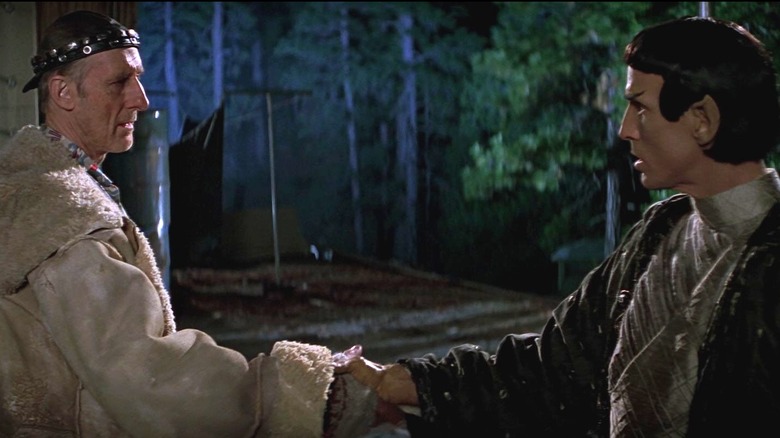
When asked about his involvement with "Star Trek: First Contact," James Cromwell was frank about his interests in aliens. In the 1990s, interest in real-life aliens was running high, and a lot of alien imagery and iconography had proliferated as an urban legend. These images were first popularized in the '80s by Whitley Streiber's book "Communion" (and its bizarre film adaptation) and juiced up by real-life paranormal shows like "Sightings." By the time "The X-Files" debuted in 1993, aliens were a big deal in pop culture. James Cromwell got swept up in the ideas, and was interested enough in the exploration of alien life that he joined CSETI. He said:
"That happens to be my interesting in doing ['First Contact' ...] I'm involved with CSETI. I'm hoping to write a novel about CSETI and Project Starlight. I'm thinking 'This is incredible. I've got this great idea for a story, and the suddenly I get this scene [wherein] I'm the guy that makes first contact.' I thought it was so serendipitous and extraordinary that I should have this interest, and then make this film. I'm looking forward to seeing whether this is all part of a plan. I think it's intriguing."
That may have been Cromwell's inspiration for getting involved in this "Star Trek" movie, but the clincher was that he was the one who got to engage in the titular first contact in "First Contact." Cromwell returned to the role of Zefram Cochran for the 2001 series "Star Trek: Enterprise" (in a video broadcast) and gave the speech wherein he talked about how his engines would allow humans to "boldly go where no man has gone before."
CSETI is not the same as SETI
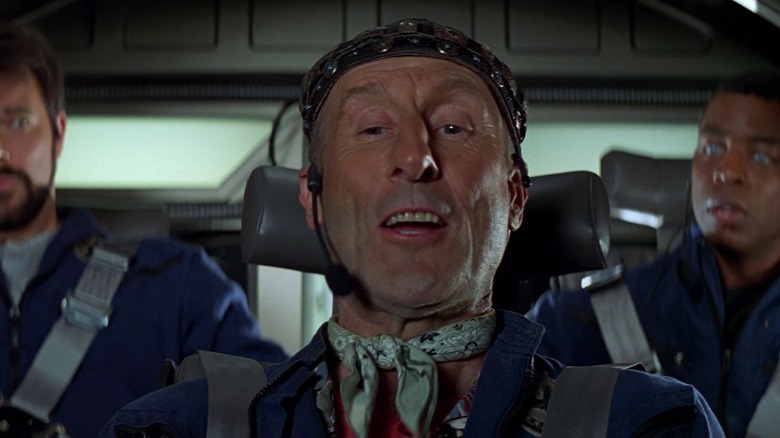
"Star Trek: First Contact" seems to have been a plum gig for James Cromwell. His character not only got to invent warp engines, but he was the first human to shake hands with a Vulcan. Then, a few years later, we learned that Zefram Cochran also co-wrote the original "Star Trek" opening narration. He was right in the center of the franchise, and Cromwell got to embody him. Add to that his interest in CSETI and Project Starlight, and it sounds like a dream come true.
Just what is Project Starlight? One can read all about it in a 1994 proposal written by Steven M. Greer, the managing director of CSETI.
As noted, though, CSETI is not the same as the SETI Institute. Greer founded CSETI in 1990, whereas SETI has been in operation since 1984. The latter has numerous noted astronomers and well-educated engineers involved, whereas CSETI is ... less prestigious. Dr. Greer has appeared in a series of increasingly unhinged documentary films all about government conspiracies and the "truth" about how alien/human hybrids live among us. The 2013 film "Sirius," based on Greer's book "Hidden Truth, Forbidden Knowledge," theorized about alien propulsion tech being secretly held by the government. Greer has since made a career of appearing in crowdfunded conspiracy-laden documentaries that are all equally unconvincing.
Dr. Greer, now in his early 70s, has even recently appeared on the fringe right-wing news network Newsmax to talk about how alien hybrids and human-made UFOs are part of a multi-decade psychological warfare operation against the public.
Cromwell's current involvement in Project Starlight is unknown, although it may be safe to assume that "The X-Files" beat him to the punch in popularizing alien conspiracies (and you can read our list of the best "X-Files" episodes here).