

Stargate SG-1's Co-Creator Scolded Richard Dean Anderson During An Early Table Read
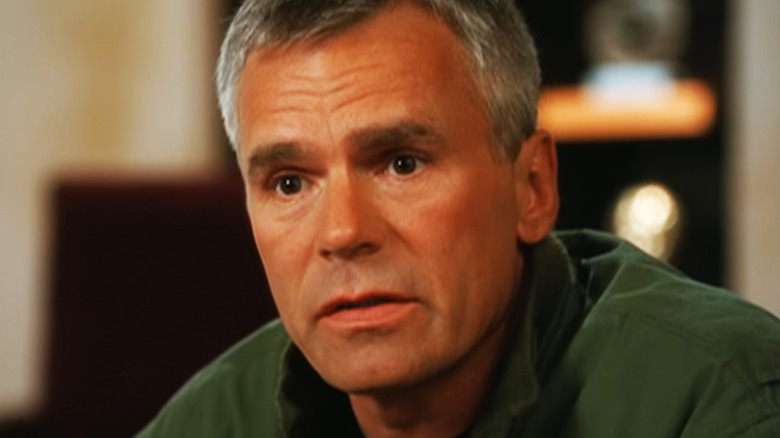
When Richard Dean Anderson first joined "Stargate SG-1," it was a big boon to the series. Having starred in "MacGyver," Anderson was a recognizable actor who lent the new show some much-needed legitimacy. But at the first table read for the series, its star demonstrated a penchant for ad-libbing to such a degree that "SG-1" co-creator Brad Wright advised him to tone it down and just read the words in the script.
If you're going to bring a sci-fi blockbuster to the small screen without its original stars, you should probably try to get at least one familiar face to help carry the new iteration. That's exactly what happened with "Stargate SG-1," a continuation of Roland Emmerich's 1994 film "Stargate," which starred Kurt Russell as Colonel Jack O'Neill. But Russell didn't reprise the role for "Stargate SG-1," leaving showrunners Brad Wright and Jonathan Glassner to look for a worthy replacement. They found it in former "MacGyver" star Richard Dean Anderson, who stepped in to lead the new Showtime series.
Anderson had two conditions to replace Russell on "SG-1." He wanted his version of O'Neill to have a humorous element and be less of a team leader and more of a team member, despite the fact that O'Neill was the head of the titular crew. As revealed in a piece from Gateworld, the actor also wanted an executive producer credit to ensure he had more creative control. He got everything he asked for, but initially, that control emboldened him a little too much, as it seems Anderson became too comfortable with altering his own dialogue.
Richard Dean Anderson was basically taken into the principal's office in his early SG-1 days

Richard Dean Anderson ultimately agreed to join "Stargate SG-1" due to a single line in the pilot script. The line, which saw Jack O'Neill telling Christopher Judge's Teal'c that he could "stay at his place" for rescuing him, seemingly fulfilled the actor's desire for his O'Neill to be more humorous than Kurt Russell's version. The rest of the script, however, was fair game as far as Anderson was concerned, as the actor ended up indulging his improvisational talents a little too much.
According to Gateworld, Anderson would improvise both on-set and at table reads, often adding in his own jokes instead of reading the lines as written. According to the report, this extemporaneous approach eventually spread to other cast members, who began adapting their own lines. As Anderson told Gateworld:
"What I brought to the table reads of the scripts was the attitude that everything was potentially a setup for a funny line, which doesn't make writers and producers very happy. So during these table reads I'd be ad-libbing on what was a fresh script."
According to the actor, eventually it got to the point where co-creator Brad Wright had to take him aside and give him a stern talking to. "[He] took me into his office like the principal," explained Anderson, "and said, 'You know, you're not doing the writers a great service by doing what you're doing in those rehearsals. Every one of us works hard to write the script and when we first hear them, you guys read them. We'd actually like to hear the words.'"
Richard Dean Anderson and the Stargate SG-1 writers were both instrumental to the show's success
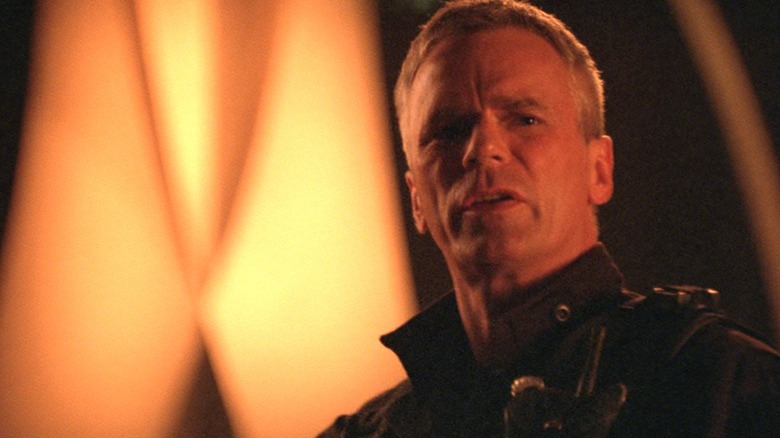
In his Gateworld interview, Richard Dean Anderson described how Brad Wright "basically chastised the hell out of [him]" during their early meeting. But the star admitted that he "deserved" it. "I told him so," said Anderson. "And it occurred to me that I should be showing some more respect for the writers, who, to this day, I respect the most out of the whole process." Rightly so.
The writing on "Stargate SG-1" proved influential on future shows such as "Bones" in part due to the balance it struck between humor and drama. Had Anderson been allowed to inject more jokes into the dialogue, this might never have been the case. That said, had the star not insisted on making his character slightly more comedic from the outset, "SG-1" might never have found the balance that made its writing so distinct and ultimately allowed "Stargate SG-1" to run for 10 seasons before it was cancelled by the Sci-Fi channel (now "SyFy").
By the end of its run, Anderson had long since started pulling away from the show, appearing less and less before becoming a recurring character in the ninth and tenth seasons. But his contribution to the show was clearly more than lending some much-needed star power at the very outset. As Gateworld noted, "Humor ended up being the glue that held the show together."