

Which Star Trek Ship Is The Fastest? How The Enterprise Measures Up To Voyager And More
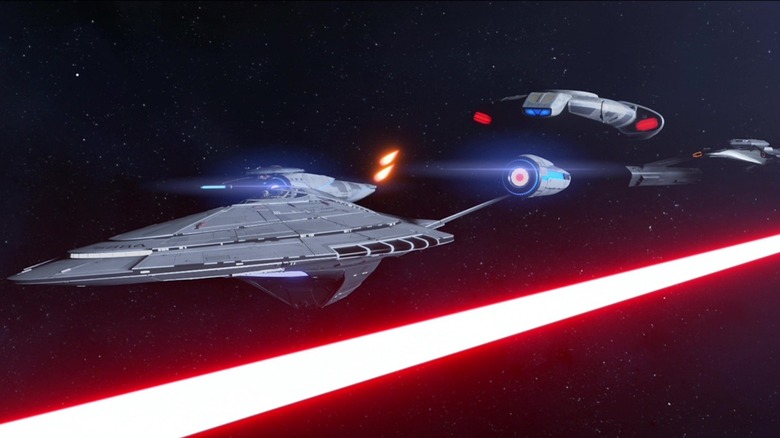
(Welcome to Trekspertise, a series where we break down the technology, history, details, and decisions that make the Star Trek universe so complex — and so fun.)
As "The Hitchhiker's Guide to the Galaxy" once observed, space is big. Space is so big that the human imagination can barely contain it. Our own sun is 93 million miles away from Earth. The next star over, Proxima Centauri, is about 4.33 lightyears away, which is almost 25 trillion miles.
When creating a sci-fi series like "Star Trek," the writers had to invent a fictional propulsion system, the warp drive, that could carry starships many times the speed of light just so they could get around our modest little corner of the Milky Way. Actual space is so big, though, that even a fictional propulsion system had limits.
The warp factors, as seen on the original "Star Trek" series, were measured on a geometric scale. Warp-1 was the speed of light, but warp-2 was eight times the speed of light, warp-3 was 27 times, and so on. There was mention of a warp-11 in the episode "By Any Other Name," which would equal 1,331 times the speed of light. Even traveling at that staggering speed, Proxima Centauri is still over 28 hours from Earth.
But the ships from the original "Star Trek" (set in the 23rd century) are downright pokey when compared to ships from "Star Trek: The Next Generation" (set in the 24th). The warp scale was reworked over time, so the warp-9 of a "Next Generation"-era ship is actually faster than the warp-11 of "The Original Series." By dint of technological advancements, any of the ships seen on "Star Trek" prior to 1987 are not going to be among the fastest.
But which "Star Trek" ship actually is the fastest?
The USS Enterprise-D can travel at warp 9.6 comfortably
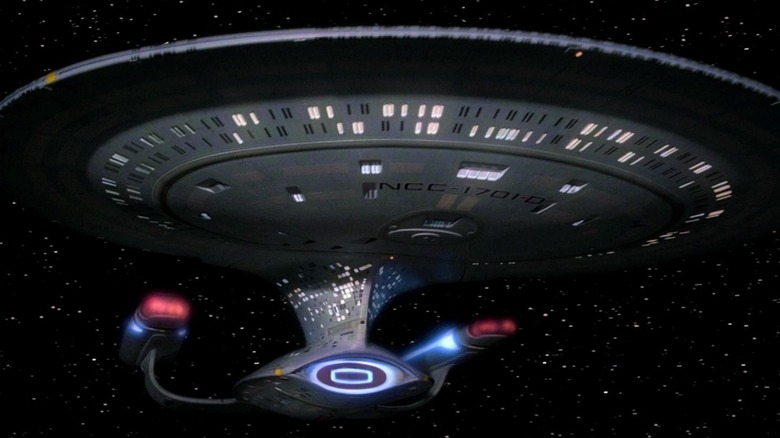
In the original series "Star Trek" episode "That Which Survives," the Enterprise experienced a technical glitch and traveled at warp-14 for about 15 minutes. That was the fastest it ever traveled.
It turns out the Enterprise's ship design might actually be realistic for warp speed, but even so, the Enterprise-D, as seen on "Star Trek: The Next Generation," was far faster. As mentioned, the warp scale was recalculated in the 24th-century timeframe of that series, and with those new calculations in place, no ship could ever achieve warp-10. Warp-10 was redefined as infinite velocity, which would mean that a vessel would pass through every single point in the universe simultaneously. That sounds handy for getting down to the video store to return your "Road House" DVD, but that's too convenient for "Star Trek" writers who require, well, trekking. Warp-10 placed a cap on how fast ships were allowed to go.
As glimpsed in the episode "New Ground," the Enterprise-D could easily sustain a speed of warp-9.2 for a prolonged period, and in fact was usually seen going at about warp-9.6. It could go up to warp-9.9 in a pinch, but it was extremely unsafe. As is stated throughout "Star Trek," when a starship travels at its maximum velocity for a prolonged period, it begins to damage the engines.
Warp-9, by the new scale, was 1,516 times the speed of light. As the decimal places increase, the warp factor speeds begin to increase by leaps and bounds. A ship that can go warp-9.5 is considerably slower than a ship that can travel at warp 9.75, for instance. Because of the way warp speeds were calculated, Warp-9.9 was actually way, way faster, equaling about 3,053 times the speed of light.
We'll see that in effect as we look at the USS Voyager, which leaves the Enterprise-D in the dust.
The USS Voyager is even faster than the Enterprise-D
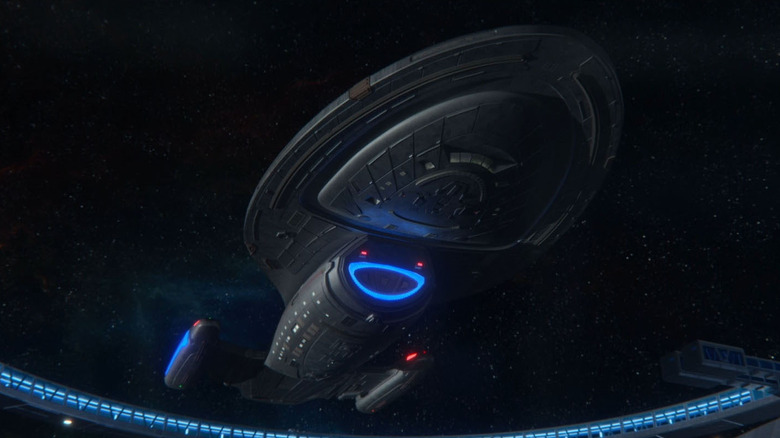
In the "Star Trek: Voyager" pilot episode "Caretaker," it's stated that the titular ship is capable of reaching speeds of up to warp-9.975. Some of the on-screen data is a little dodgy, though.
Resourceful Trekkies have calculated the distances the Voyager traveled, and they're not consistent. In the episode "The 37s," for instance, the crew said they could travel at warp-9.9, stating they traveled about four billion miles (or .00068 lightyears) in one second. That would mean they were traveling at 21,473 times the speed of light! But in the episode "Inside Man," they traveled at warp-9.9 for two full hours and only traversed 0.7 lightyears, which would mean they were only traveling about 3,066 times the speed of light. That speed would certainly help get you from Los Angeles to Las Vegas before the breakfast buffets closed, but it's very different than what was previously established.
It's possible, though, that the inconsistent numbers might reflect the fact that the USS Voyager was stranded in the Delta Quadrant, and had inconsistent access to fuel and repair technology. The Voyager's engines may have fluctuated in efficiency and speed depending on the resources at hand. (Imagine, for instance, having to run your car on rubbing alcohol or high-grade rum. It wouldn't be as efficient.) That handy-dandy excuse was written into the "Star Trek: Voyager Technical Manual," which was not released to the public and used instead as a writer's guide.
It's generally accepted that the USS Voyager was much faster than any of the ships Trekkies had previously seen. The best, most widely accepted number is that warp 9.975 is 3,056 times the speed of light. The Voyager can stay at that speed for about 12 hours without beginning to suffer engine problems.
The USS Protostar may be the fastest starship of them all
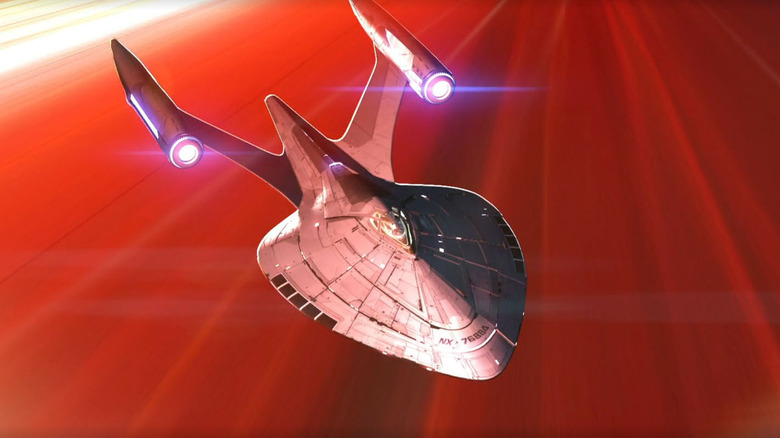
In the animated series "Star Trek: Prodigy," the main characters found an experimental Starfleet vessel called the USS Protostar, which was equipped with a new kind of engine drive capable of traveling at previously unknown speeds. The ship's conventional warp drive could carry the Protostar at about warp-9.97, which is impressive — even faster than the Voyager. It was a very, very small vessel, and had two warp cores, giving it that much more power. (If your lawnmower had two engines, you could get that puppy up to 50 miles per hour.) At the heart of the Protostar was an actual protostar, a massive power source that allowed the ship to somehow slip into a faster form of warp.
It was stated that the Protostar was able to travel over 4,000 lightyears "in a matter of minutes." This would have taken an ordinary 24th century starship about four years to travel. 4,000 lightyears equates to 23.514 quadrillion miles. The entire Milky Way is only about 120,000 lightyears across. The writers of "Star Trek" kept their ships relatively slow, as it would allow the galaxy to seem that much bigger, and give the show's writers more exploratory storytelling options. With "Prodigy," however, the showrunners upped the stakes.
So let's do some calculating. If that "matter of minutes" mentioned above was 10 minutes, that means the Protostar could travel 24,000 lightyears in an hour, right? That's 210,384,000 times the speed of light. I don't even know what that means in terms of warp factor. The Protostar could traverse the entire Milky Way in five hours. Of course, the proto-warp drive was still experimental, and could only be sustained for a few minutes at a time. But, golly, that's fast. No wonder we once called the Protostar one of the most powerful ships in "Star Trek."
The USS Discovery can teleport ... but does that count?
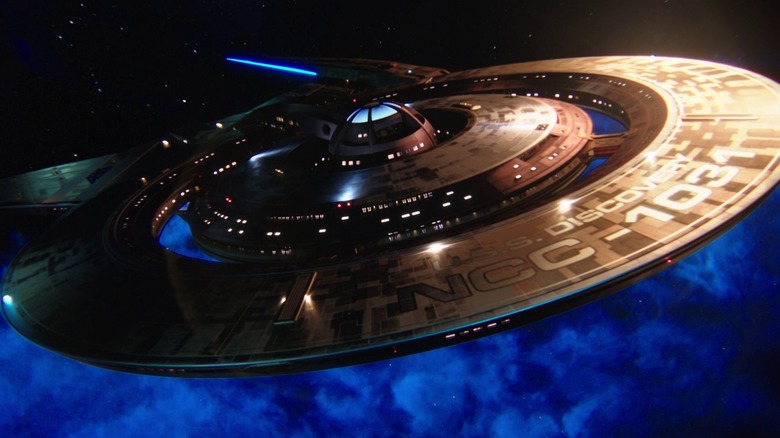
Of course, who needs a warp drive when you can teleport?
The USS Discovery on "Star Trek: Discovery" was in operation shortly before the events of the original "Star Trek," so we're back to using the old-fashioned warp scale and traveling in a ship that cannot go nearly as fast as the Enterprise-D or the Voyager.
During the course of the series, however, the Discovery was thrown forward in time to the 32nd century, where the ship underwent a massive, futuristic refit, giving it engines that could, presumably, fly incredibly quickly. Still, the 32nd century was recovering from a cataclysm that destroyed most starships, so the actual maximum warp of the era's vessels could conceivably still be slower than centuries earlier. The actual top speed of the Discovery isn't much discussed on the series, though ... because the ship can teleport.
Early in the series, the crew of the Discovery discovers a universe-wide mycelial network of interdimensional spores. Thanks to some technical jiggery-pokery, the engineers on the Discovery were able to tap their engines into this organic network (often using Lieutenant Stamets, played by Anthony Rapp, as an organic component) and allow the ship to slip between dimensions, re-emerging instantaneously anywhere else in the network. "Star Trek: Discovery" effectively eliminated trekking from its formula.
The spore drive, like the protostar drive, was experimental, and its operation was so specific to the Discovery that the technology was not implanted across all of Starfleet. Plus, there were plot contrivances in the series that essentially removed all records of the Discovery from Starfleet's archives. The Discovery is the only ship that can teleport using the mycelial network. It wasn't traditionally fast, but it could get you to your destination in a (literal) flash.
But fastest ship in Star Trek is ... [drumroll please]
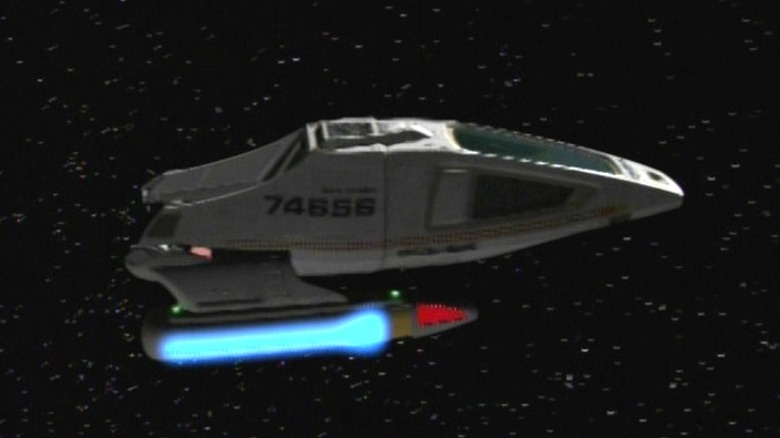
Thanks to the controversial "Star Trek: Voyager" episode "Threshold," the actual winner of the "Star Trek" speed contest is the Delta Flyer. Congratulations! Here's your trophy and your outsize novelty check.
In "Threshold," the crew of the Voyager finds a new type of dilithium crystal that could conceivably make the ship travel past warp-10. Dilithium is a rare mineral that is required to regulate the matter-antimatter flow into a starship's engines. The better the crystals, the better the engine efficiency.
Warp-10 is infinite velocity, which would get the Voyager back to Earth instantaneously. The crew outfits its high-tech shuttlecraft, the Delta Flyer, with these crystals, and the ship does indeed reach infinite velocity. In passing through every point in the universe pilot, Tom Paris begins to evolve into something other than a human. If a ship has reached infinite velocity, then it's clearly the fastest thing we've ever seen on "Star Trek."
There are other contenders for which ship is the fastest, of course, as all the above information doesn't account for all of the transwarp technologies seen throughout the franchise. There are portals, subspace conduits, quantum slipstreams, wormholes, and other bizarre phenomena that allow ships to very occasionally surpass their engines' capabilities and traverse immense distances in a matter of minutes. Those technologies, however, are sparse. It's important that "Star Trek" is an actual trek through the stars. We want to stop at nearby planets, visit every outpost like a cosmic Stuckey's, and say hello to friendly aliens.
There are also alien ships that are said to be very fast, but aren't really explored further. In the "Star Trek: The Animated Series" episode "The Counter-Clock Incident," for instance, there is a ship that is said to travel at warp-36! But based on what we actually see, it's clear the Delta Flyer takes the top prize.