

How Fight Club Author Chuck Palahniuk Felt About The Brad Pitt Movie
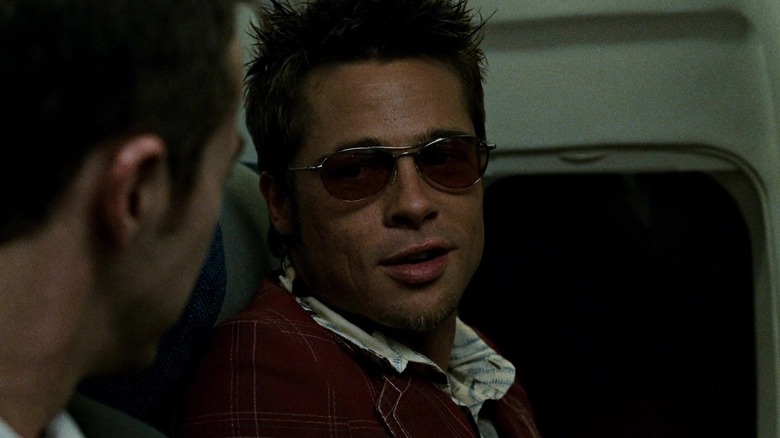
David Fincher's 1999 film "Fight Club" was never meant to be an aspirational text. The character Tyler Durden, played by Brad Pitt, spends the movie espousing a violent, anarchic mindset derived from his self-styled notions of the male's shrinking role in end-of-the-millennium society. He sees masculinity as a waning force that needs to be reawakened, and in his view, masculinity is an ascetic lifestyle devoted to destruction. Partway through "Fight Club," Tyler gives a utopian speech about men climbing the vines growing around a ruined, post-apocalyptic cityscape. For Tyler, this is the world the way it was supposed to be: men as modern-day Tarzans. Women don't seem to have any role in this future.
Although "Fight Club" is undeniably cool — Fincher directed with a great deal of MTV panache — Tyler Durden was meant to serve as a warning. The need to reclaim masculinity is not a noble endeavor, as modern masculinity was little more than men punching each other in the face. "Fight Club" is a great film, but one might want to be wary of young men who declare it to be one of their favorites.
The film was based on the 1996 novel by Chuck Palahniuk, his first to be published. The movie launched Palahniuk into the center of the pop literary canon and made him one of the most-read authors of the 2000s; at the very least, I personally recall seeing his books being read in public.
And what does Palahniuk think of the "Fight Club" movie? In brief, he thinks it's so good, he's a little embarrassed. Fincher and the film's screenwriters, Jim Uhls, managed to streamline his story and turn it into something even better. Palahniuk admitted as much in an interview with DVD Talk.
Chuck Palahniuk loved the Fight Club movie more than his own book
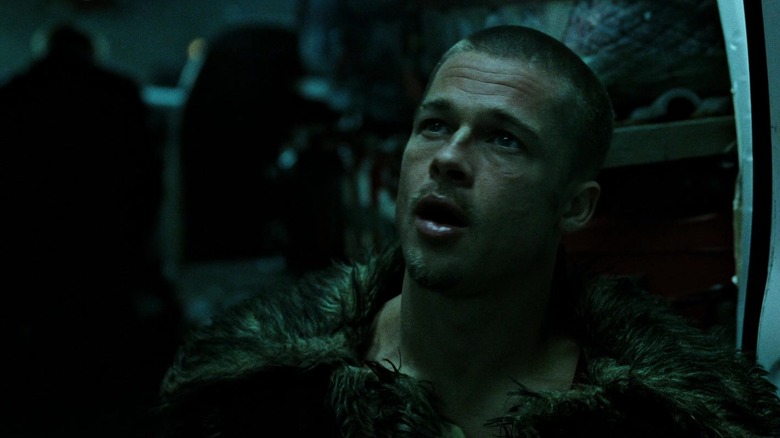
Chuck Palahniuk was asked directly what he thought of David Fincher's "Fight Club" movie, and he said that he was always included in the filmmaking process, which he appreciated. The problem was that Palahniuk didn't know much about filmmaking, so when he was called in to watch dailies, he didn't really know what they meant. "Here were these wonderful reaction shots and things like that," he said, "which seemed so random. Beautifully composed, attractive, and funny in their own way, but I had no idea how they went together." When he finally saw the finished movie, Palahniuk became a little self-conscious that the filmmakers had taken his story and improved upon it. He discovered new things in what he wrote. In Palahniuk's words:
"[W]hen I sat down with Jim Uhls and record a commentary track for the DVD, I was sort of embarrassed of the book, because the movie had streamlined the plot and made it so much more effective and made connections that I had never thought to make. There is a line about 'fathers setting up franchises with other families,' and I never thought about connecting that with the fact that 'Fight Club' was being franchised and the movie made that connection. I was just beating myself in the head for not having made that connection myself."
The dialogue in question comes from an exchange between the film's narrator (Edward Norton) and Tyler Durden. "I don't know my dad," the narrator said. "I know him, but he left when I was like six years old. Married this other woman, had some other kids. He, like, did this every six years; he goes to a new city and starts a new family." To which Tyler replies, "F***er's setting up franchises."
How Chuck Palahniuk felt about the twist in Fight Club
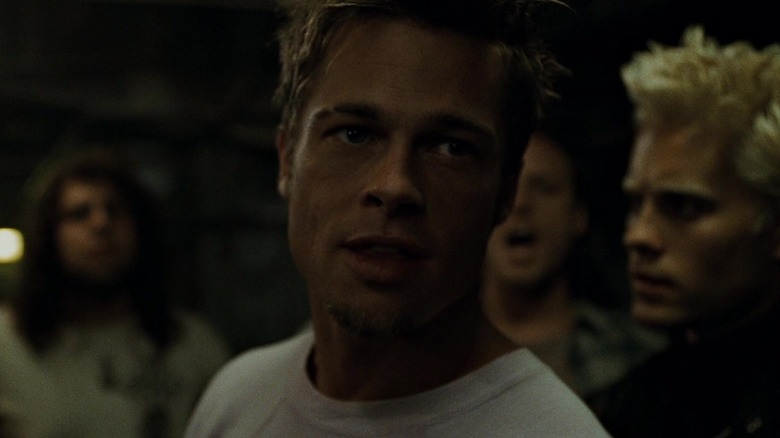
There is a big twist in "Fight Club" that blew the minds of the people who saw it in 1999. It's revealed about two-thirds of the way through the movie that Tyler Durden and the film's narrator are actually the same person. The narrator created the "Tyler" alter ego for himself, allowing "Tyler" to serve as an outlet for his deeper, darker impulses. The final act of the movie is the narrator learning how to wrangle this cult leader he has unexpectedly become. In the "Fight Club" novel, this twist comes much earlier in the story. He explained:
"The actual realization was one of the parts of the movie that was the closest to the book, the process in which Tyler was revealed. It's almost word for word from the book, that scene in particular, and the telephone call to Marla. So I was very happy with that. It's funny, there was so much concern about whether or not people would accept the plot twist and David just kept on saying, 'If they accept everything up to this point, they'll accept the plot twist. If they're still in the theater, they'll stay with it.'"
Marla was played by Helena Bonham Carter in the movie. Marla is a deeply disturbed character with suicidal impulses, but she has a firmer grasp on the world than the narrator/Tyler does. There was no fear that audiences wouldn't accept the twist, nor were there studio demands — as far as Palahniuk knew — to remove or alter the twist. Fortunately, Chuck Palahniuk loved how the twist was handled in the movie, feeling it was presented appropriately.