

Cillian Murphy's 2011 Sci-Fi Movie Has An Awesome Premise That Never Lived Up To Its Potential
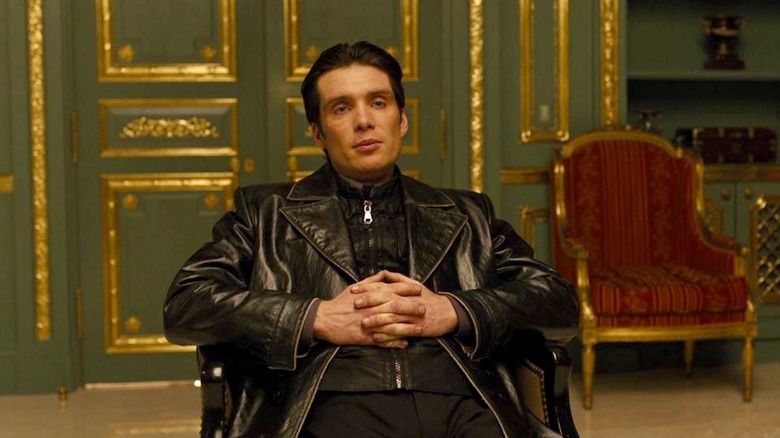
The premise for Andrew Niccol's 2011 sci-fi film "In Time" is novel. It takes place in the year 2169, when money has been replaced, quite literally, by time. Every citizen has a light-up countdown clock implanted in their forearm, and when that clock reaches zero, they die. Most working-class people have to work eight-hour days only to get a few extra hours tacked onto their deathclocks at the end of their shift. Missing a bus can mean doom. The wealthy, meanwhile, can live for centuries, accumulating more time than they know what to do with. As close as I can figure, this is a metaphor for the insidiousness of intergenerational wealth. People who are born rich tend to stay rich and can pass wealth on to their kids. People born in poverty rarely escape poverty.
The main character of "In Time" is Will (Justin Timberlake), an impoverished factory worker who is barely keeping ahead of his clock. He engages in risky Russian-roulette-style underground arm-wrestling matches, where players can clasp hands and, if strong enough, steal time from the other's deathclock. The plot of "In Time" involves Will rescuing a rich, 105-year-old man (Matt Bomer) from some muggers. The rich man, in a fit of introspection and self-awareness, transfers all the years of his own life into Will's arm before dying. Will is now "rich," but that makes him suspect. The local time cops (represented by a sexy, leather-clad Cillian Murphy) assume that Will is living on stolen time.
With that much time on his deathclock, Will is now able to infiltrate the inner circles of the bourgeoisie and begins to see how the other half lives. They regularly bet millennia of time in poker matches. They easily swap out decades of their own lives for fancy cars.
In Time doesn't do enough with its weird premise
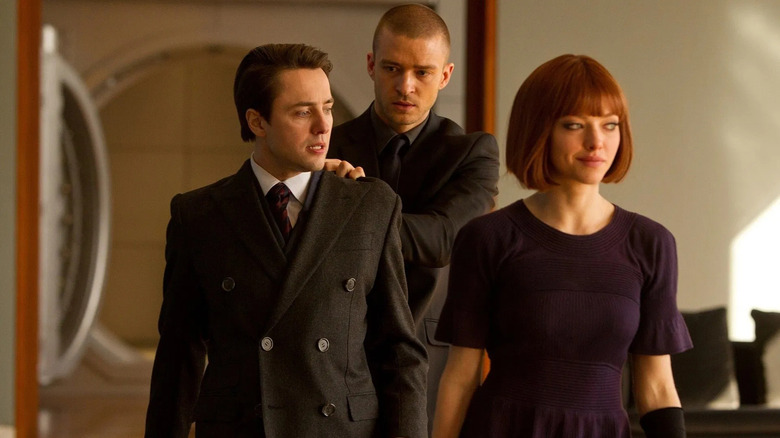
The "time is money" conceit of "In Time" is innovative enough, I suppose. And it leads to a fun climax wherein Will, having kidnapped a wealthy heiress played by Amanda Seyfried, has to break into a vault belonging to the heiress' father (Vincent Kartheiser) and steal one million years' worth of time. He will take that time into the poor neighborhoods and give the impoverished longer lives. It becomes a Robin Hood story. Anyone who has lived in poverty knows how busy your life is, how hard it is to get around, and how expensive it can be. The thought of giving poor people literal leisure time is an effective enough metaphor.
But Andrew Niccol doesn't push his premise far enough. His film is about story and thrills, not the elaborate sci-fi world he created. For instance, if the poor are always pressed for time, wouldn't their lives become devoted to moving and speaking quickly? One would think that a sign of poverty in "In Time" would be a runner's physique and sturdy running shoes. They should speak quickly and in abbreviations. Caffeine and/or cocaine would be consumed in great quantities. None of those conceits are part of "In Time."
Likewise with the wealthy. If they have centuries to dither around and do nothing, shouldn't they walk and talk very slowly? Shouldn't they recite entire monologues in discussion? Why would they need fast cars? A sign of wealth should be very, very slow vehicles. Watching long, slow movies would be the ultimate in time-wasting luxury. Those ideas, too, are absent from the movie. At the very least, "In Time" explains that the rich never go swimming in the ocean, as it's too much of a risk to their precious, precious lives.
Harlan Ellison sued the makers of In Time

Critics weren't terribly fond of "In Time," and it currently only has a 36% approval rating on Rotten Tomatoes, based on 173 reviews. Noah Berlatsky, writing for the Atlantic, noted that the film aspired to be an essay denouncing capitalism, but wasn't smart enough to follow through on its ideas. He also noted that the premise seemed a little played out, and felt weirdly old-fashioned, as if it had been cribbed from an old "Star Trek" script.
Berlatsky's review might have been a spot-on, as the notoriously cranky, and lawsuit-loving sci-fi author Harlan Ellison sued the makers of "In Time" for ripping off one of his ideas. Ellison, having not seen the movie, heard that its premise was remarkably similar to his 1965 story "'Repent, Harlequin!' Said the Ticktockman." Ellison's story takes place in a world where efficiency of time is paramount to existence, and if anyone does anything that is considered a waste — like showing up late for work — the time they wasted will be audited off the end of their lives. The main character of the story is an anarchist who wants everyone to ignore their schedules.
Ellison's lawsuit initially included an injunction against the film's release. Ellison, however, dropped the suit entirely when he actually saw the movie. "In Time," he found, was wholly original and had nothing to do with "'Repent, Harlequin!'" There was no settlement, Ellison received no special credits, and the film was released as it would have been otherwise.
Niccol's film was a modest hit, making over $174 million on its $40 million budget. It was never a major blockbuster, though, so it's largely passed from memory. It's a hoot, but it could have done so much more. Niccol, who wrote "The Truman Show," was capable of more.