

Before The Twilight Zone, Rod Serling Wrote A Western That Deserves More Love
We may receive a commission on purchases made from links.
Rod Serling's writing career began long before he created his hit anthology series "The Twilight Zone" in 1959. One can read all about Serling's story in Nicholas Parisi's biography, "Rod Serling: His Life, Work, and Imagination." Serling served in World War II, fighting in Japan, an experience that left him with deep psychological wounds and a trick knee that bothered him for the rest of his life. Serling always had an interest in radio and writing for the medium, and dipped into his college radio station from time to time before the war. After the war, he started going to radio stations as part of his post-war recovery theater classes.
Serling wrote scripts for radio shows for years before pivoting to television, right when the medium was new. He contributed stories to shows like "Kraft Television Theater" and "Playhouse 90" in the early-to-mid 1950s, and even started writing a few movies. Prior to the creation of "The Twilight Zone," serling was credited on three feature films, including the Van Heflin business drama "Patterns," the war picture "The Rack," and the intense Western "Saddle the Wind," released in 1958.
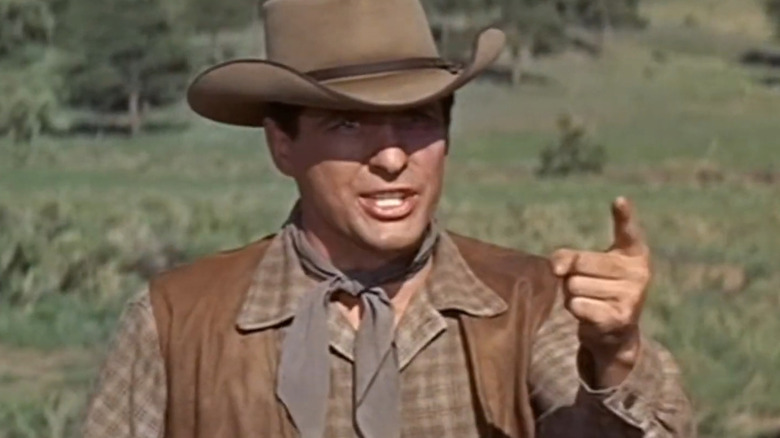
"Saddle the Wind" starred Robert Taylor as Steve Sinclair, a former gunfighter who once fought for the Confederacy. He's shown to be a hero of the local community who only wants to live in peace. As we know from myriad Westerns, "just wants to live in peace" is a predictor that a violent shadowy figure is about to arise from their past. In this case, it's Steve's violent brother, Tony (John Cassavetes), who aims to be a star gunfighter himself someday. Naturally, Steve and Tony will eventually come to violently butt heads.
Saddle the Wind is an intense Western drama from writer Rod Serling
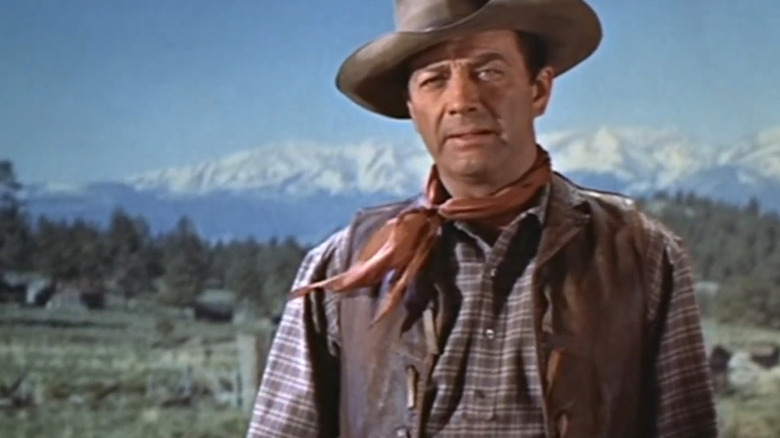
Tony, of course, is a hothead of the highest order, and Cassavetes brings a level of intensity one might not be used to from films of the era. Tony also brings along his feisty girlfriend Joan (Julie London, who also sings the film's theme song). Tony, clearly marked by a violent past, thinks that everything is a fight and is eager to kill people to keep his brother safe. Steve objects. Regardless, Tony kills one of Steve's old gunfighting rivals (Charles McGraw) in a fit of rage.
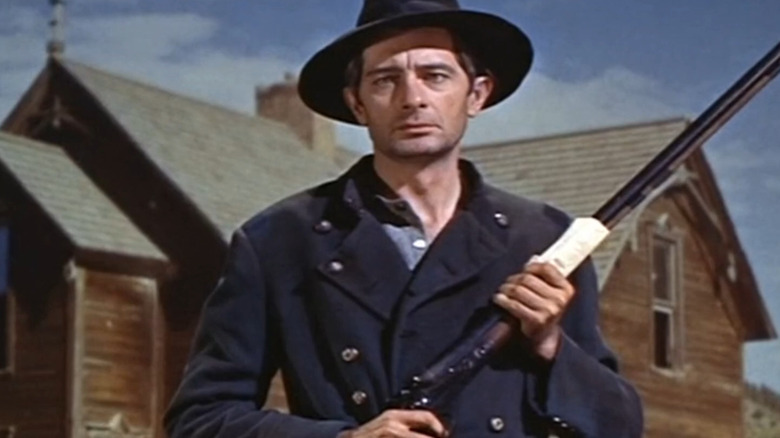
And if that weren't problem enough, Tony begins threatening a peaceful farmer (Royal Dano) who wants to move in nextdoor to Steve. The farmer is just a farmer, and has no schemes in mind. The film will climax with Tony and Steve facing one another with guns in hand. One can see just from the description that "Saddle the Wind" is about Steve trying to tame his own wilder, violent impulses, represented by Tony. He is trying to put a saddle on the wind.
"Saddle the Wind" was directed by Robert Parrish, who may be best known for his wild, 1967 spoof movie "Casino Royale," one of the stranger aberrations in the James Bond canon. The great Elmer Bernstein ("The Great Escape," "The Magnificent Seven," "Ghostbusters" wrote the score; Eli Wallach regrets not being able to hear that "Magnificent" music while filming). Julie London's single is marvelous and beautiful, as most of London's songs tend to be.
"Saddle the Wind" wasn't a huge hit, and it wasn't up for any notable awards. It's just a good, intense little Western, mostly buoyed by its great anti-violence themes and a great performance from John Cassavetes.
How Rod Serling pivoted to The Twilight Zone
One can actually find the 1959 issue of Variety, wherein Rod Serling was announced as starting up his own production company. He started the company the same year he signed a contract with CBS, agreeing to write scripts for "Playhouse 90," but also develop his own TV projects. Serling, it seems, didn't necessarily have any kind of ambition to get into movies, and was more comfortable with the volume of output that television required. "The Twilight Zone" was also his attempt to gain creative control over his project (something that was stated in Serling's 1995 "American Masters" biography), and that he wanted to hire respected writers that he liked. The rest is history.
That's not to say that Serling was limited to TV. He continued to writer TV scripts through the 1970s, only stopping because of his death in 1975. In 1960, he wrote a celebrated script for "Playhouse 90" called "Requiem for a Heavyweight," a script that he would adapt into a feature film in 1962. He wrote the popular political thriller "Seven Days in May," but his most famous script was probably for the 1968 film adaptation of Pierre Boulle's "Planet of the Apes." Serling co-wrote that script with Michael Wilson.
Rod Serling loved science fiction, and was always on the lookout for new voices in the medium. Serling died before the release of "Star Wars," but he was already sniffing around the film's creator "George Lucas" when he released his dystopian thriller "THX 1138." Serling's career was vast and broad, and his cinema is noteworthy. "Saddle the Wind" can be rented online.