

Matthew McConaughey's Animated Adventure On Netflix Is A Modern Marvel Worth Revisiting
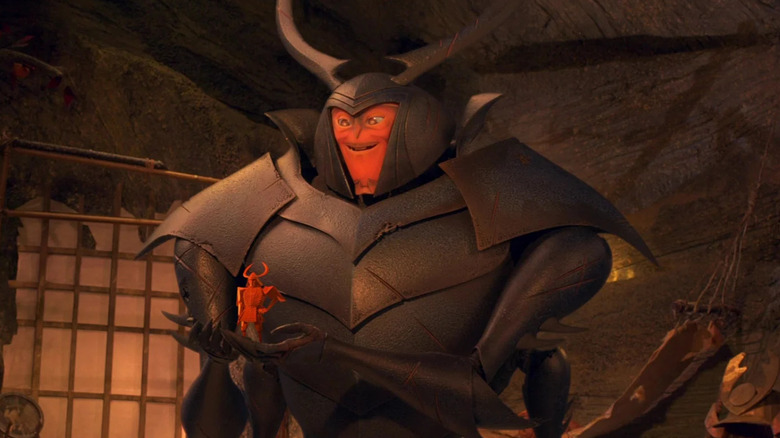
Travis Knight's 2016 film "Kubo and the Two Strings" is a visual marvel and a fascinating story. It also immediately invited controversy when it was released, as the film featured Japanese characters, but starred white actors from the United States, England, and South Africa. The lead character, Kubo, was voiced by Art Parkinson, a white actor from Ireland. Also on the cast were Charlize Theron, Ralph Fiennes, Rooney Mara, Brenda Vaccaro, and Matthew McConaughey. The only Japanese or Japanese-American actors on the cast were George Takei and Cary-Hiroyuki Tagawa, and they had smaller, supporting roles.
One might also criticize that "Kubo" purports to be a Japanese folk tale, but was wholly the creation of screenwriters Marc Haimes and Chris Butler. The production, at the very least, took its visual cues from various Japanese artists and art forms. Origami and shamisen music are used extensively, while the film's visual cues were taken from woodblock prints, specifically the art made by Hokusai, Hiroshige, and Koichi Sato. Travis Knight talked about all the Japanese arts he studied in a 2016 interview with Wired. He liked the idea of his stop-motion animation studio, Laika, making a samurai epic, a medium he was fond of, and that was pitched to him by a fellow coworker.
"Kubo" was widely seen, but it didn't take the world by storm like Laika's previous films "Coraline" and "ParaNorman." The former made almost $186 million at the box office, while the latter made over $107 million. "Kubo" only netted $77.5 million on its $60 million budget, which counts as a loss, according to the rules of Hollywood accounting.
Still, the film's visual artistry was recognized by many; "Kubo" was nominated for Best Animated Feature at the Academy Awards. It's currently on Netflix and worth discovering.
Kubo and the Two Strings still looks great
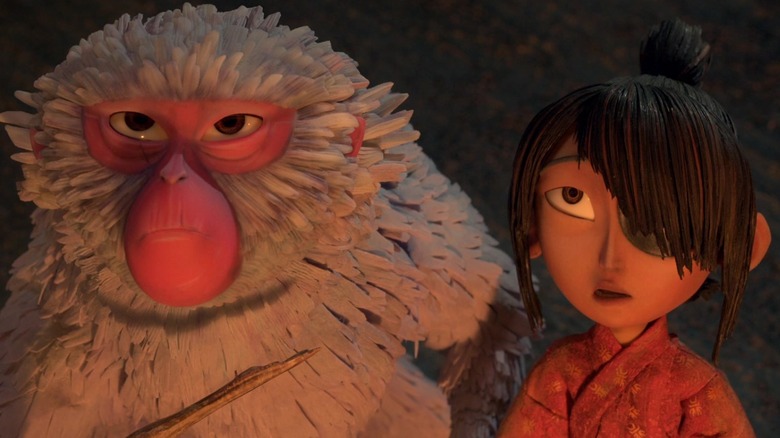
While the cultural insensitivity is present in "Kubo and the Two Strings," visually, it's still excellent. As in all of Laika's productions, the character design is both blocky and tactile, with sharp edges and rough surfaces coating every person and every wall. Laika also famously uses 3D printing to construct its maquettes, allowing the stop-motion process to be sped-up and streamlined. The 3D printing also allows characters to have a much wider variety of facial features, as animators weren't limited to the faces they had already built.
The story is appropriately folkloric. Kubo lives in a small village in feudal Japan where he plays his two-stringed shamisen to tell tales in the town square. Kubo has some mental powers, as his music allowed origami to come to life and enact his songs. His mother (Theron) is wasting away mentally, and warns Kubo that his grandfather, a god of the moon, may return someday and remove his right eye; Kubo lost his left eye in infanthood. One night, Kubo's twin aunts (Mara) attack him. After a fracas that takes his mother's life, Kubo finds himself out on the lam, seeking mystical armor and weapons by his mother's instructions.
Kubo is joined on his quest by a mystical talking macaque (also Theron), and eventually finds a human-sized half-beetle warrior (McConaughey) to team up with as well. During their quest, there is a standout sequence with a giant skeleton, and an encounter with a sea monster. The animation is quite excellent. There will, of course, be additional plot developments and reveals, specifically about the true nature of the talking macaque and the beetle warrior. "Kubo" is part myth, but just as much "The Wizard of Oz."
Laika has struggled over the years
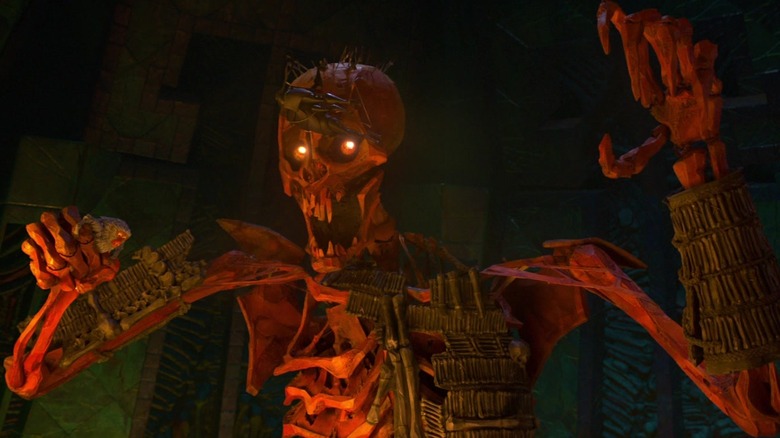
A behind-the-scenes clip that played over the credits of "Kubo and the Two Strings" revealed that the skeleton was an enormous creation, which no doubt made it very difficult to animate.
Critics loved "Kubo," and it has earned a 97% approval rating on Rotten Tomatoes, based on 229 reviews. Most were impressed with its visuals and its unique sense of melancholy; it's an adventure story, yes, but one that's infused with death and mourning. Justin Chang, writing for the Los Angeles Times, said that the film had a dreamlike quality, one that left him forgetting that the characters were all stop-motion puppets. /Film loved the film's tone of sadness.
Travis Knight, the son of Nike CEO Phil Knight, was indeed grilled about the film's casting in the above-linked Complex article. His response was a little lackluster. He pointed out that he was concerned about good actors playing the parts and that Matthew McConaughey was a great actor. He pointed to the fact that it was a Japanese tale, even if it wasn't voiced by Japanese actors. 2016 was when a lot of animated shows and movies began to acknowledge that, for the amount of racial and cultural diversity on screen, the recording booths were still largely filled with white actors. In 2017, filmmaker Hari Kondabolu released the documentary film "The Problem with Apu," about the Indian character on "The Simpsons" who was voiced by white actor Hank Azaria.
Laika suffered a big blow in 2019 with the release of their sasquatch comedy "Missing Link," which earned only $26.6 million on its $100 million budget. The studio's next film, "Wildwood," also directed by Knight, is due in theaters in October of 2026.