

George Lucas Helped Make A Movie That Was 'Banned' In Japan For Over 40 Years
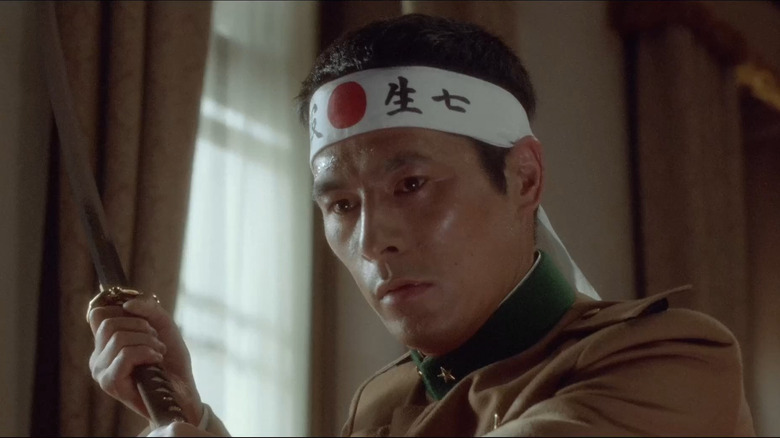
The life of Yukio Mishima (1925 – 1970) was broad and fascinating. He was one of the most prominent authors and playwrights of the 1950s and 1960s in Japan, having written seminal works like "The Sailor Who Fell from Grace with the Sea." He wrote several essays about the importance of tradition in an increasingly modernized Japan, including "On the Defense of Culture" in 1968, which argued for the importance of an emperor.
Mishima was also politically controversial, promoting a lot of somewhat extreme right-wing ideas. He wrote a play about Adolf Hitler, "My Friend Hitler," calling him a "political genius," although he was quick to add that Hitler should never be seen as a hero. Mishima was shocked by the uprising of the New Left in Japan, and took a blood oath (literally; he signed his name in blood) vowing to stop the Left Wing at all costs. This is all described in Naoki Inose's biography of Mishima called "Persona." The end of Mishima's life was also dramatic. He infamously invaded a military base in 1970 and took an army general hostage. Mishima gave a speech about returning Japan to the way of the samurai, hoping to whip the army into a frenzy and stage a coup. When the soldiers were not whipped, Mishima committed seppuku.
The life and works of Mishima were adapted into a film in 1985 in the form of Paul "Taxi Driver" Schrader's colorful epic "Mishima: A Life in Four Chapters." George Lucas and Francis Ford Coppola were the executive producers, and the film was a dreamlike anthology piece that followed Mishima in real life (played by Ken Ogata), intercut with dramatizations of his most famous stories. The film was banned in Japan, however, as Schrader posited that Mishima was bisexual, something his widow objected to.
Mishima: A Life in Four Chapters was banned in Japan for its queer content
"Mishima" was massively ambitious, trying to distill Yukio Mishima's life and works into a single movie. Paul Schrader co-wrote the screenplay with his brother Leonard — who had spent many years living in Japan, notably among the Yakuza and his sister-in-law Chieko, a Japanese native. Shrader always made ambitious, overarching stories. He once talked to /Film about his film "First Reformed."
"Mishima" was shot in Japan, in Japanese studios, and with a cast of Japanese actors. And yet the film was never actually released in Japan, mostly because the Shraders leaned hard into Yukio Mishima's queer writings, and the fact that Mishima might have been bisexual. It seems that 15 years after Mishima's death, he was still being vaunted by people in Japan's far-right circles, and the implication that he was queer angered the notoriously bigoted groups. His widow also objected to the implication that her dead husband was secretly queer. This was all detailed in an article in the Hollywood Reporter. The 1985 anger over "Mishima" made Schrader's film radioactive for exhibitors, and it remained off movie screens for 40 years. It didn't make its proper debut in Japan until 2025.
Mishima often wrote about queer themes, notably in his novel "Forbidden Colors," which partly follows the inner conflicts of a gay man who marries a woman as a marriage of convenience. The book, some critics have posited, is autobiographical. Mishima's queer legacy has been written about at length by authors more talented than I, but Takeshi Dylan Sadachi's essay for Slashqueer will have all the coverage one might require for a quick primer. Mishima was a gay icon and an aspiring fascist. Paul Schrader courted controversy in Japan by depicting both elements of the author's life.
Mishima: A Life in Four Chapter was wasll recieved elsewhere
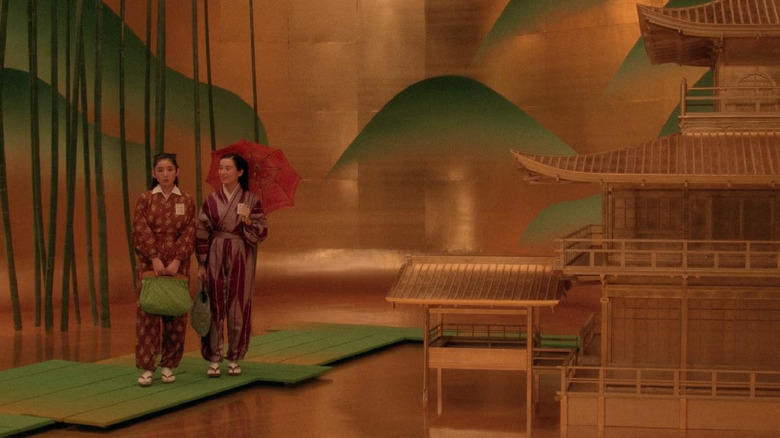
Elsewhere, "Mishima" was widely praised. Roger Ebert famously gave the film four stars, writing that the film "takes this most flamboyant of writers and translates his life into a carefully structured examination of three different Mishimas: public, private, and literary." As the title implies, "Mishima" is broken into four parts: one that is directly biographical and three that stage stylized renditions of Mishima's writings. There is a short based on "The Temple of the Gold Pavilion," a short based on " Kyoko's House," and a short based on "Runaway Horses."
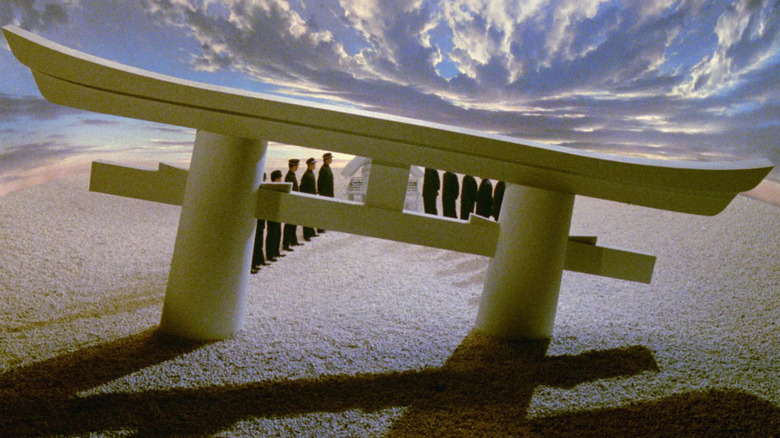
Most of the film is presented in a highly stylized, near-abstract style, with sets bursting with gorgeous, garish colors. Everything is heightened and symbolic, the perfect choice for Mishima's exuberance. Ebert pointed out that Mishima posed for beefcake photos, so there is more than a little theatricality to his life. About the film, Ebert wrote:
"The scenes from the novels were visualized by designer Eiko Ishioka, who seems to have been inspired by fantasy scenes from early Technicolor musicals. They don't summarize Mishima's novels so much as give us an idea about them; as we see the ritualistic aspects of his fantasies, we are seeing Japan through Mishima's eyes, as he wished it to be."
Ebert eventually included "Mishima" in his "Great Movies" series. Paul Schrader, meanwhile, is still giving controversial reviews to this day. He hated "Joker 2."
Variety also wrote a glowing review, admiring Schrader's visuals and his ability to capture the largesse of his subject. "Mishima" won an award at Cannes, but was ignored by the Academy Awards, perhaps because of its controversy. Luckily, the film was kept alive on home video and is now part of the Criterion Collection. It's an astonishing and striking film, and is certainly worth a look.