

The Pitt Proves Why Grey's Anatomy Should've Ended 10 Years Ago
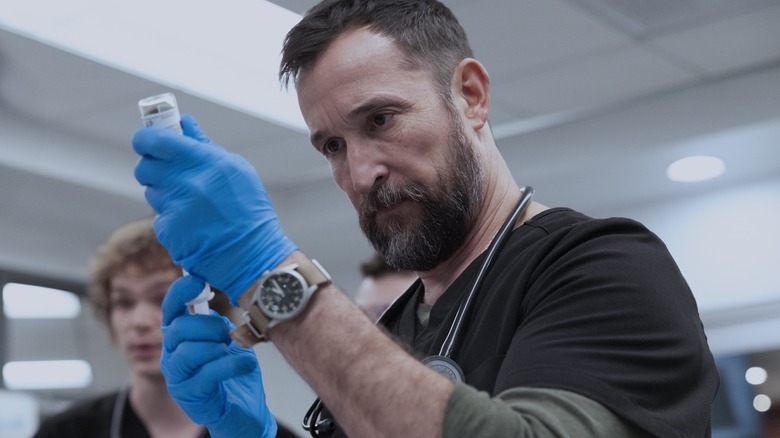
I've been watching "Grey's Anatomy" since it premiered in 2005. For better and definitely for worse, it's the longest relationship of my life to date. Despite the diminishing returns each season has produced over the last several years, I was happy to see so much chatter about "Grey's Anatomy" on my social media timelines recently. Granted, it was for a terribly sad reason — namely, the death of one of the show's stars and emotional touchstones, Eric Dane, who was diagnosed with ALS just 10 months before he passed away. Even under genuinely gutting circumstances, it was strangely comforting to see people reappraising some of the best episodes of Shonda Rhimes' landmark medical show.
Still, I couldn't stop thinking about how ... bad "Grey's Anatomy" has become, especially when we have another medical show making waves on the small screen at present. I am talking, of course, about "The Pitt."
On some level, it's a fool's errand to compare "Grey's Anatomy" to "The Pitt," considering that the former is basically a primetime soap opera set in a hospital and the latter is a gritty, doggedly realistic depiction of real-time shifts in a busy emergency department. They're not really supposed to achieve the same thing in terms of how they tell their respective stories, but at the end of the day, they're both TV medical dramas, so I'm here to compare them anyway. In varying ways, I'm a fan of both shows — again, I really miss the glory days of "Grey's Anatomy" compared to the expository slop they've been giving us since that dreadful COVID-19 season — but there's no question that "The Pitt" is concrete proof that "Grey's Anatomy" should have called "time of death" already.
Grey's Anatomy once felt like a breath of fresh air and outlasted many other medical dramas
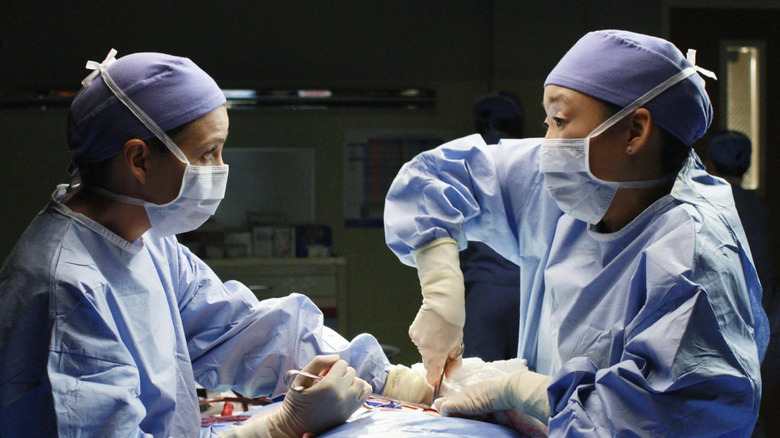
The thing that really sucks about how badly "Grey's Anatomy" sucks now is that it was really good for a long time ... and, like "The Pitt" does now, it felt like a breath of fresh air compared to some of the other medical shows at the time. Sure, people love "House," but that show took itself incredibly seriously, and "ER" is obviously one of the shows that defined the small-screen medical drama, but "Grey's Anatomy" just felt like something entirely new back in 2005. Led by Ellen Pompeo as the titular Dr. Meredith Grey — whose first day and subsequent 48-hour shift as a surgical intern takes place during the show's pilot — "Grey's Anatomy" was snappy, funny, and even sexy. With an original supporting cast that included major talents like Sandra Oh, Katherine Heigl, Chandra Wilson, and Patrick Dempsey, just to name a few, "Grey's Anatomy" combined the traditional "case of the week" structure of its predecessors with enough interpersonal drama to fill the lengthy, very real medical textbook "Gray's Anatomy."
Even as the show passed its tenth season, "Grey's Anatomy" did, admittedly, find new ways to innovate, even if "innovation" on that show sometimes meant "killing its fictional doctors in increasingly stupid ways." I brought up that COVID-19 season earlier as the end of "Grey's Anatomy" as we knew it — which was, for reference, season 17 — but even though the show has largely become a punchline now, it was genuinely gripping television for decades. (Bomb in a body cavity episode, anyone?!) Unfortunately, "The Pitt" makes "Grey's Anatomy" look downright silly now, and it really exposes that the longest-running medical drama in history should probably hang up its stethoscope.
These days, a series like The Pitt shows just how poorly Grey's Anatomy is aging
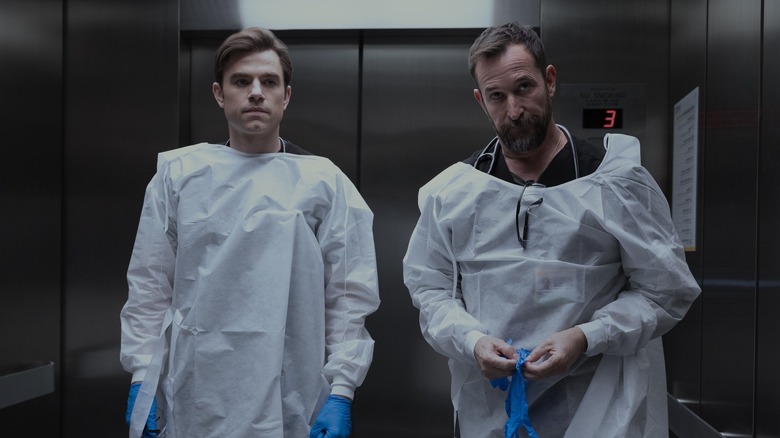
When you lock in for any given episode of "The Pitt," you can certainly expect that the show will unpack some of the interpersonal dynamics between the doctors, but you also know you're gonna see (and hear) some really gross stuff. Throughout the show's first and second seasons, you could see anything from a fully degloved hand or ankle, a guy projectile vomiting after winning a hot-dog eating competition, a full-on childbirth (complete with close-ups), and things of that nature. While there's obviously a difference between network TV standards (like "Grey's Anatomy") and premium network shows ("The Pitt," which airs on HBO Max), the point I'm trying to make is that something as intentional and realistic as "The Pitt" makes "Grey's Anatomy" look unrealistic at best and sort of stupid at worst. (The surgery scenes in "Grey's Anatomy" look like a game of "Operation" compared to the carnage of "The Pitt.")
"Grey's Anatomy" doesn't even have the titular Grey on it anymore — Ellen Pompeo left during season 19, though she still works as an executive producer, provides voiceover, and appears on the show enough that you might have forgotten she departed at all — so it probably should be over due to that alone. The fact of the matter is that a show grounded in our reality, like "The Pitt," where the doctors look appropriately stressed and harried throughout the day, is the natural successor to "Grey's Anatomy," where every doctor is rocking a flowing blowout and a face full of makeup while they dally about in on-call rooms. "Grey's Anatomy" has run its course, and "The Pitt" is here to carry the torch.