

Modern Star Trek Is Obsessed With One Particular Thing, And It's Getting Ridiculous

In the "Star Trek: Starfleet Academy" episode "The Life of the Stars," the character of Sam (Kerrice Brooks), a sentient hologram, needs to return to her home planet of Kasq — a colony of all-holographic beings — for reprogramming. A recent spate of trauma has overwhelmed her artificial brain, and she requires the aid of her holographic creators. She is joined on her journey by the chancellor of Starfleet Academy, Captain Ake (Holly Hunter), and the school's holographic doctor, the Doctor (Robert Picardo).
In order for Captain Ake to interact with a planet of holograms, she, Sam, and the Doctor are beamed into a black-and-white nether-space of some kind. It looks like Starfleet Academy, but cherry blossoms sprinkle from the ceiling. It seems to me that the Kasqians created this holographic space, extrapolated from the Doctor's memories, as a sort of psychic dreamscape where everyone could interact.
Two episodes earlier, the Betazoid Tarima (Zoë Steiner) was in an intimate situation with Caleb (Sandro Rosta), and she used her psychic powers to create an interactive dreamscape, also extrapolated from his memories. They saw a psychic field of whispering grasses.
Indeed, looking back over all the "Star Trek" that has been released since the franchise's streaming launch in 2017, the trope of the interactive dreamscape has been frustratingly common. There are many, many scenes of characters falling into comas or projecting their consciousness into a computer, and solving an element of the episode's drama in the dream world. It's a limp storytelling cliché, and it's all over the franchise now. And while older "Star Trek" episodes did this as well ("Shades of Gray," "Phantasms," "Distant Voices," "The Thaw," etc.) it's become common enough in the streaming era to be a matter of concern.
Why is Star Trek obsessed with psychic dreamscapes?
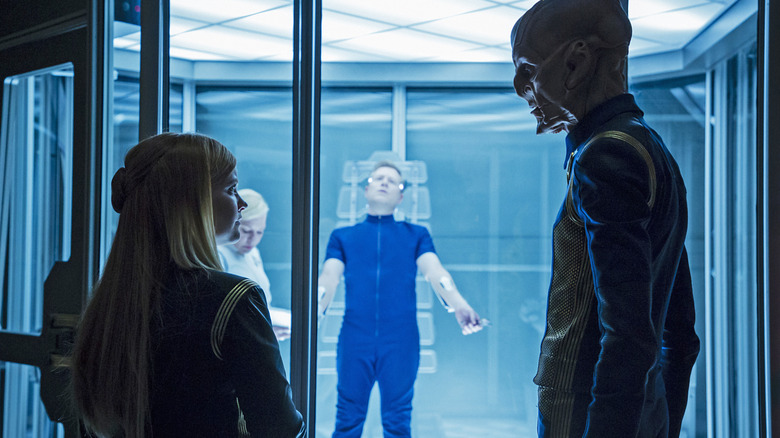
Looking back over the recent years of "Star Trek," one can see psychic dreamscapes everywhere. In the 2018 "Star Trek: Discovery" episode "Vaulting Ambition," Lieutenant Stamets (Anthony Rapp) found his consciousness projected into an interdimensional, galaxy-wide cloud of spores called the mycelial network. The network was envisioned as a psychic dreamscape where Stamets could interact with his mirror self.
Later, in the 2019 episode "Saints of Imperfection," the crew of the Discovery even finds that the deceased Dr. Culber (Wilson Cruz) remained alive inside the mycelial network, a pure dreamlike consciousness. They contrive the means to resurrect him. To clarify, the mycelial network isn't so much a parallel dimension as it is a psychic realm where consciousnesses move around in a disembodied fashion, seeing psychic projections based on their experiences and memories.
Dreamscapes like this are a problem for two reasons. For one, there is something inherently non-dramatic about the conceit. A character may be fighting monsters in their minds, but back in the real world, we're just watching someone lying on a gurney having a nightmare. That's not terribly exciting.
Secondly, it's unbearably contrived. Rather than have a character defeat their trauma in the real world, teleplay writers simply have them face their trauma literally, fighting a visual manifestation of their own fears. That can only work in very limited circumstances, but in newer "Trek" episodes, it's everywhere. See the 2020 "Discovery" episode "Forget Me Not," wherein Michael Burnham (Sonequa Martin-Green) travels into a psychic Trill dreamscape to converse with Adira (Blu del Barrio) and their lover Gray (Ian Alexander). The dreamscape sequence plays out like a TV commercial for perfume rather than a proper drama.
On the whole, "Discovery" never quite worked.
More examples of dreamscapes in new Star Trek
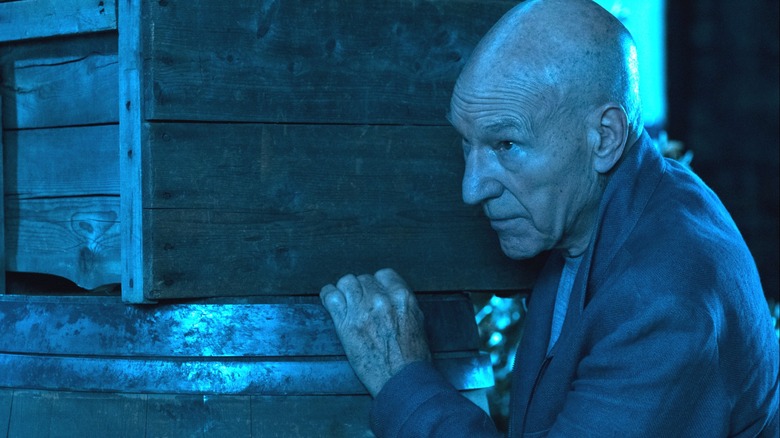
The most insufferable example of a modern "Star Trek" dreamscape is in the "Star Trek: Picard" episode "Hide and Seek," from the show's second season. In that episode, Admiral Picard (Patrick Stewart), having been hit by a car, falls into a coma and has visions of his dead mother (Madeline Wise) and dead father (James Callis). He relives a hide-and-seek game from his childhood, which, he now realizes, was when he acknowledged that his mother was suffering from extreme depression. The dreamscape sequence is intercut with peril in the waking world, as the episode's villain fights the show's cast of violent heroes.
Not only is the sequence insufferable, but it introduces new trauma that Trekkies never knew Picard had. "Hide and Seek" invented a new trauma for a legacy character, and then used a contrived dreamscape to solve it, all in the course of one episode. It's pretty bad.
"Picard" went back to the dreamscape conceit in the episode "Dominion." In that episode, Data and Lore (both played by Brent Spiner) are fighting for psychic control over the same android body. They are seen in a white, heaven-like dreamspace having a face-to-face conversation about their personalities, while Lore "deletes" memories from Data's brain. Data will ultimately gain control of the android body, but to make the conflict visibly dramatic, the show's writers thought the two needed to talk in person. Why this couldn't be done via a singular Spiner performance in the waking world remains a mystery.
There are additional examples besides, but the ones listed here are proof enough that new "Star Trek" has succumbed to a trend. And it's a trend, I think, that needs to end.