

George Lucas Helped Make One Of The Best Samurai Movies Of All Time
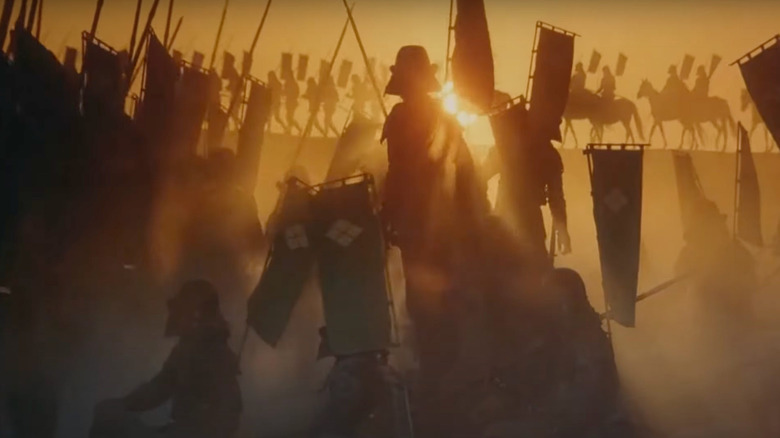
Akira Kurosawa was one of the most celebrated filmmakers in the world when, in the mid-1960s, he decided to leave his native Japan for Hollywood. The master responsible for such classics as "Seven Samurai," "Ikiru," and "Yojimbo" had resisted the allure of working on a big-budget studio movie for years, but with the Japanese film industry experiencing financial difficulties, he finally gave in. The experience wrecked him, and played a large role in driving him to attempt suicide in 1971.
Kurosawa originally intended to make the action film "Runaway Train" (in 70mm!) for Embassy Pictures. Unfortunately, the Japanese director had difficulty communicating with his English-speaking collaborators, and the picture was ultimately scrapped (though Russian filmmaker Andrei Konchalovsky would bring Kurosawa's idea to full-throttle, frostbitten life in 1985 with stars Jon Voight and Eric Roberts).
Kurosawa then moved on to the ambitious "Tora! Tora! Tora!," an epic World War II film for 20th Century Fox that was to depict the assault on Pearl Harbor from both American and Japanese perspectives. Kurosawa would've handled the latter half of the narrative, while skilled studio veteran Richard Fleischer would tackle the American portion. The struggling studio had $25 million riding on "Tora! Tora! Tora!," and Fox president Darryl F. Zanuck had zero interest in humoring Kurosawa's sui generis creative process. The studio muscled the maestro and sent him to a doctor who diagnosed him with neurasthenia (a now-dated medical term for weakness of the nerves). This led to his dismissal.
Back in Japan, Kurosawa's creative peers sought to reignite their friend's creative zeal by financing his drama "Dodes'ka-den," but the film fell short of critical and commercial expectations, which drove Kurosawa into a suicidal spiral. He survived, but he feared his filmmaking career was over.
George Lucas saved Akira Kurosawa's life by forcing 20th Century Fox to co-finance Kagemusha
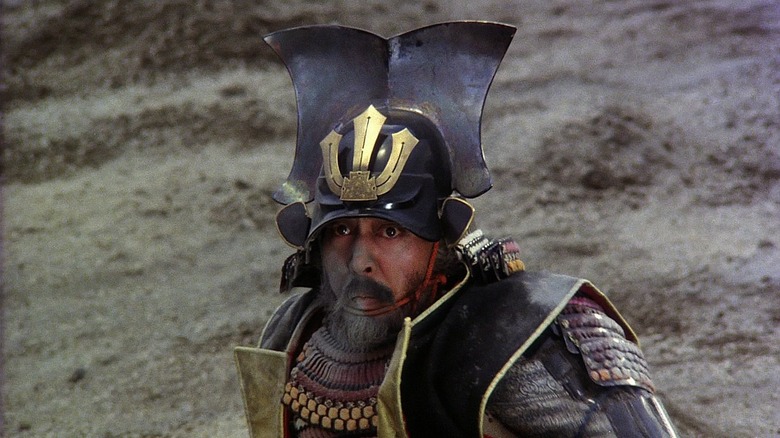
In the late 1970s, George Lucas, who worshipped Kurosawa's work (the Japanese director's "The Hidden Fortress was a huge influence on "Star Wars"), used his newfound studio leverage to secure 20th Century Fox co-financing for the filmmaker's epic "Kagemusha." He saved his hero's career, and, quite possibly, his life.
Released in 1980, "Kagemusha" is the three-hour Japanese historical epic that returned Kurosawa to international prominence. Set around the 1575 Battle of Nagashino, the film is basically a tragic version of Ivan Reitman's "Dave." When beloved daimyō Takeda Shingen (Tatsuya Nakadai) is assassinated, a lowly regarded thief who's served as his double takes control of Takeda's clan, thus preserving his reign. It's a movie in which a rogue finds purpose and (spoiler) selflessly gives his life. The massive battles presage the majestic clashes in Kurosawa's 1985 masterpiece "Ran." It was a stirring return to form from a director who'd lost faith, to a nearly fatal degree, in his art after a rough go in Hollywood.
"Kagemusha" tied Bob Fosse's equally brilliant "All That Jazz" for the Palme d'Or at the 1979 Cannes Film Festival, and earned two Academy Award nominations. The support of Lucas and Francis Ford Coppola behind the scenes was vital, but the movie was too good to deny. Great? I can't quite go there. It's Kurosawa's "Jurassic Park." He's punching his way back into form, but the great work, "Ran," is the destination. Lucas and Coppola were able to get him back in the gym, and he exploded with an all-time epic in "Ran." "Kagemusha" is an essential Kurosawa movie. It's a bridge to a masterpiece. And "Ran" would've never happened without Lucas and Coppola.