

Robert Duvall Starred In The Sci-Fi Movie That Launched George Lucas' Career
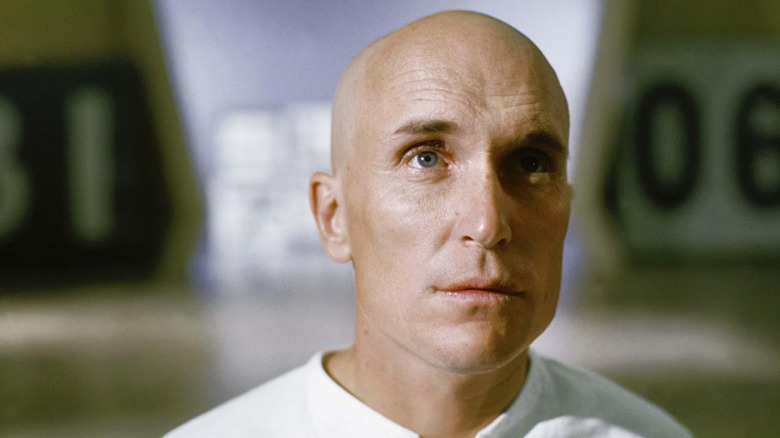
If you're a cinephile, you've almost certainly heard of "THX 1138." Perhaps you recognize it as an often referenced and quoted term, turning up in everything from "American Graffiti" to various "Star Wars" films and shows, not to mention the cinema tech company. Of course, this is all because "THX 1138" was George Lucas' debut feature, released by Warner Bros. in 1971. If you're a "Star Wars" fan who hasn't seen "THX," however, that's not a huge surprise. Despite both films being science-fiction parables, "THX 1138" doesn't have the same winningly broad appeal as Lucas' 1977 cultural juggernaut does. That's by design, though, because Lucas in the early 1970s was a young counterculture filmmaker, joining forces with friend Francis Ford Coppola at the latter's ill-fated American Zoetrope company to produce challenging, American-made art films. "THX 1138" was the second major movie to be made by American Zoetrope, following Coppola's somber contemporary drama "The Rain People" from 1969, which Lucas was an assistant on.
The co-star of "The Rain People" was an up-and-coming actor named Robert Duvall, who had impressed audiences and Hollywood with his portrayal of Boo Radley in 1962's "To Kill a Mockingbird." When it came time for Lucas to find an actor to play the title character in "THX," he turned to his and Coppola's colleague Duvall. It's possible that Lucas did this primarily for aesthetic reasons, as the film is set in a dystopian, dehumanizing future society in which everyone's head is shaved bald, even women, and Duvall already had a receding hairline at the time. Yet the choice of Duvall for THX turned out to be a canny and ingenious one, as the actor's blue collar grit and intensity provides the perfect contrast for Lucas' strange, abrasive brave new world.
Robert Duvall is perfect as a man who doesn't belong in THX 1138
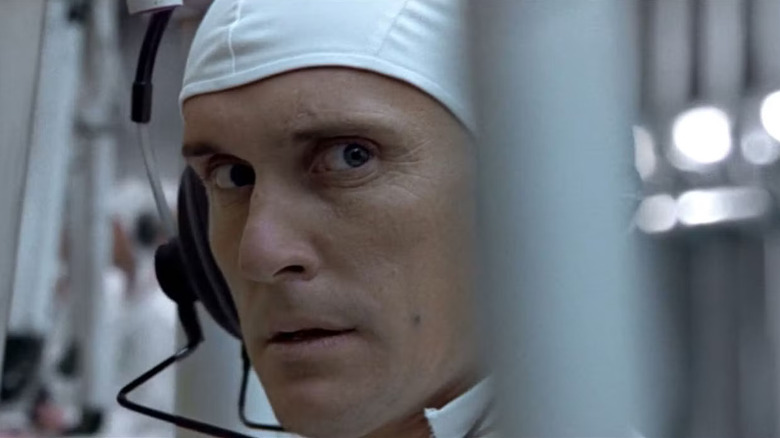
If you thought "Star Wars" began challengingly by throwing the audience into the deep end of its galaxy, George Lucas surprisingly went even harder on that front with "THX 1138." Not only is there no helpful opening crawl to partially explain things, the dialogue itself is a mishmash made up of the actors' (some of whom were real-life poets) improv, scripted futuristic terms, and excerpts from the speeches of Richard Nixon. Every choice made by Lucas and his collaborators in the film is designed to be oppressive and unsettling, from the uniform bald heads and white uniforms (with extras hired from a nearby cult!) to the score by Lalo Schifrin being bits of classical music played backwards and electronically distorted.
The general plot of "THX 1138" involves Duvall's character, THX, going off his mandatory drug regimen and falling in love with a fellow worker, LUH 3417 (Maggie McOmie). Then, after the authorities discover this violation and chuck THX in prison, THX's entire goal becomes to simply escape from this hellish existence. Given all this, Duvall was the perfect actor to play the role. He wears a look of bewilderment and unease half the time, and the other half he's channeling his discontentment into grim determination. Duvall's performance is understated and subtle, but always appropriate, the actor understanding that he needn't do too much to make an impact in such strange context.
Although "THX 1138" flopped upon its initial release, it helped launch Lucas' career, and Duvall only continued to rise with the release of "The Godfather" the year after. While the recently departed Duvall and Lucas never worked together again, it's hard to imagine another collaboration being as unique or special.