

Steven Spielberg Wanted To Include A Musical Number In His Dark Sci-Fi Classic
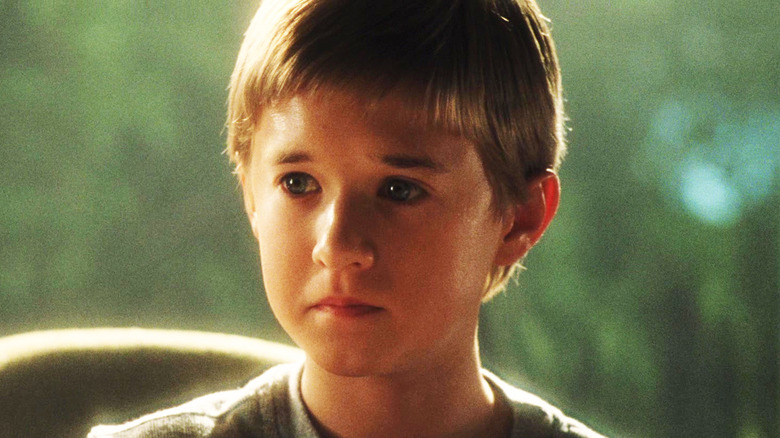
Steven Spielberg harbored ambitions to make a musical long before he directed his vibrant take on the classic musical "West Side Story." So strong was his love for the form that he tried to shoehorn a song and dance number into "A.I. Artificial Intelligence," but ultimately had to cut it due to time and budget constraints. That was probably for the best seeing as "A.I. Artificial Intelligence" proved divisive even without a musical interlude.
Since he was a child, Spielberg was fascinated by musicals. From Leonard Bernstein to Stephen Sondheim, the future filmmaker was enraptured by the legends of musical theater. Once he became established himself in Hollywood, however, it took some time for him to oversee a musical of his own. Still, he always maintained a desire to do so. As he told the BBC, "I think I wanted to direct a musical film because I knew I couldn't sing and dance. It's a tremendous way of sort of throwing myself into a genre that physically I would never be part of."
But Spielberg didn't exactly throw himself into it. Rather, he circled the idea for decades before finally jumping in with 2021's "West Side Story." The second major film adaptation of Bernstein, Sondheim, and Arthur Laurents' 1957 musical, Spielberg's movie followed the beloved 1961 film of the same name and finally allowed him to realize a childhood dream. In truth, the director had dallied with the idea of injecting some musical theater magic into one of his earlier films. Unfortunately, his musical number had to be abandoned.
Steven Spielberg took over A.I. Artificial Intelligence from Stanley Kubrick
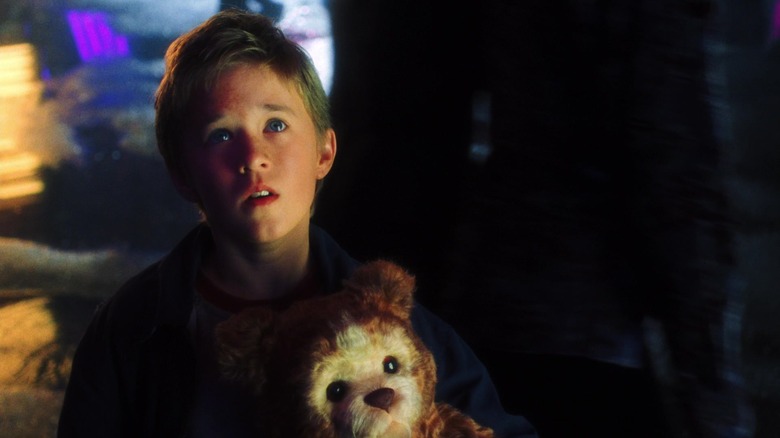
In the mid-'90s Stanley Kubrick finally gave up on directing his long-gestating adaptation of Brian Aldiss' story "Supertoys Last All Summer Long." He'd been attached to the project since 1973 but had procrastinated in the most Kubrick-ian ways possible. Aside from simply becoming sidetracked by the myriad other projects he was developing, Kubrick used a less-than-honest contract trick to free up his schedule for "The Shining." That essentially meant Aldiss' story went unadapted for decades.
When he finally gave up on the project however, Kubrick didn't let it go entirely. Instead, he handed it to his longtime friend Steven Spielberg. The pair first met in 1980 at Elstree Studios, where both "Raiders of the Lost Ark" and "The Shining" were filmed. 14 years later, Kubrick asked his friend to take over the "Supertoys" adaptation, saying, "I think this movie is closer to your sensibility than mine." When he said that, however, he hardly could have known that Spielberg's sensibility involved a fondness for musical theater that would see him try to shoehorn a song and dance number into a sci-fi drama.
When Spielberg took over from Kubrick on what later became "A.I. Artificial Intelligence," he saw an opportunity. The film is set in a dismal 22nd Century where humanity has created androids, or "mechas," to carry out the roles left vacant by a dwindling population. David (Haley Joel Osment) is a prototype mecha with the ability to feel love. At first, David finds a home with a family but is cast out into the world and goes on a "Pinocchio"-inspired pilgrimage to find the blue fairy who he believes can finally make him a real boy. This is where Spielberg's musical ambitions came in.
Steven Spielberg planned then cut an elaborate musical number for A.I. Artificial Intelligence
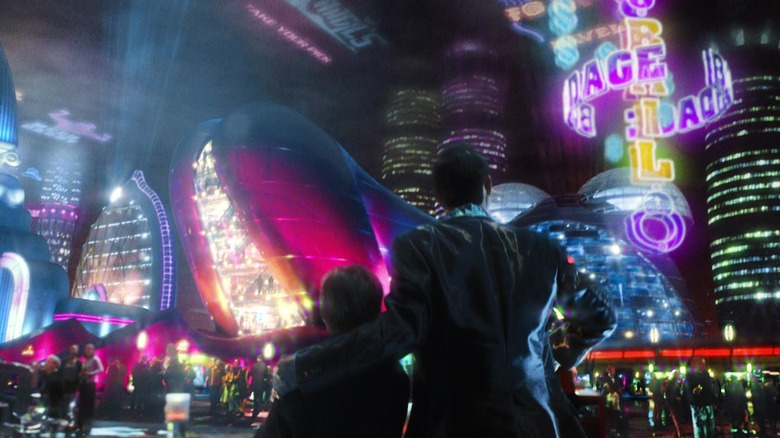
Steven Spielberg had many grand plans for his 2001 sci-fi effort. Heck, at one point "A.I. Artificial Intelligence" almost starred an actual robot before that idea was scrapped. As was the big musical number, which would have occurred when David and his fellow forsaken mecha, Gigolo Joe (Jude Law), arrive in the meretricious hub of Rouge City. It's here that Steven Spielberg originally planned an elaborate musical number.
In an interview with The Ringer, co-founder of Legacy Effects and dedicated mecha maestro on "A.I.," J. Alan Scott, talked about multiple scenes that had to be dropped from the final production. One of these, it seems, was set to take place on the Rouge City set that had been built on Warner Bros. soundstages. According to the outlet, Spielberg planned a "full musical number" for David and Gigolo Joe's arrival in the city, with producer Bonnie Curtis saying, "Steven is always trying to figure out how to do a musical number."
So set on this idea was the director that VFX artist Dennis Muren developed a system that created a basic visualization of Rouge City that could be overlaid on Spielberg's monitor as the actors performed their choreography. None of this came to fruition, however, as Spielberg was also producing the film, and as such was acutely aware of cost. That led him to cut several of the more ostentatious scenes including his big homage to musical theater. Given the film was already criticized for its unusual mix of tones, i.e. the Kubrickian coldness and Spielbergian warmth, a song and dance number mid-way through a story about a dispossessed android searching for acceptance probably would have only made things worse.