

Guillermo Del Toro Gave Half His Hellboy Salary Back To The Studio For A Great Reason
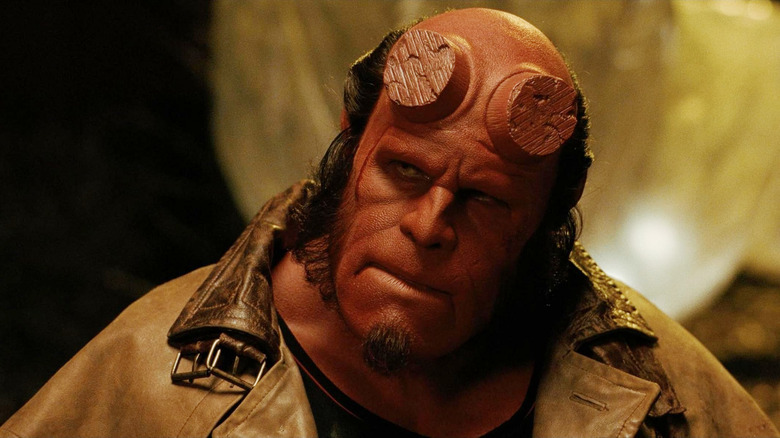
You don't get Guillermo del Toro's career by being a bootlicker. Quite the contrary, the Oscar-winning filmmaker has always bet on himself, whether he's making movies about humans being horny for fish-men or facing off with real-life monster Harvey Weinstein (prompting his buddy James Cameron to nearly fight the disgraced mogul in his honor). In doing so, del Toro has also remained true to the themes of disobedience and anti-authoritarianism that have long defined his artistry, further cementing his reputation as one of our most esteemed modern semi-cult figures.
He's even put his money where his mouth is in a more literal sense. Weinstein's Miramax, you see, was the production company behind 1997's "Mimic," itself the sci-fi horror creature feature that served as both del Toro's English language directing debut and first time calling the shots on a major studio picture. But while he described his experience making the film as "horrible, horrible, horrible" in a 2018 interview with The Independent, he admitted elsewhere that it taught him a valuable lesson despite Weinstein's constant interference and bullying behind the scenes.
Addressing The Guardian's Mark Kermode in 2006, del Toro recounted how the money people on "Mimic" turned him down when he wanted a specific shot for the film, "so I said, 'I'll make you a bet: I'll put my salary on that shot, and if it ends up in the [final] cut, you pay me back.'" Sure enough, del Toro got his money back. Spurred on, he then bet "half" his salary on 2002's "Blade II" that the final edit of the movie would use his preferred vampire designs and won again. But alas, the third time wasn't the charm when he made the same gamble on an unidentified aspect of his comic book flick "Hellboy."
Hellboy didn't stop Guillermo del Toro from betting on himself
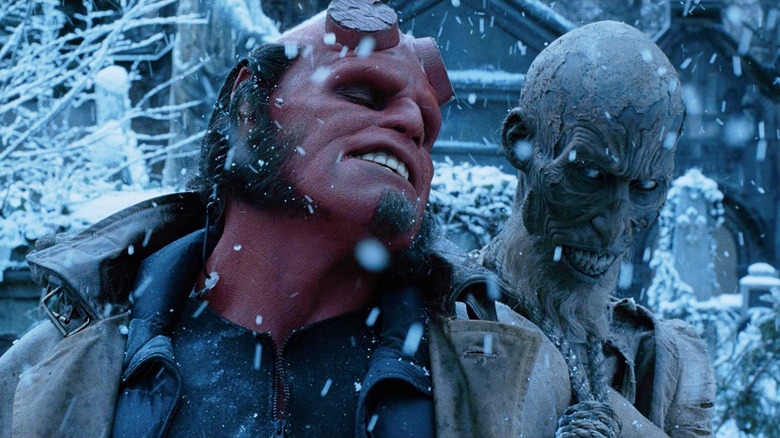
It feels strange to call 2004's "Hellboy" a compromised movie. While it's relatively faithful to Mike Mignola's source material visually (partly because there's some overlap between Mignola's "Hellboy" comic books and the heavily shadowed, minimalistic Gothic aesthetic of del Toro's lower-budgeted affairs from this era), it's very much its director's creation with respect to its creature designs, human-monster romances, and complicated father-son relationships.
Compared to later del Toro projects, though, Ron Perlman's initial outing as Hellboy just doesn't feel as weird and gross. But while he may've lost whatever skirmish cost him half his salary, del Toro did win other fights during the film's development, including the battle to cast Perlman to begin with. More than that, it solidified his commitment to earning less to avoid sacrificing his creative vision.
So it was when he returned in 2006 with "Pan's Labyrinth." As he explained in that Guardian piece, he yet again gave up a chunk of his salary to maintain artistic control on the film. "We didn't make a contract seeking points in case the movie grossed so much. None of that bulls***. Just take my salary, on my word. And [the movie's backers] took it," he noted. The outcome? "Pan's Labyrinth" proved to be a stunning political fantasy allegory that also doubles as a great lesson in filmmaking.
Nothing's changed since then. Speaking with Bright Wall/Dark Room in 2017, del Toro revealed that he similarly wound up "deferring" parts of his salary on his wildly expensive giant mecca tentpole "Pacific Rim," his Gothic horror-romance drama "Crimson Peak," and even his Best Picture Oscar-winning, politically radical, fish-man banging "The Shape of Water." He might not be a "rich man" (his words to The Guardian), but he's something way better.