

Guillermo Del Toro's Pan's Labyrinth Taught Me One Filmmaking Lesson That No Other Movie Did
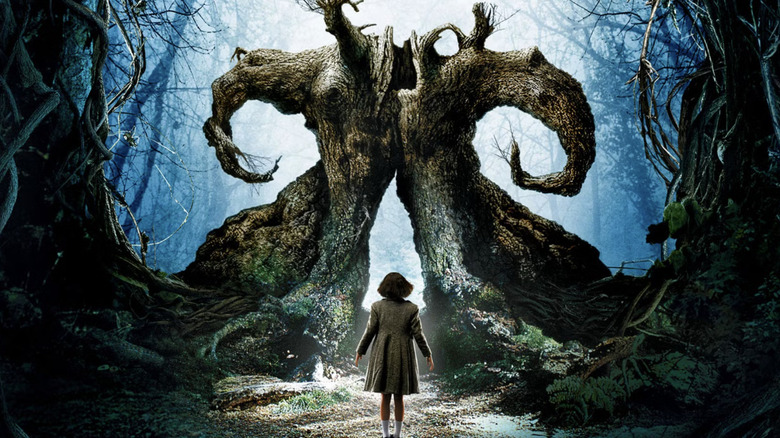
Film critics and enthusiasts have observed a tendency to think of film as a plot-driven medium, where the words matter more than the camera choices. This is even though the word "movie" derives from "moving images." (One reason for this might be because streaming and cell phones mean people often glance away from movies that they're watching, and so don't even try to decipher visual language — but that's a discussion for another time.)
I definitely used to think this way when I was a teenage cinephile. It took me embarrassingly long to realize that in film, the director expresses themselves in every detail of the visuals. The frame isn't the stage where the story unfolds, it is the story. Saying, for instance, the colors of a movie are of lesser importance is about as ignorant as saying the colors in a painting are arbitrary. The movie that unlocked my mind to receive that lesson was Guillermo del Toro's "Pan's Labyrinth," which to this day I and many others would call his masterpiece.
I first watched the film in 2017, when I was about 17 and had recently realized the annals of film had much greater treasures than just superheroes. If I were to count my top 10 favorite films, there would be a spot reserved for "Pan's Labyrinth." The movie has a high-contrast color palette, but individual scenes tend to take a single one of those colors. Shots in "Pan's Labyrinth" can be a dreary, rainy blue, a bright gold, or a shadowed green, but rarely more than one.
The most obvious underpinning of this contrast is that nighttime scenes are dark blue and daytime scenes are bright yellow, of course. But "Pan's Labyrinth" is also a magical realism film, and its colors divide those two moods.
Color is storytelling in Pan's Labyrinth
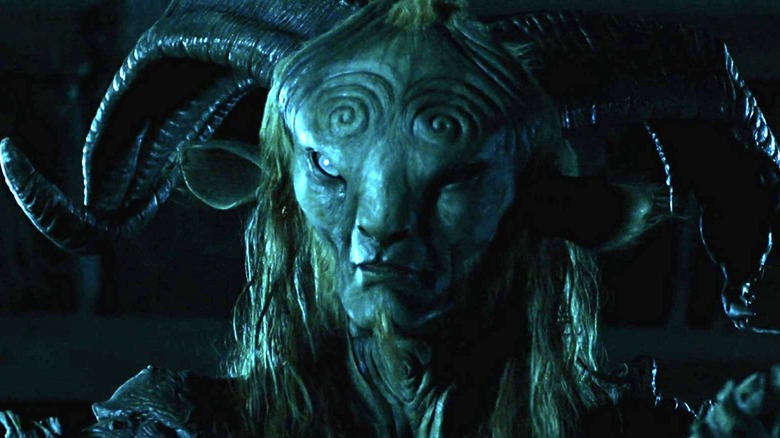
Set in 1944 Spain, "Pan's Labyrinth" follows young dreamer Ofelia (Ivana Baquero). She's the stepdaughter of uptight but vicious Captain Vidal (Sergí Lopez), who is hunting republican rebels hiding in the nearby forest. The film alternates between adult characters, who are starring in a brutal war drama, and Ofelia, who prefers to keep her nose down in storybooks. She's also drawn to a nearby labyrinth, where a Faun (Doug Jones) offers Ofelia a chance to escape her painful world forever.
These two interlinked stories must also stand apart; Ofelia is chasing a magical world (or imagining it) so she doesn't have to live in the real one. Generally, the fantasy scenes or ones centered on Ofelia in "Pan's Labyrinth" are colored in bright gold, while the most violent scenes in Vidal's reality are blue. Guillermo del Toro and his cinematographer Guillermo Navarro juxtapose melancholy to fantasy, all with shifts in color.
When Ofelia is first introduced, reading a storybook during a car ride, the scene is colored gold. There's no magic just yet, but this already codes Ofelia as living in a fairy tale (like the girl in the "Pan's Labyrinth"-inspired music video, Paramore's "Brick by Boring Brick"), or as if innocence shines off her.
There are hard switches of color between cuts, like a lovely dream abruptly ended. In Ofelia's first Faun-given task, she crawls through a tree to slay an unwelcome toad. Even if it's cramped and muddy, the scene is still bright gold. But when Ofelia exits the tree, the film has returned to blue. It conveys a time passage (night has arrived), but also a switch to reality; Ofelia's adventure has ended, and she's left to face the fact that she's cold, dirty, and stuck out in the rain.
The full color spectrum of Pan's Labyrinth
The most blatant and tragic shifts from gold to blue come at the end of "Pan's Labyrinth," via Ofelia's contrasting fates. In the real world, she lies bloody and dying, shot by Vidal. But then the screen explodes in bright light, and as the Faun promised, she's reborn as Princess Moanna in the golden underworld. Then, another flash, and the gold hue is driven out by the return to Ofelia's death.
Blue and gold are not the only colors that the movie employs, though. Nighttime scenes set within the labyrinth, or when the Faun is onscreen, take on a green tint. This complements the moss on the labyrinth's ancient walls, as well as the vegetation growing on the Faun's woodlike skin texture, all suggesting the magic is of the Earth. The turquoise coloring can almost pass for blue, so why is the Faun (a definite magical character) colored more like the "adult world" segments? Perhaps because it's more ominous that way. The Faun is creepy and foreboding, enough to make us suspect he might be misleading Ofelia; the magical world can be as off-putting as Vidal.
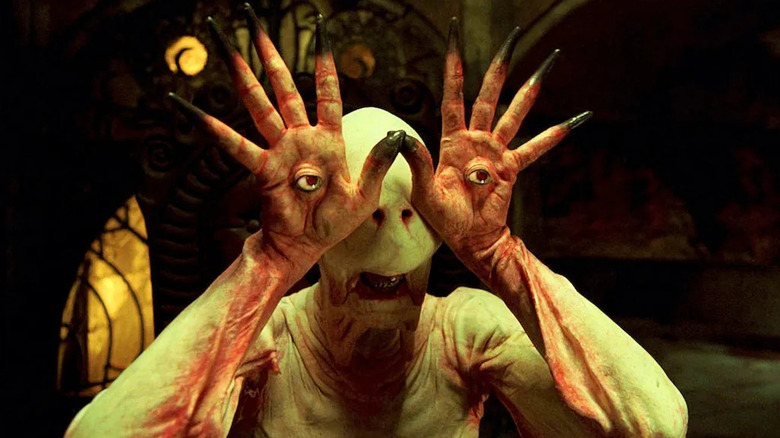
Ofelia gets a truer taste of fantastical danger when her second task brings her into the domain of the child-eating Pale Man (Doug Jones). The scene has the golden tones of the other fantasy scenes, but note the feast before the Pale Man's table: red wine, red berries, red meat, etc. Though bathed in yellow, the food coloring suggests blood and violence.
True to its setting, "Pan's Labyrinth" is a Spanish-language film. I still need subtitles to understand its dialogue, but it also taught me to read the more universal language of images and color with which filmmakers like Guillermo del Toro speak.