

Pluribus Star Rhea Seehorn's Debut Was On One Of TV's First Prestige Crime Shows

Rhea Seehorn is superb as Carol Sturka in Vince Gilligan's sci-fi series "Pluribus," the actor's second collaboration with the "Breaking Bad" creator. The first was "Better Call Saul," where Seehorn played Kim Wexler in a highly memorable turn. While Seehorn might be best known for these dual television roles, she began her career by starring in a 1997 tutorial video for a "Magic: The Gathering" game, which is essentially a collectible/tabletop card game with a magic system and battle mechanics. In the same year, Seehorn bagged a crucial episodic cameo in "Homicide: Life on the Street," the acclaimed police drama that was airing its sixth season in 1997. While this wasn't quite the breakthrough she needed, it helped.
To understand the legacy of this seven-season NBC show, we need to look at the police dramas that were being made during that time-frame. When "Homicide: Life on the Street" premiered in 1993, it rejected the cookie-cutter expectations that came with being a police procedural and didn't always present the fictional Baltimore Police Department in a positive light. Every cop in the Homicide Department is a flawed individual who gets involved in grounded criminal cases, as the series is based on David Simon's non-fiction book, "Homicide: A Year on the Killing Streets." In fact, Simon had approached Baltimore native Barry Levinson ("Rain Man") to turn his book into a film, but the "Diner" director thought it was better suited to a multi-season TV format. And he was right.
This didn't mean that the merits of "Homicide: Life on the Street" were immediately recognized. Ratings for the show were abysmally low during the initial seasons, and NBC struggled to understand its appeal. In hindsight, it is great television, and certainly deserves more appreciation than it currently enjoys.
Rhea Seehorn's Homicide: Life on the Street episode is a banger
David Simon is more popularly known for creating "The Wire," but Simon's experience with "Homicide" convinced him that TV was ready for "The Wire." It's also not far-fetched to state that fan-favorite cop dramas like "Brooklyn Nine-Nine" wouldn't exist without the 1993 NBC show paving the way. The connection between "Brooklyn Nine-Nine" and "Homicide" feels special due to Andre Braugher, who was a memorable, beloved aspect of both shows. In "Homicide," Braugher played Detective Frank Pembleton, the brilliant, egotistical detective who hides an inner fragility that is subtly fleshed out over the course of six seasons.
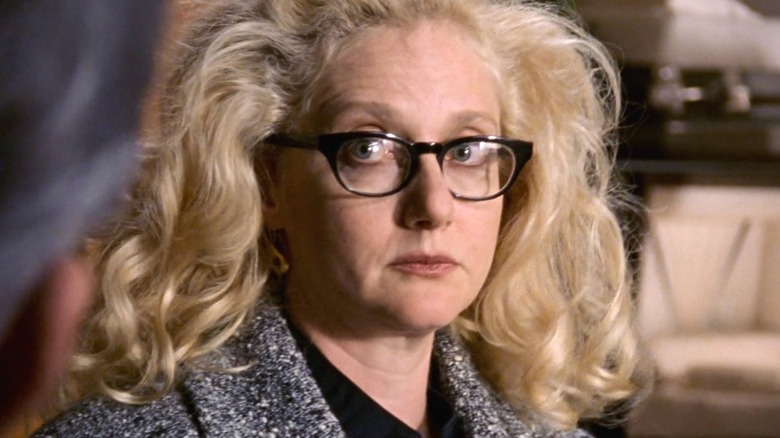
In the show's Seehorn episode, titled "All is Bright," detectives Laura Ballard (Callie Thorne) and Stuart Gharty (Peter Gerety) investigate a laundromat murder. During the investigation, they interview the victim's girlfriend, who provides a startling testimony. I won't be spoiling the twist reveal towards the end, but "All Is Bright" features Seehorn as Jenny in two brief scenes, and moves on pretty quickly with its holistic approach to the case-of-the-week format. It's a heartrending entry directed by none other than Matt Reeves (!), and also features a moving performance by Kathryn Erbe, who plays Rita Hale. While the Jenny-centered scenes aren't meaty enough for us to glean much about Seehorn's early-career performances, it's a great episode nonetheless, highlighting the show's ability to explore heavier themes with nuance.
While it's completely viable to only check out this particular season six episode, "Homicide" immediately hooks you with its Levinson-directed pilot, which effectively injected tense claustrophobia into the procedural format at the time. The first season alone boasts several classic entries, but it only gets better with each subsequent season. Now, that's what we call true prestige television.