

Orson Welles' Underseen Western From The '60s Will Change How You See The Actor
We may receive a commission on purchases made from links.
The career of Orson Welles is varied and fascinating. Many people likely know about Welles' rise to fame as a cinematic wunderkind with the release of "Citizen Kane" in 1941, while others will be happy to tell you about his directorial successes with movies like "The Stranger" and "The Lady from Shanghai." Film trivia buffs will also be able to bend your ear about the troubles Welles had working on "The Magnificent Ambersons" and its notorious re-edits. Ditto 1958's "Touch of Evil," a Steven Spielberg favorite that was re-cut against Welles' wishes. Luckily, he wrote an extensive memo about the changes he would've made to "Touch of Evil," and editor Walter Murch reassembled the movie as best he could according to Welles' notes in 1998. Some of us remember when that happened, and it was reviewed by Salon at the time.
Welles' later years were beset by struggles. He didn't just butt heads with studios; he seemingly had to wrestle with his own career and legacy. He spent a long time in Europe, away from the Hollywood mainstream. His version of "Dox Quixote" was notoriously never completed, and that's just one of the numerous film projects that Welles never actually finished. He made ends meet by acting in various films, and throughout the late 1960s, he appeared in a good number of European genre movies, along with film adaptations of classic novels and seemingly whatever else he could find.
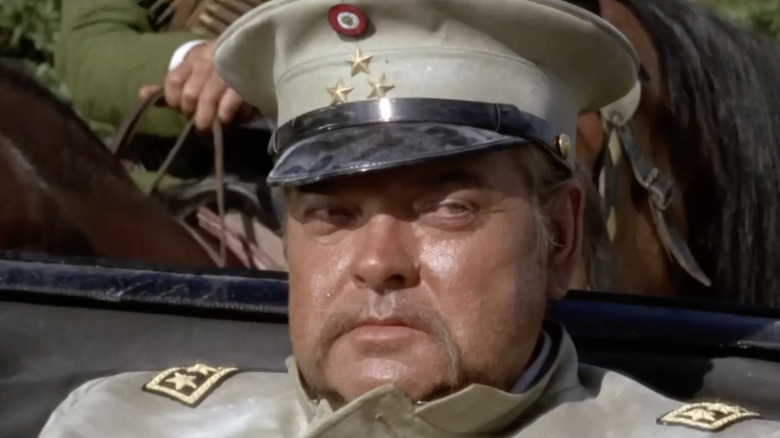
Director Giulio Petroni's 1969 Western movie "Tepepa," aka "Tepepa ... Viva La Revolución" in Spain, aka "Blood and Guns," was one such paycheck for Welles. In it, he played Colonel Cascorro, a wicked antagonist, opposite the charismatic revolutionary Jesus Maria "Tepepa" Moran, played by Cuban-born actor Tomas Milian. Not only that, but Welles is also weirdly terrifying in his role.
Orson Welles played the villain in the 1969 Western film Tepepa
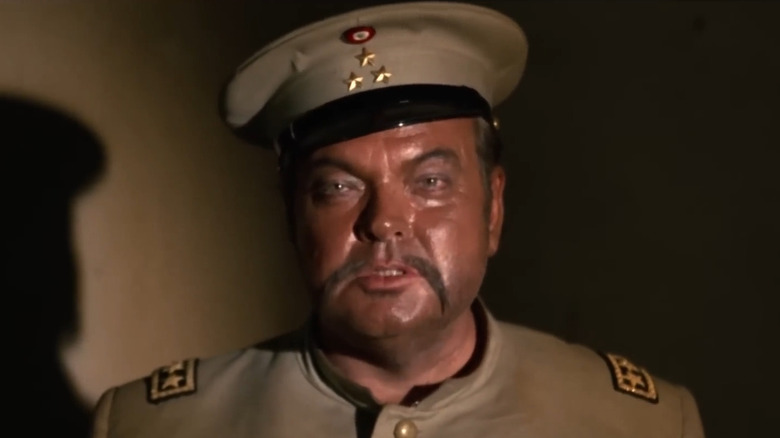
"Tepepa" belongs to a Spaghetti Westerns sub-genre that could be referred to as "Zapata Westerns." These are Westerns about brave Mexican heroes who fight imperialism — usually in the form of evil or wealthy people from the U.S. but also freelance fascists — on the American frontier. The subgenre isn't enormous, but "Tepepa" falls squarely within its walls. The imperialist in "Tepepa" was played by Orson Welles, who depicted his character as sweaty, cruel, racist, and happy to gun down Mexican victims. During an early scene, for example, he's shown remarking that the locals make good target practice.
Later in the film, a eugenicist doctor (John Steiner) claims that all criminals tend to have certain facial features ... and skin colors. Welles' character, Colonel Cascorro, notes, essentially, that racial profiling will only make his job that much easier. Good golly, is he ever a slimeball. Welles appears intoxicated throughout his performance, which might have been genuine; the artist was well-known for his ... interest in booze (as detailed in author Frank Brady's book "Citizen Welles: A Biography of Orson Welles"). Readers might also be familiar with the notorious TV commercial outtakes for Paul Masson champagne, in which Welles is quite clearly intoxicated. If Welles was sober on set, however, behaving like he was perpetually intoxicated was a great character choice for Colonel Cascorro. It made the character seem just that much more terrifying.
That said, "Tepepa" isn't terribly well-known in the U.S. outside of Spaghetti Western enthusiasts. It was directed by Giulio Petroni (who also helmed the Lee Van Cleef classic "Death Rides a Horse"), and its music was provided by Ennio Morricone. That should come as no surprise, either; Morricone wrote the scores for 23 films in 1969 alone.
Orson Welles was difficult to work with on the set of Tepepa
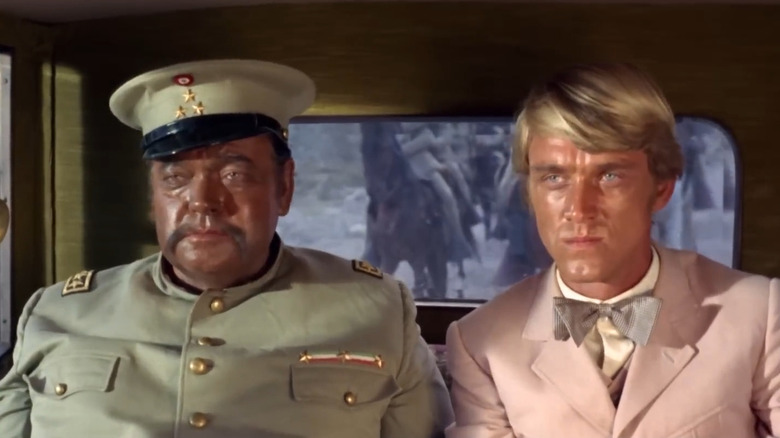
In a 2007 article for the Italian paper La Repubblica (originally printed in Italian), actor Tomas Milian was said to have been disappointed after working with Orson Welles. It seems that Milian, like many actors and filmmakers, idolized Welles and was honored to be collaborating with him. But it appears that Welles was rude on set and even referred to Milian as being a "dirty Cuban." There is also a brief anecdote in that same article about how Milian asked where he should be standing in a certain shot, and Welles said that anywhere was fine, just so long as he couldn't see Milian's face. This was clearly one of those "never meet your heroes" moments.
"Tepepa" is, as one might be able to glean from its genre, a pointedly political film about fighting fascism. This becomes especially obvious when one realizes that the film's co-screenwriter, Franco Solinas, wrote the screenplay for Gillo Pontecorvo's revolutionary 1966 war classic "The Battle of Algiers."
Letterboxd users seem to like "Tepepa," giving it an average 3.5 star rating (out of five). Some of the reviewers were astonished to see Welles in a Western of this stripe; it seems out-of-place on the actor's filmography. Curious souls and Italian Western enthusiasts would do well to track it down. It's currently available to stream on Prime Video, and on the Plex channel.
And Welles still had masterpieces in him. In 1974, he directed the fascinating, mind-bending documentary "F for Fake," which examines the nature of truth in relation to media. His film "The Other Side of the Wind," which was shot over many years in the 1970s, was finally completed and released in 2018. It, too, was great.