

Matt Damon Had A Small Role In Francis Ford Coppola's Underseen Fantasy Movie
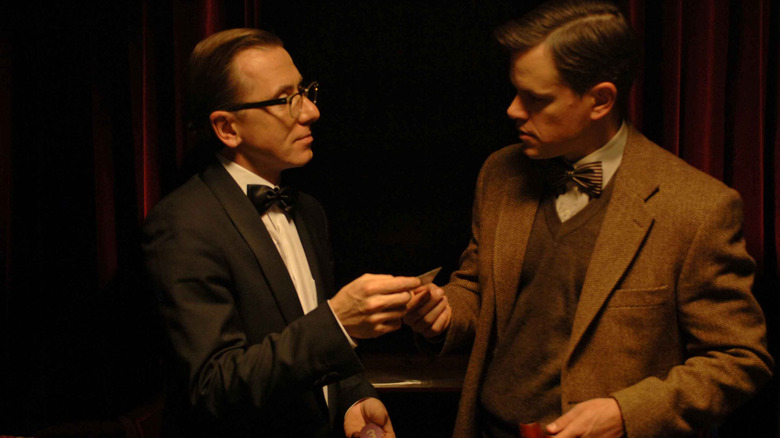
After pouring every ounce of his filmmaking imagination into 1992's visually sumptuous "Bram Stoker's Dracula," the creative fire seemed to go out in Francis Ford Coppola's soul. He went four years in between movies, and when he reemerged, it was with "Jack," an execrable piece of counterfeit Hollywood sentiment starring Robin Williams as an adolescent afflicted with a disease (progeria, basically) that causes him to age rapidly. Though Coppola continues to express affection for the movie, it felt like a paycheck gig from an artist who wanted to work but not necessarily create.
Coppola redeemed himself the following year by turning John Grisham's formulaic page-turner, "The Rainmaker," into a surprisingly textured legal drama decked out with colorful performances from powerhouse actors like Danny DeVito, John Voight, Mary Kay Place, Mickey Rourke, and Roy Scheider. But the whole movie could've easily collapsed had Coppola not cast Matt Damon in his first leading man role. Still boyish at the age of 26, Damon is enormously sympathetic as an underdog, unconnected attorney who's taken on a case that, if skillfully prosecuted, could seriously damage a major, unscrupulous health insurer.
"The Rainmaker" was a nifty return to form for Coppola. It proved he was still a nimble filmmaker, a perceptive observer of human behavior, and a first-rate director of actors. And while it's a tremendously satisfying movie, it also felt like batting practice. Was this the warm-up for his long-gestating epic "Megalopolis?" Nope. It was the beginning of a 10-year hiatus that ended with the inscrutable 2007 fantasy/drama "Youth Without Youth." Coppola made it on a shoestring $1 million budget, but his towering stature enabled him to cast high-priced talent, which included Matt Damon. Is it worth a watch?
Matt Damon momentarily energizes Coppola's sleepy Youth Without Youth
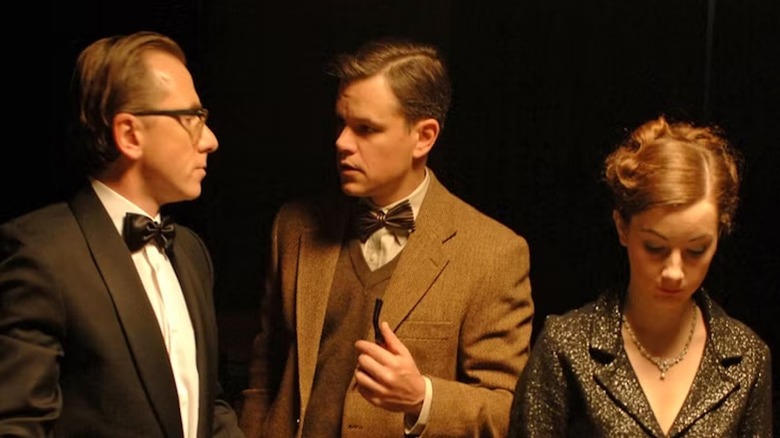
"Youth Without Youth" is based on a novella by the Romanian religious scholar Mircea Eliade. It is a dense, difficult text, but it does have a hook! In 1938, 70-year-old linguistics professor Dominic Matai (Tim Roth), who believes his life's work has been a complete waste, travels to Bucharest to kill himself in the home city of his true love, Laura (Alexandra Maria Lara). Before he can die by suicide, he is struck by lightning, which imbues him with psychic powers. When the Nazis learn of his extrasensory capabilities, they seek to exploit his gifts as a means of winning the war. And then the film goes haywire in the dullest manner imaginable.
Damon briefly turns up as ambitious "Life" magazine reporter Ted Jones, who tries to talk Matai into an interview that could benefit the Allies during World War II. It's one of the film's best scenes, if only because Damon's energy jolts Coppola's movie out of its pervasive lethargy. But it's too little, too late. The movie can't be roused out of its navel-gazing torpidity. And it earned Coppola some of his most scathing reviews since "Jack."
In a 2024 interview with Rolling Stone, Coppola characterized "Youth Without Youth" as a "test," one that would essentially reeducate and rewire him as a filmmaker. It certainly is a testing movie. I root for Coppola every time out, and have found value in late-career efforts like "Tetro," "Twixt" and the profoundly fascinating failure that is "Megalopolis." I get almost nothing out of "Youth Without Youth." But if it rejuvenated Coppola's love for the craft, it was a film well worth making.