

Stanley Kubrick's Underseen Heist Movie Got A Perfect Score From Roger Ebert
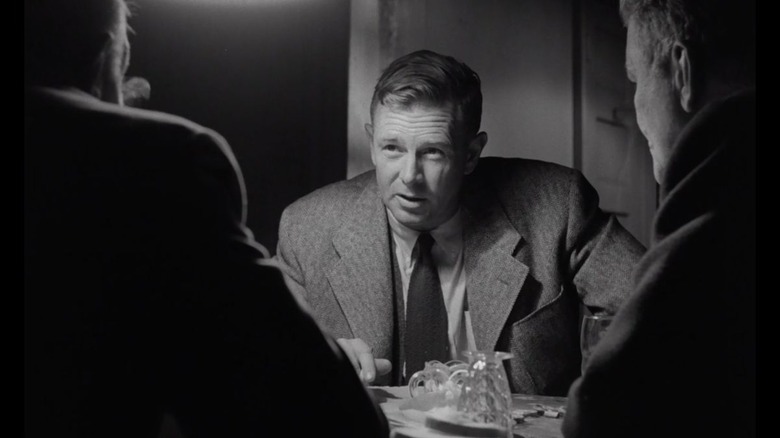
Stanley Kubrick went from working as a professional photographer to being a filmmaker when he directed 1951's "Day of the Fight," a 16mm documentary short film about boxer Walter Cartier. To make a film about boxing was a natural transition, as Kubrick had already photographed multiple boxing matches in the preceding years. Those familiar with Kubrick's movies like "2001: A Space Odyssey" and "The Shining" may be surprised to learn that, as a photographer, he tended toward a hard-edged realism, capturing candid shots of real life. He wasn't yet obsessed with craft and camera placement. Indeed, Kubrick directed multiple films before he nailed down his signature aesthetic style.
In 1953, Kubrick directed his first feature, "Fear and Desire," a war satire that he wasn't fond of. He was quoted on NPR in 1994 saying that it was his amateur filmmaking experiment, and he supposedly tried to burn the master print. (Unsurprisingly, it typically places low on Kubrick movie rankings.) Then, in 1955, Kubrick helmed "Killer's Kiss," a film noir about, you guessed it, a boxer. He didn't like "Killer's Kiss" either, however, as its distributor, United Artists, demanded that he change his original ending to be happier.
Third time seemed to be the charm for Kubrick, though, as he went on to direct 1956's "The Killing," a noir film about a racetrack heist that goes wrong. Sterling Hayden portrayed the lead character, and he would go on to play a notable role in Kubrick's classic 1964 anti-war satire "Dr. Strangelove, or: How I Learned to Stop Worrying and Love the Bomb." "The Killing" could be considered the first "proper" Kubrick movie, and it has been widely praised for years. Roger Ebert even listed it in his Great Movies essay series, handily giving it a four-star review.
The Killing is one of the greatest heist movies ever
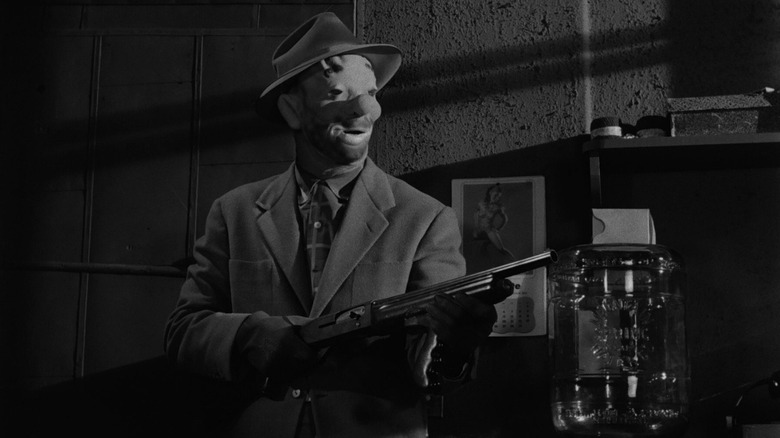
Ebert began his admiring essay on "The Killing" by discussing Stanley Kubrick's strange and swift evolution as a director. He noted that if "The Killing" didn't have a directed-by credit, no casual cineaste would have put together that it was made by the same man who directed "Barry Lyndon" or even with "Dr. Strangelove." Kubrick had, in Ebert's eyes, tried to make every one of his films unique.
Kubrick was a well-known chess enthusiast, and Ebert isn't the only critic to liken "The Killing" to a chess match. Sterling Hayden plays Johnny Clay, a gangster with a great idea on how to pull a heist at a racetrack. He assembles a team of fellow law-breakers and assigns each of them a very specific task to be performed at a specific racetrack at a very specific time. The bruiser Maurice Oboukhoff (Kola Kwariani), for instance, has to start a brawl at just the right moment to provide a distraction. The ensemble of lowlifes includes the wimpy George Peatty (Elisha Cook Jr., giving the movie's greatest performance), as well as a panoply of crooks, lovers, and bitter wives. Sherry Peatty (Marie Windsor), George's wife and a gold-digger of the highest order, is another standout character.
Like all noir films, there are no heroes here. The world of "The Killing" is one of lowlifes and scumbags who aren't just in it for the money; they need to commit crimes because it's all their minds are wired for. Indeed, Johnny is an expert planner, mapping out the film's central heist with accuracy and enthusiasm. He just wants everything to go 100% right, and his crew can pull things off. No points for guessing that Johnny's plan goes badly for everyone.
The Killing is lean and mean
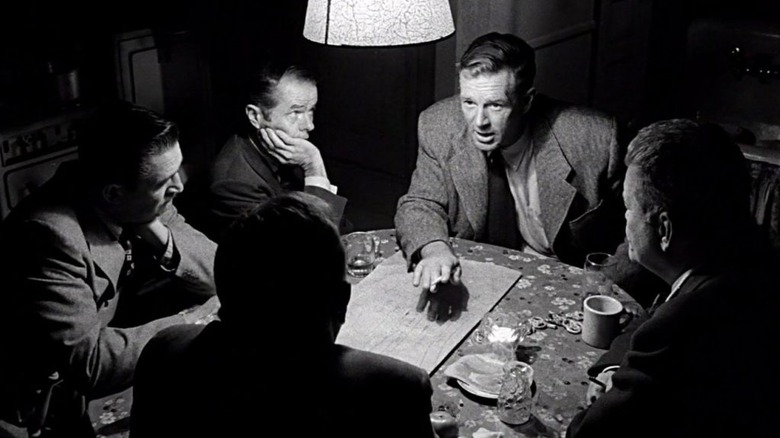
In many ways, Johnny's like a film director trying to meticulously plan a series of perfectly interlocking scenes to create great art. But everything has to go perfectly, which it doesn't. One scene falls apart, and other scenes tumble after it. Stanley Kubrick may have, without even realizing it, directed a film about how his own moviemaking experiences up to that point had been fraught and difficult. This is reflected in Johnny's attitude. He doesn't see the heist as something frothy and fun (like in the "Ocean's Eleven" movies). No, this is a technical work of engineering. Johnny's a hard-minded engineer who seems to think little of human passions. Kubrick has sometimes been accused of being cold and dry, and that attitude is reflected in Johnny's hard-minded tough-guy persona.
"The Killing" was praised by critics upon its release, but feels like a mountainous achievement to modern eyes. It's gripping and bleak, sweaty and desperate. Despite Johnny's coldness, the film is passionate and emotional, more so than many of Kubrick's later movies (1957's "Paths of Glory" notwithstanding). Like his photographs, "The Killing" has a documentary feel, with Kubrick shooting at real locations and photographing actual races.
There is a fun story that Roger Ebert quoted in his essay about how Kubrick was such a perfectionist that he once phoned up a projection booth in Kansas City, from his home in England, to complain that the image was out-of-focus. (I guess someone alerted him.) Kubrick always needed his films to be just so, especially after the terrible time he had working on the studio picture "Spartacus" in 1960. "The Killing," then, symbolizes the conflict between Kubrick's own perfectionism and what goes awry in his head when people don't follow his plans to the letter.