

How Total Recall Director Paul Verhoeven Felt About Colin Farrell's 2012 Remake
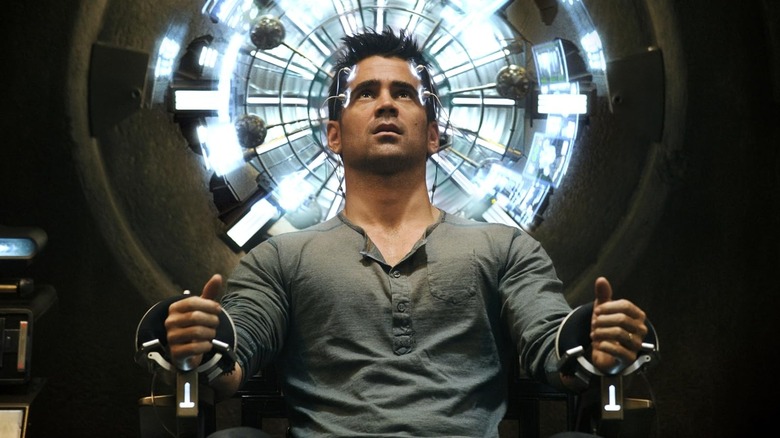
Somebody please tell Hollywood studios to stop remaking Paul Verhoeven's American movies. (If they really want to redo one of his profane European offerings, though, I'd be almost morbidly curious to see their take on his queer nun drama "Benedetta.") Just look at 2014's "RoboCop," a retelling that lacks both the personality and satirical sting of the Dutch filmmaker's original 1987 sci-fi action classic. And given how incisively Verhoeven reworked Robert A. Heinlein's "Starship Troopers" novel into a wry cinematic lampoon of fascism and militarism, there's not much point in revamping that property from an artistic perspective.
2012's "Total Recall" is just further proof that Verhoeven's stateside productions should be left well enough alone. Directed by Len Wiseman (the overseer of the "Underworld" franchise) and credited to screenwriters Kurt Wimmer ("Equilibrium") and Mark Bomback ("Dawn of the Planet of the Apes"), the Colin Farrell-starring sci-fi action-thriller is as polished and carefully packaged as you would expect from a creative team like that. It's also pretty superficial; its action sequences are glossy but fail to leave much of a lasting impression, while its characters and themes could use a good deal more development. The man, the myth, the legend Roger Ebert himself rated it higher than most other critics, yet even he wrote in his review that it "never touched [him] emotionally" like Verhoeven's 1990 "Total Recall" did.
Verhoeven, on the other hand, was less charitable. Speaking at a Q&A after a screening of his own "Total Recall" in 2012 (via ScreenRant), the filmmaker claimed that one of the remake's producers had referred to his original version as "cheesy or something," adding that Farrell had (again, allegedly) similarly deemed it "kitschy" in an interview. "So, I dare to say that his version was not good," Verhoeven explained.
Why Paul Verhoeven's Total Recall is better than the remake
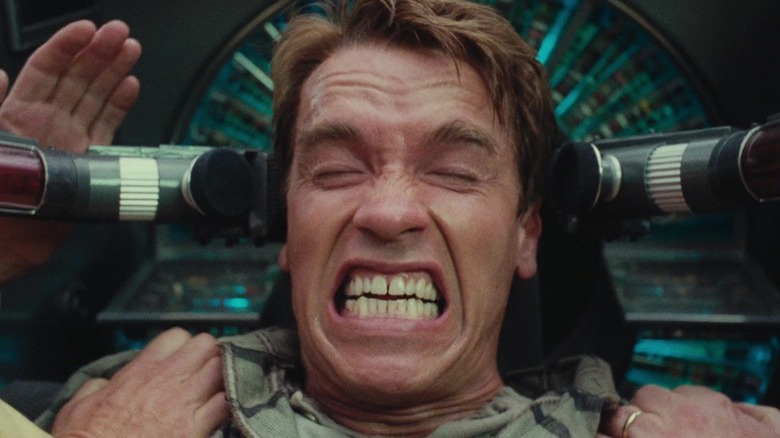
In its defense, 2012's "Total Recall" is no paint by numbers rehash. For that matter, Paul Verhoeven's 1990 movie differs significantly from its own source material, i.e. the 1966 Philip K. Dick short story "We Can Remember It for You Wholesale." The main thing they have in common? They all begin with an average Joe named Douglas (Douglas Quaid in the "Total Recall" films but Douglas Quail in Dick's story) deciding to get fake memories implanted in his brain in a future where that's actually possible. Except, it turns out these "fantasies" are based on real memories that've been erased from Douglas' mind. Or are they?
Both iterations of "Total Recall," like Dick's story, examine how the version of ourselves that we present to the world can differ from who we "really" are, to the degree where it becomes not only difficult but dangerous not to recognize the difference. This is where Verhoeven's film has a big advantage over the remake: Because Arnold Schwarzenegger plays Douglas Quaid here, and his grand adventure has many of the same elements as your average cinematic power fantasy starring the Austrian Oak, the whole movie is as much a meta commentary on itself as it is a straightforward genre flick. The reboot just doesn't have that added layer of meaning.
Moreover, like 2014's "RoboCop," the 2012 "Total Recall" comes across as bland and generic compared to Verhoeven's crackpot artistry. The original film explores tyranny and corporate oppression on a fantastical vision of Mars populated by mutant under-classes, as brought to life through imaginative production design and incredible non-CGI effects. With its Earth-based storyline and grounded dystopian setting, however, the "Total Recall" reboot is "realistic" to a fault. Who'd fantasize about something like that?