

How Fast Is Mach 10 In Top Gun: Maverick?
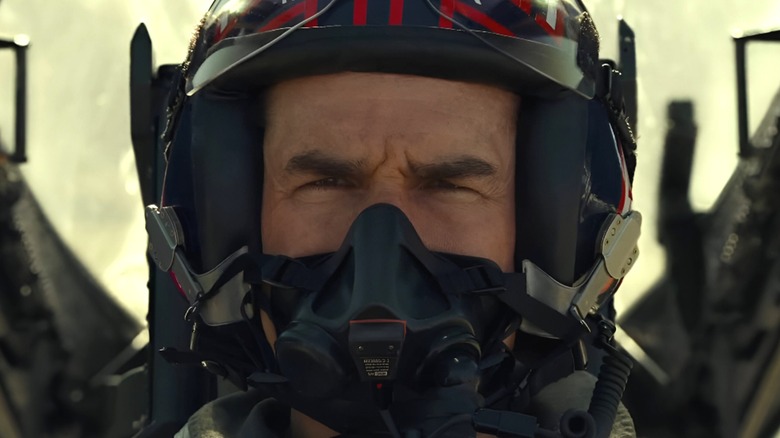
Tony Scott's "Top Gun" was a huge commercial hit in 1986 and has maintained a glowing legacy ever since. More than three decades later, Joseph Kosinski gave us "Top Gun: Maverick," the critically acclaimed sequel that understands the inner workings of a thrill-inducing blockbuster. Kosinski leans hard into Tom Cruise's commitment to showmanship, and Maverick is still as gutsy and unpredictable as in Scott's original — which is precisely the source of conflict in the blockbuster sequel. Part of the film's appeal lies in the specialized planes that the characters (mostly Maverick) fly, where every design detail and prop plays a seminal role in selling us the fantasy of "the fastest man alive."
The film opens with Maverick flying the experimental Darkstar, a fictional craft designed by engineers at Lockheed Martin. There aren't too many special effects tricks at play here, as a full-scale mockup of the craft was built to make the hypersonic plane look believable. In "Top Gun: Maverick," the Darkstar is due for test flights soon, and Maverick is tasked with gauging its highest speed while still adhering to safety rules. As expected, he pushes the craft past its limits while ignoring orders, adamant to fly the Darkstar beyond Mach 10. To everyone's surprise, he accomplishes the impossible, even though the craft breaks apart in the Mojave Desert after reaching the Mach 10.2 mark.
While we can glean that Mach is a unit of aircraft speed, the film doesn't explain what it is or put things into context in any way. While we have no idea how fast Mach 10 really is, it's clear that it is too fast for an experimental plane like the Darkstar with a risk-taker like Maverick at the helm.
Calculating the exact speed of a plane at Mach 10 is trickier than you think

To keep things simple, Mach is the ratio of an object's speed in relation to the speed of sound. But as speed increases, the compression of the air molecules around an aircraft changes. The speed of sound is said to be 343 m/s (meters per second), which can be roughly understood as 761 miles per hour. The fictional Darkstar is a hypersonic jet (as is any aircraft that flies above Mach 5) that reaches Mach 10 pretty quickly, so we have to exercise some suspension of belief here. For reference, the fastest manned aircraft ever flown in real life was the X-15, which flew at Mach 6.7 (2,298 m/s, or around 4,500 miles per hour).
Though the Darkstar reaches Mach 10 quickly, it does experience issues like overheating, as Maverick has a tough time piloting the craft. But he manages to reach Mach 10.2, which is just over 10x the speed of sound at sea level. If we connect these theoretical dots, we can come to the conclusion that Mach 10.2 is roughly 7,800 miles per hour, but again, this has never actually been done before, so there's some guesswork involved. Even by theoretical standards, that's a bit insane, as that would require the aircraft to fly above 40,000 feet, and anyone ejected from the plane would be killed instantly by relative weight/air density. The fact that Maverick was able to do all of this and live can be simply chalked up to the fact that, in the world of this movie, he's built different.
But actions have consequences, so Maverick comes very close to being terminated and is assigned to train a group of young, gifted recruits who are tasked with a rather impossible mission.
Top Gun: Maverick uses its opening Mach 10 sequence to pay homage to the original

"Top Gun: Maverick" opens the way it does not only to remind audiences of Maverick's personality, but to draw a parallel to its predecessor, in which Maverick (Cruise) flies the F-14A Tomcat, while Nick "Goose" Bradshaw (Anthony Edwards) acts as his Radar Intercept Officer. During the final mission to intercept two hostile MiG-28s, Maverick defies orders to land as he wants to ensure that his wingman, Cougar (John Stockwell), is able to land safely after going into shock. Mav is reprimanded nonetheless, as naval aviators are expected to adhere to certain rules (which Maverick routinely struggles against).
The sequel is all about Maverick confronting his past while sifting through memories and regrets. There's a lot of baggage attached to training Bradley "Rooster" Bradshaw (Miles Teller), Goose's son, who resents him and blames him for his father's death. This is the emotional heft of "Top Gun: Maverick," even though the uranium enrichment plant mission is the Climactic Spectacle™ that the film steadily builds towards. Nostalgia isn't just an embellishment here, as the F-14A Tomcat (which plays a part in Goose's heartbreaking death) is situated front and center during the climax, fulfilling a role that is equal parts emotional and exhilarating.
Maverick's Mach 10 sequence isn't just a proof of his aerial machismo, but a reminder that the man has been stubborn about letting go of the past. This isn't always a bad thing, as he uses this outlook to push the limits of his new crew, who go on to achieve the impossible precisely because Maverick refuses to follow the rules. This is a risk-laden endeavor, but "Top Gun: Maverick" turns it into a celebration of life and the bonds that sustain such an adrenaline-soaked existence.