

M. Night Shyamalan's Old Was Inspired By This 1975 Film With A 92% On Rotten Tomatoes
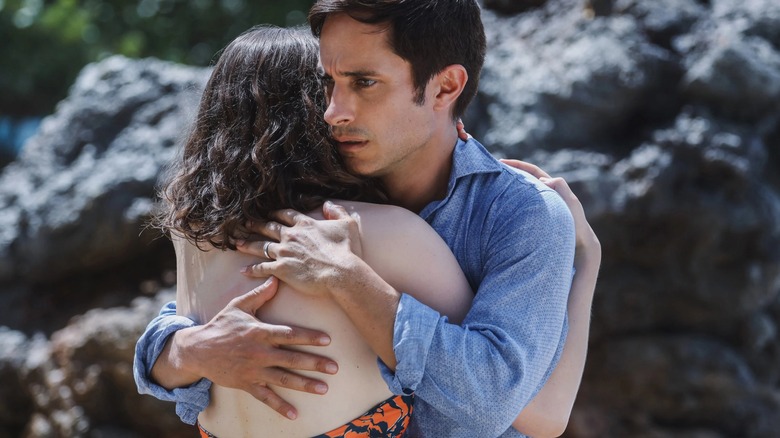
M. Night Shyamalan's divisive horror-thriller, "Old," tackles intriguing themes. The 2021 film might be a far cry from most M. Night bangers, but it dares to do something different while playing around with genre conventions. It's a bizarre, gimmicky exploration of the existential fear of aging, but this very lack of subtlety can also be a lot of fun. After all, the premise itself is inspired by Pierre Oscar Lévy's "Sandcastle," a gripping graphic novel about the far-reaching consequences of rapid aging, including intergenerational trauma. In terms of thematic depth, "Sandcastle" is the superior text here, as it is populated by compelling characters torn apart by an inexplicable phenomenon they are ill-equipped to navigate.
While Shyamalan revamps the core tenets of "Sandcastle" into a story uniquely suited to his sensibilities, he also takes cues from a 1975 cult classic that resists straightforward interpretation. Speaking to Yahoo! Entertainment, Shyamalan explained that Peter Weir's "Picnic at Hanging Rock" was integral to the core theme in "Old," namely our "dysfunctional relationship with time:"
"That [Weir's film] was a huge inspiration [...] We're just trying to beat [time]. We're trying to be younger than we are, or if you're younger, you're trying to get to somewhere older than you are. You're always not OK with where you are."
This parallel might sound confusing at first glance, as "Picnic at Hanging Rock" is significantly different in its treatment of time (and the mysteries it evokes) than "Old." For starters, Weir's film doesn't have a clear resolution, and Shyamalan concludes "Old" on a cathartic note. Also, Weir uses the language of voyeurism to construct the central mystery, where four people mysteriously vanish during a sightseeing trip. So, what does this beautiful and uncanny story have in common with Shyamalan's beach-horror?
Like Old, Picnic at Hanging Rock is also about the passage of time
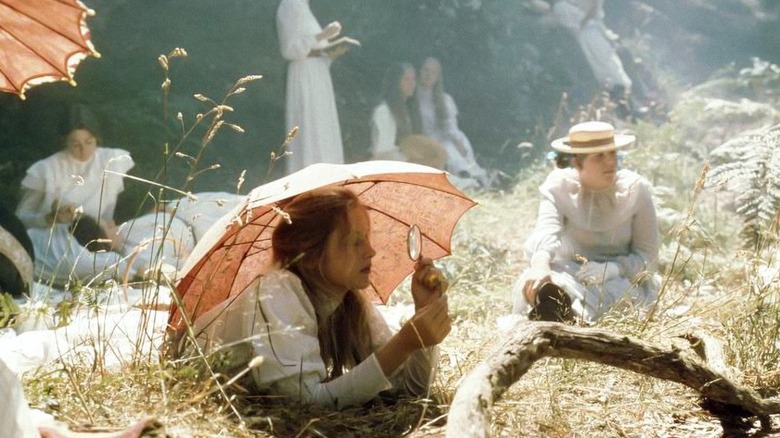
Shyamalan tackles time and its accelerated effects in "Old" on a literal level: teenagers unwittingly become parents in the blink of an eye, and those with pre-existing medical conditions suffer in grotesque ways. Weir's film doesn't operate on such hyper-realities — it takes on an almost-hallucinatory quality to portray the slow/mundane passage of time instead. Weir extensively uses slow-motion and dreamy dissolves to portray the girls at Appleyard College, who speak languidly while gazing at each other and frolicking in nature. At times, they are the ones being watched, be it inside lavish college interiors or near the wild rock faces and caves that make up Hanging Rock. This dreamlike state is shattered once a girl breaks down after her friend's disappearance, screaming in horror to convey the ugliness of the situation.
Now, "Picnic at Hanging Rock" is about many things, including burgeoning female sexuality, where the lure of Hanging Rock is associated with a curious and eager transition into adulthood. None of this is spelled outright, of course, as Weir is more interested in using the passage of time to convey these themes via a slow-burn mystery-drama. During the titular picnic, time seems to come to a standstill right before the disappearances, and even those who search for the missing girls realize that they have no way of telling time. Perhaps Shyamalan's statement about time-related dysfunction refers to this integral aspect of Weir's film, where those eager to leap into adulthood undergo a journey that is impossible to return from, which manifests as a literal vanishing from the material realm.
"Old" might be as subtle as a heavy-handed morality tale, but you can glimpse the thematic influences of Weir's classic if you squint hard enough.