

The Testament Of Ann Lee Review: Amanda Seyfried Is Divine In This Jaw-Dropping Musical
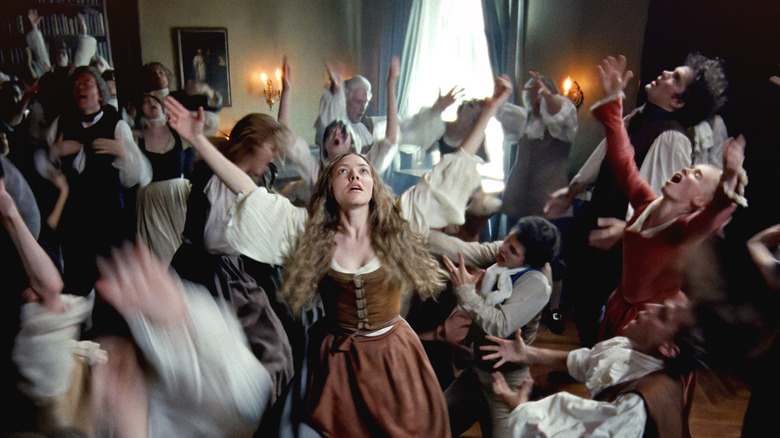
I've never seen anything quite like "The Testament of Ann Lee." That's the type of hyperbolic opening statement I usually like to avoid when crafting a review, but Mona Fastvold's gloriously unique spiritual musical is truly one of a kind — a swooning, dizzying experience filled with song and dance meant to conjure up a kind of religious ecstasy. I'm not sure this type of movie is destined to find a wide audience, but I am absolutely thrilled it exists. Are you tired of the same old slop being churned out by Hollywood? Are you bored with lifeless musicals that fail to quicken the pulse and rile up the blood? The answer to your prayers is here in the form of "The Testament of Ann Lee," one of the best movies of the year.
Amanda Seyfried, who has another movie opening this month, gives arguably the best performance of 2025 as Ann Lee, the woman who lead the Shaker (or "Shaking Quakers") movement in the 1700s. The Shakers were a religious sect that used song and dance as a form of worship, and Fastvold uses that concept and runs wild with it, creating a musical full of haunting, sensual movements and songs that inspire a feeling of being enveloped by some sort of supernatural force. Composer Daniel Blumberg took actual Shaker hymns to craft many of the songs in the film, and while I don't think you can call any of them "toe tappers," they made the hairs on the back of my neck stand on end. Hearing them, one can fully understand why and how Ann Lee became such a holy figure.
Played with raw, unflinching elation by Seyfried, who has never been as good as she is here, Ann Lee is seen as the Second Coming of Christ who leads her followers from Manchester to America, building a community that takes to the woods to move as if they're possessed by unseen forces. Choreographer Celia Rowlson-Hall has found a way to make the dance movements look both spontaneous and meticulously designed, which is stunning to behold.
The Testament of Ann Lee takes the form of a fable
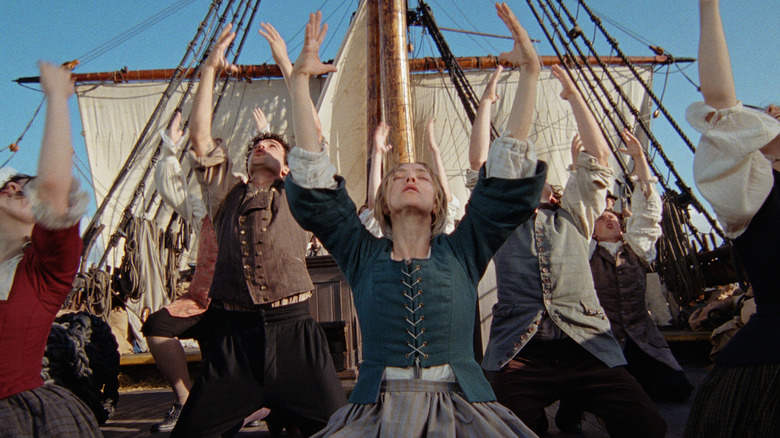
Ann Lee is an illiterate young woman who falls in love at a religious meeting with a man named Abraham, played by Christopher Abbott. They seem to genuinely be in love, at least at first, and their union produces four children. Unfortunately, all four children die quickly after childbirth, and the shock and grief seem to open Ann's eyes to the truth: abstinence is the key to getting close to God. She quickly rises from congregant to leader, instructing her followers to give up all fleshly desire — a concept that doesn't sit very well with the lustful Abraham.
There are many ways Fastvold, writing the script with Brady Corbet (the duo also co-wrote last year's wonderful "The Brutalist"), could've approached this story. A more cynical filmmaker may have even taken a winking, mocking approach. But Fastvold found herself genuinely moved by Ann Lee's story while doing research, and treats the nearly forgotten religious figure with respect and reverence. That's not to say the film is flat-out confirming that Ann Lee was the real deal.
Instead, "The Testament of Ann Lee" takes on a fable-like quality, with the story narrated by Ann's closest confidant, Mary Partington, played with gentle grace by Thomasin McKenzie. Frequently, when Mary is about to fill in some details about Ann's life, she begins with the caveat, "There are some who say..." Did any of this happen the way it happens here? Well, some people say it did, and that's all we need to know.
See The Testament of Ann Lee on the big screen
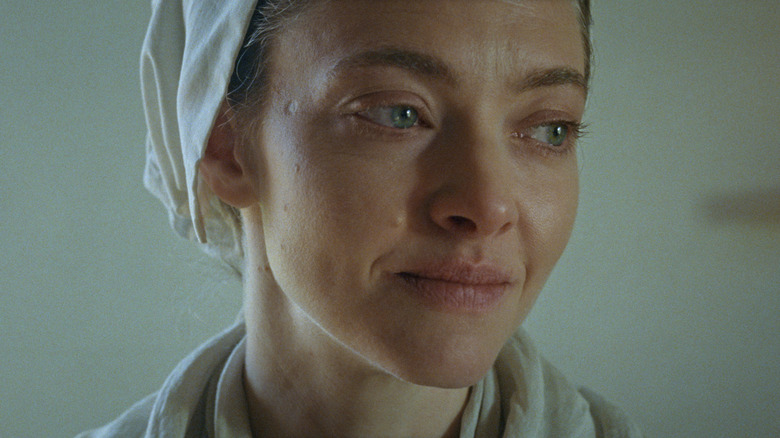
After facing persecution in England, Ann and her followers (including her devoted brother, played by Lewis Pullman) head to the new world, where (through possible divine intervention) they find a patch of land near Albany and begin building a community, attracting both new followers and doubters. The journey to America serves as one of the most stunning set pieces of the film, as the rough sea voyage becomes a test of faith, with the Shakers gaining the respect of the rough crew through their belief. Through trials and tribulation, Ann Lee's faith never wavers, even as some close to her — like her husband — begin to grow weary.
The actors all perform their own singing, which only heightens the experience. Seyfried, who has sung in several films already, has a beautiful voice, while others are a bit more rough and clumsy. Pullman's singing voice, for instance, is slightly off-key, and yet that only enhances his character as he spreads the message his sister wants to bring to the world. The musical numbers are all jaw-dropping in their uniqueness, as cinematographer William Rexer glides the camera through crowded rooms and vast open spaces, all while the actors fold themselves over one another, twisting about as if their movements are being guided by a divine hand.
Every aspect of the film is pitch-perfect, but it's Seyfried's performance that keeps everything flowing. Seyfried works hard to make Ann Lee seem genuine, flawed even, — achingly human all while striving to transcend into something inhuman at the same time. "The Testament of Ann Lee" isn't trying to convince us that Ann Lee really was the Second Coming of Christ, but rather showing us how so many people might have believed that she was. The film isn't interested in the institution of organized religion as much as it is the concept of pure, unflinching faith. It is somehow secular and spiritual all at once. What a marvel, what a joy it is to see a film like this. It's very existence feels like a kind of miracle.
/Film Rating: 10 out of 10
"The Testament of Ann Lee" opens in theaters on December 25, 2025.