

Before Avatar, James Cameron Produced A Fascinating George Clooney Sci-Fi Flop
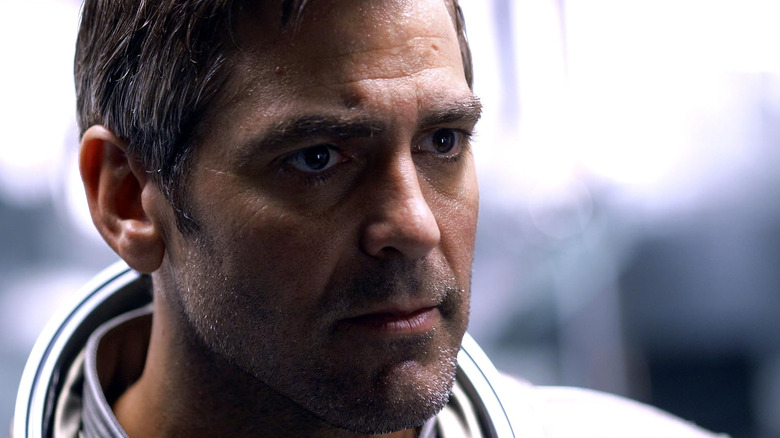
Stanisław Lem's 1961 novel "Solaris" has provided the inspiration for three films. There was a little-seen Russian TV movie adaptation released in 1968 and directed by Boris Nirenburg and Lidiya Ishimbayeva. Then, in 1972, Russian filmmaker Andrei Tarkovsky made his "Solaris," a notoriously downbeat and hypnotically slow-moving movie that famously includes long takes and extended spans without any dialogue. Indeed, there's an extensive sequence in Tarkovsky's movie where a character drives down a long highway, uninterrupted, for several minutes. Finally, in 2002, Steven Soderbergh helmed his own "Solaris," this time with a $47 million budget and the participation of Hollywood darling George Clooney. But despite all that and being produced by James Cameron (who almost directed the film himself at one point), the movie flopped.
Lem's book and its screen adaptations are all about how alien life will likely be so different from humankind that we will probably struggle to communicate. "Solaris" itself alludes to a distant planet that's covered with a vast, living ocean. The story's protagonist, Kris Kelvin (who is renamed Chris Kelvin in Soderbergh's film) travels to a space station orbiting Solaris, only to find that his dead wife is there, having been psychically created (or, if you will, resurrected) out of his memories. Soderbergh, like the Russian filmmakers and Polish author before him, embraces a strange, ethereal tone, making it seem like Dr. Kelvin has entered an eerie, cosmic dream space that he doesn't fully understand.
Soderbergh's "Solaris" also leans into memories, psychological realism, and the sadness one experiences after a loss, all trudged up by the mysterious emotional caprices of an ineffable, planet-sized extra-terrestrial intelligence. It's certainly ambitious, although one can see why it wasn't a broadly successful crowdpleaser (unlike Cameron's box office-breaking sci-fi epic "Avatar," which came out seven years after Soderbergh's film).
Steven Soderbergh's Solaris is a headtrip
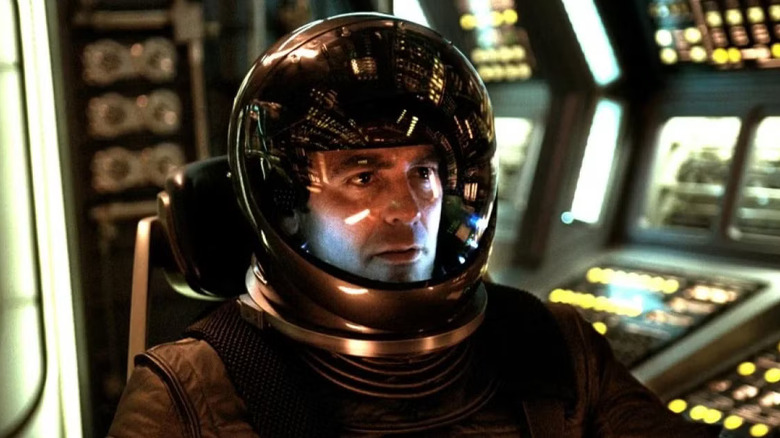
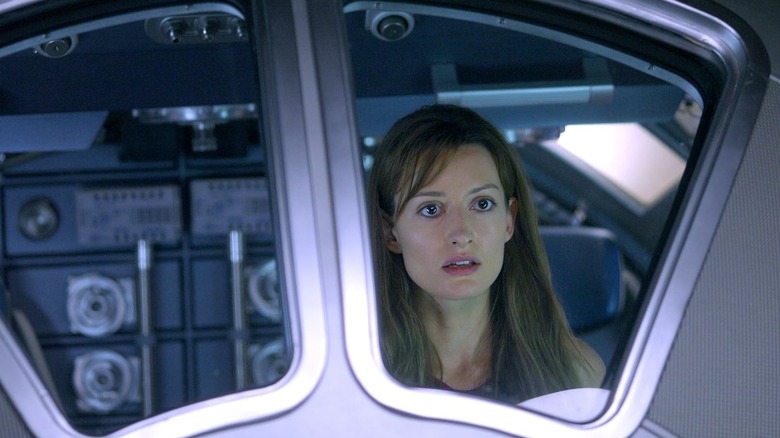
Soderbergh presents "Solaris" as a mystery, just like Lem does in his book. In Soderbergh's movie, Kelvin is invited by a stationed astronaut (Ulrich Tukur) to come to the Solaris space station to investigate something he refuses to explain. When Dr. Kelvin arrives there, he finds that the astronauts have all died or died by suicide. Moreover, the only people left (as portrayed by Jeremy Davies and Viola Davis) are reluctant to talk about what's happening. Meanwhile, Dr. Kelvin is haunted by dreams of his dead wife Rheya (Natasha McElhone), who similarly died by suicide several years earlier, and when he awakens the morning after his arrival, Rheya is on the station as well, alive and well. She is no illusion; she's an actual, physical being.
Dr. Kelvin doesn't know what this creature is, so he jettisons her into space. He's then informed by Davies and Davis's characters that Solaris has been psychically resurrecting all the astronauts' families. So, when Rheya manifests a second time, Kelvin allows her to stick around. Sadly, much like the real Rheya, the artificial Rheya then begins having suicidal impulses of her own. She also complains that her mind is not wholly human, which means she cannot seem to connect with her human emotions. When she does die by suicide, the new Rheya is almost immediately resurrected. This is when we learn that the other astronauts on the Solaris station were unable to "kill" their own accidentally manifested apparitions, which meant they were constantly hounded by their own bad memories.
Naturally, there are further twists in the story, but I will leave those for viewers to discover.
Solaris is a story of emotions, not events
Contrary to what the above description might imply, "Solaris" is no thriller or plot-driven film. Indeed, while one is watching Soderbergh's movie, one gets the impression that little is happening in any given moment, at least story-wise. Instead, as with Lem's book and Tarkovsky's own film adaptation, Soderbergh is attempting — in a sad, tragic way — to capture the emotional state of the characters more than their sci-fi plight. The concepts are interesting, but the plot demands that the alien intelligence at its center be non-understandable. Why does this living ocean communicate through clones of dead relatives? What is it learning from humans? Will it ever learn how human interactions are supposed to work? Or is it merely activated by the psychic vibrations from nearby human beings?
More than anything, "Solaris" is about a mourning man who realizes that all his memories of his dead wife are tainted by her suicide. When an alien resurrects Kelvin's version of his wife, she is as suicidal as he remembers, not necessarily as alive and complex as she actually was. Solaris itself doesn't so much understand life and death, but it has a lock on compassion.
Despite its ambition, Soderbergh's "Solaris" wasn't terribly well-liked. Critics were merely warm towards the movie, admiring its ideas more than its open heart. (It currently has a merely-okay 66% approval rating on Rotten Tomatoes.) Robert Ebert was, at least, fond of the movie, writing that "the Soderbergh version is like the same story freed from the weight of Tarkovsky's solemnity." He added that "it evokes one of the rarest of movie emotions, ironic regret."
Ironic regret wasn't enough to draw in the crowds, though. Audiences stayed away, and the movie is generally ranked lower among Soderbergh's directorial efforts.