

Three Seinfeld Writers Rewrote The Grinch Script - But Were Left Out Of The Credits
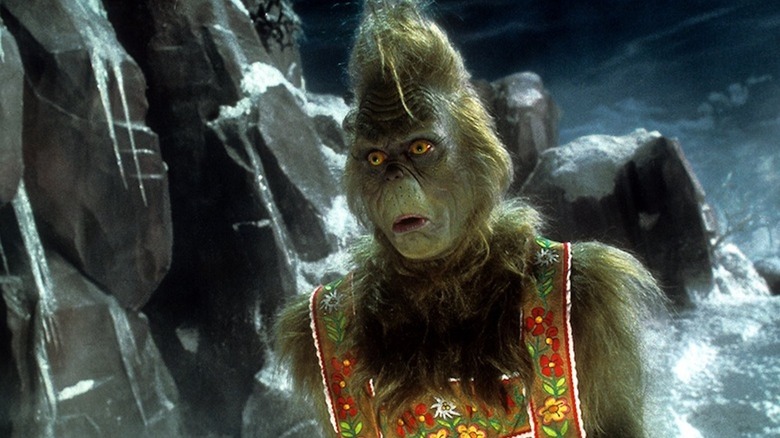
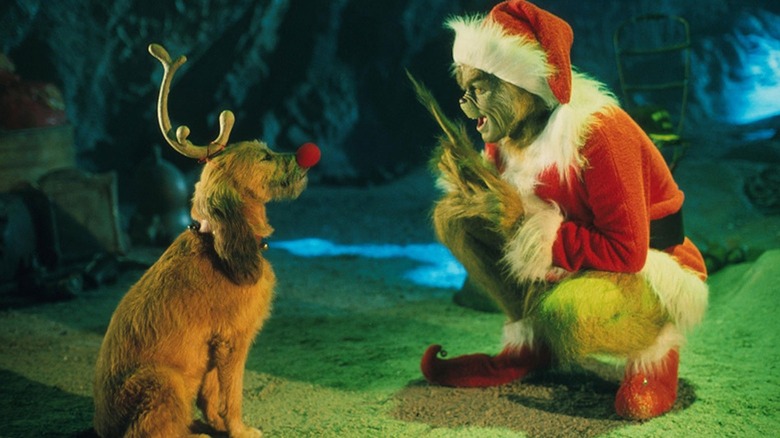
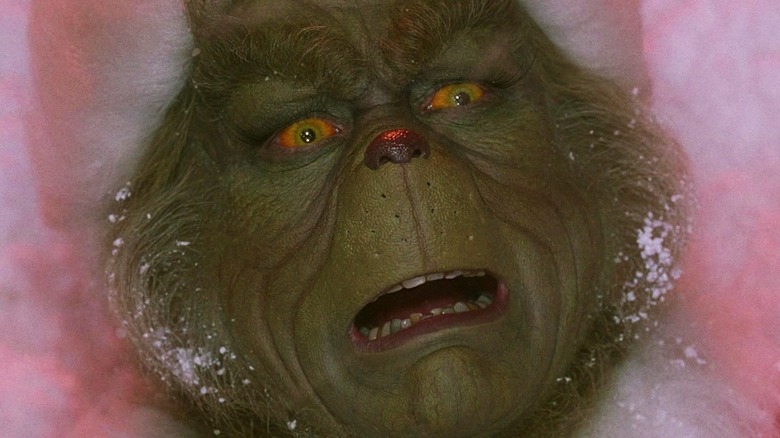
Ron Howard's live-action take on Dr. Seuss's "How the Grinch Stole Christmas" was a holiday season smash when it hit 25 years ago. It grossed $348 million against a budget of $123 million, and received a respectable A- Cinemascore. It was not, however, a hit with critics, who found Jim Carrey's performance as the title creature unsettling (if not downright horrifying), and its depiction of Whoville oddly off-putting. Sure, the production design and, of course, Rick Baker's makeup FX work on the rubber-faced Carrey were astonishing, but what was enchanting on the page and in animated form just looked wrong when brought to tactile life.
Nevertheless, Howard and Universal Studios spared no expense in bringing the misbegotten monstrosity to the big screen and wasted a ton of talent in the process. Aside from squandering Baker's work and a maniacally committed performance from Carrey (who was allegedly cruel to Baker's crew), they also wasted the considerable talents of Alec Berg, Jeff Schaffer, and David Mandel, three brilliant comedy writers who'd just completed their run on "Seinfeld," and were on the cusp of hugely successful careers as a team and as solo scribes (for beloved series like "Curb Your Enthusiasm," "Veep," "Silicon Valley" and "The League").
The first draft of "How the Grinch Stole Christmas" was initially knocked out by the screenwriting duo of Jeffrey Price and Peter Seaman ("Who Framed Roger Rabbit?"), but, as is often the case in Hollywood, other writers were sought out to bring a fresh perspective to the rewriting process. This is where Berg, Schaffer, and Mandel came in. They were grateful for the work, especially when they realized they'd be receiving "written by" credits, which would trigger residuals on what was sure to be a blockbuster motion picture. Alas, at the last second, they were denied credit.
Writing nearly every line of Jim Carrey's dialogue wasn't good enough for a writing credit
In an oral history on the making of "How the Grinch Stole Christmas" for Vulture, Mandel said that while the trio had signed separate television deals at various Hollywood studios, they were "in demand on comedy movies to bring a bit of what they used to call 'Seinfeld smart' humor to the scripts." Berg added, "Our thing was basically the two-week rewrite where we just did comedy punch-ups. God, we worked on so many movies."
"How the Grinch Stole Christmas" was different, however, because they were brought in to do an extensive rewrite on a script that wasn't working. "We came in at a pretty late stage," said Berg. "It was fully cast. They were building sets." As they continued to work on the film, it became clear to the three writers that they would be receiving credit. "The way it works with the Writers Guild is the studio or the filmmakers propose a credit," said Berg. "And what they proposed, which was fair, was story by [Price and Seaman] and then screenplay by all of us." When their names appeared on the film's first teaser trailer, this seemed like a done deal.
Then Price and Seaman changed agents, and the WGA credit arbitration took a turn.
From the Grinch to the Cat in the Hat
Even though the time had elapsed on the aforementioned tentative credits deal, Berg said that Price and Seaman had been improperly notified, which led to arbitration. "There were three people who read the different drafts," he said. "Two sided with them and one sided with us." Schaffer added, "I distinctly remember the tipping reader said, 'Rewriters should never get credit.'"
According to Mandel, they wrote just about every line of Carrey's dialogue, but that wasn't good enough for the WGA. It's likely cold comfort, but Mandel said that Ron Howard and his Imagine production partner Brian Grazer have always been grateful to the trio for their hard work. In the Vulture piece, Carrey said, "[O]h my God, no, those writers deserved a lot of credit, for sure." In a cruel twist of fate, Berg, Schaffer, and Mandel would, three years later, receive sole "written by" credit on a different live-action Dr. Seuss adaptation: Bo Welch's "The Cat in the Hat." That catastrophe, which makes "How the Grinch Stole Christmas" look like Alastair Sim's "A Christmas Carol," was a known disaster throughout its shoot, leading people on the Universal lot to call it "The S****y Kitty." That film bombed, so the boys didn't even have significant residuals to show for their tortured effort.