

5 Best Rob Reiner Movies, Ranked
The world was absolutely shocked by news late on December 14, 2025, revealing that writer, director, actor, and producer Rob Reiner — alongside his wife of 36 years, Michele Singer — was found dead in his Los Angeles home. The circumstances surrounding Reiner's passing at 78 are, as of this writing, difficult to discuss, largely unconfirmed, and wholly gruesome; a man who produced some of the most emotionally resonant films in cinematic history deserved a gentler ending, to say the least. I'm not here to discuss the intricacies of Reiner's death, though. I'm here to talk about his legacy, particularly as a director.
Now, Reiner was also an actor who had the ability to make you smile whenever he showed up in a project, whether he was playing Jessica Day's (Zoey Deschanel) affable dad on "New Girl" or Jordan Belfort's (Leonardo DiCaprio) irascible father in "The Wolf of Wall Street." (Okay, he was really good at playing dads, but you get my point.) As a director, though, the guy was unstoppable, especially during a period from 1984 to 1995. Unfortunately, I've been tasked with listing just five of Reiner's unbelievably varied and all-around excellent movies, which means I had to leave some off the list — including his political drama "A Few Good Men," which features game-changing performances from both Tom Cruise and Jack Nicholson.
Reiner was a titan of the entertainment industry who had a unique way of depicting deeply human characters, even in heightened cinematic situations, and each movie on this list shows off that particular talent, along with his incredibly vast range as a director and his ability to handle any genre and tone with apparent ease. Here are Rob Reiner's five best movies, ranked ... although "ranking" Reiner's films is really like choosing between your children.
5. Misery (1990)
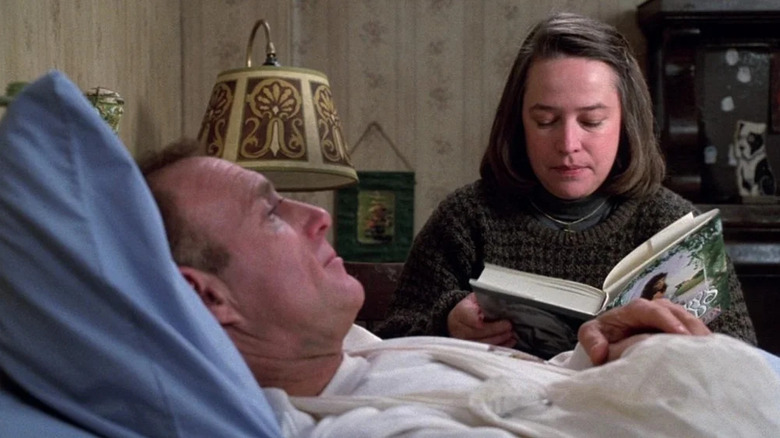
Rob Reiner made two movies that feature one character reading to another while they're laid up in bed. One is "The Princess Bride," and the other is "Misery." (I'm going to repeat myself about this, but the range of this man was unbelievable.) Based on Stephen King's novel of the same name, "Misery" — the movie that won star Kathy Bates her first Oscar, which remains one of the only acting wins for a horror movie in the Academy's history — stars James Caan as Paul Sheldon, the novelist behind a series of romance books set in the Victorian era that feature a main character named Misery Chastain. As Paul drives through snowy conditions from Colorado to New York, hoping to leave behind his Misery Chastain novels and write something new and "serious," he gets into a car accident. Unfortunately for Paul, the woman who saves him is Annie Wilkes (Bates), a superfan of the Misery Chastain books.
At first, it seems, to Paul, that Annie saved his life by bringing him to her isolated cabin, but once she realizes he's going to kill off Misery and end his book series, Annie switches gears from caretaker to kidnapper, brutally assaulting Paul in the process. (Remember the hobbling scene?! I sure do!!!) Bates is terrifying and amazing in "Misery," Caan is outstanding as the terrified and trapped Paul, and Reiner, a comedic legend, uses his impeccable timing to craft one of the eeriest, most unsettling horror movies in the entire genre.
4. Stand by Me (1986)
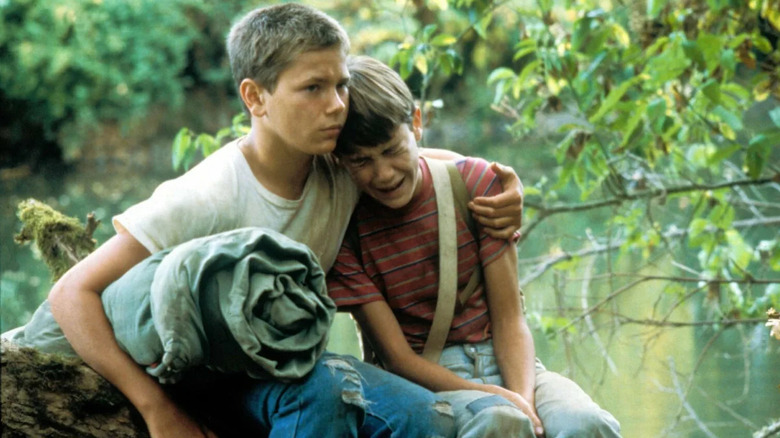
Without Rob Reiner's "Stand by Me," we might've never gotten movies and TV shows like "Dazed and Confused" and "Stranger Things" — because "Stand by Me" set a major standard for all the coming-of-age stories that would follow in its footsteps. Reiner's second Stephen King adaptation — there's a title switch-up here, as the source material is a novella by King simply called "The Body" — is told through flashbacks to narrator and protagonist Gordon "Gordie" LaChance's days as a young boy (with Richard Dreyfuss playing an older Gordie) after he learns that one of his childhood friends has passed away ... and centers around one particular summer weekend in 1959.
12-year-old Gordie, played by Wil Wheaton, is enjoying one last spot of freedom on that Labor Day weekend with his friends Chris Chambers (River Phoenix), Teddy Duchamp (Corey Feldman), and Vern Tessio (Jerry O'Connell) when Vern mentions that his older brother claims there's a dead body in their sleepy, small town of Castle Rock. The body, which may or may not be a local teenager, is by the train tracks, so the four boys set out to find it and alert authorities, assuming they'll be hailed as heroes if they do. Along the way, the friends pull apart and get closer, with Chris and Gordie bonding over their own personal struggles. "Stand by Me" honestly shouldn't work; it's a coming-of-age story where a group of boys come face to face with a desecrated body and are left traumatized. But in Reiner's capable hands, it's one of the most emotionally resonant movies ever made.
3. This is Spinal Tap (1984)
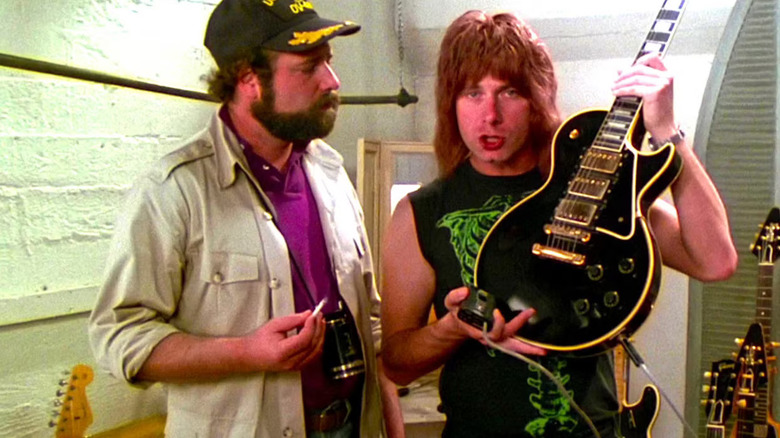
One of the funniest movies ever made and the template for pretty much every mockumentary that followed in its beautifully absurd footsteps, Rob Reiner's first-ever feature film was "This is Spinal Tap," which is, frankly, ridiculous. Reiner, who appropriately appears in the fake documentary about the fake British band Spinal Tap as the documentarian filming them — Martin "Marty" Di Bergi — brought together some of the funniest comedians alive to play the fake musicians, including Christopher Guest as guitarist Nigel Tufnel, Michael McKean as singer David St. Hubbins, and Harry Shearer as bass player Derek Smalls. (Notice I didn't mention a drummer. Even though R.J. Parnell's Mick Shrimpton is Spinal Tap's drummer throughout this "documentary," their drummers tend to die in increasingly weird ways like "choked on someone else's vomit" or "exploded on stage," the latter of which happens to Mick as the film ends.) Through the rise of Spinal Tap (during which they change genres over and over again before landing on heavy metal) to their meteoric success, this faux documentary follows the band during a concert tour, charting their ups and downs.
From Nigel explaining to a baffled Marty that this amp "goes to 11" from a wrongly sized Stonehenge prop being in "danger of being crushed by a dwarf" to the ongoing issues with the cover art for Spinal Tap's perfectly named album "Smell the Glove," everything about "This is Spinal Tap" is, basically, perfect. Without it, we wouldn't have cult classics like "Walk Hard" or "Popstar: Never Stop Never Stopping," just to name a few. Reiner also directed the long-awaited 2025 sequel "Spinal Tap II: The End Continues," in which he reprises his role as Marty; the film released just months before the director's tragic passing.
2. The Princess Bride (1987)
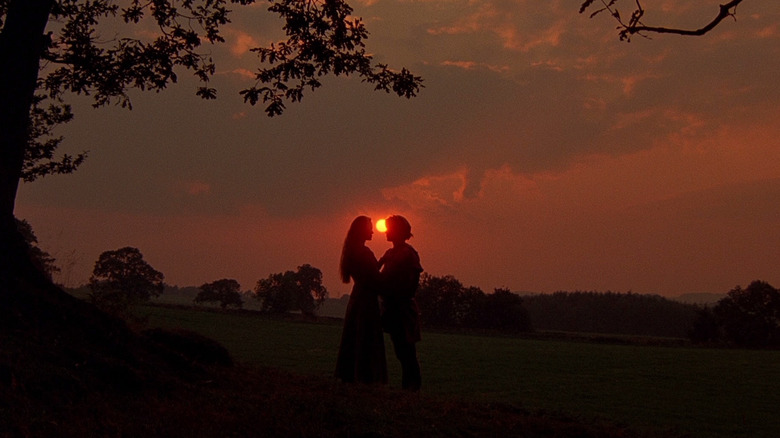
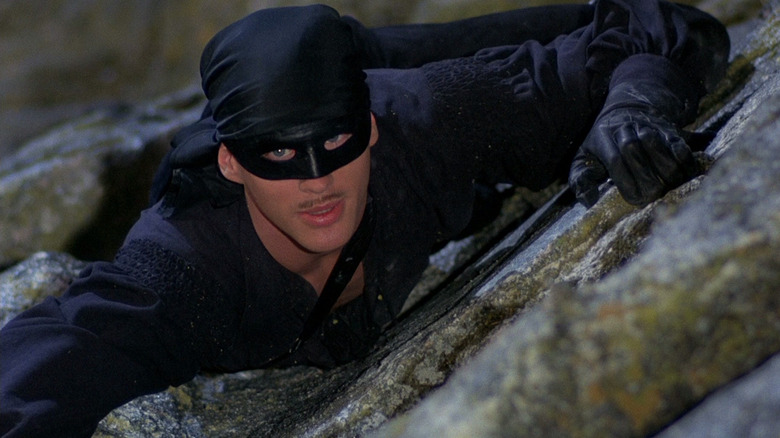
It is legitimately absurd to me that the same man who directed "This is Spinal Tap" and "Misery" also directed the swoony, lovestruck film "The Princess Bride." Based on the book by William Goldman (who also penned the screenplay), "The Princess Bride" utilizes a framework wherein a young boy home sick from school (Fred Savage) is hesitant to let his grandfather (Peter Falk) read him one of his very favorite stories, especially when the kid hears there's "kissing" in it. Undaunted, the grandfather starts reading ... and the kid is hooked by the story of Buttercup (a then-unknown actor named Robin Wright), a farm boy named Westley (Cary Elwes), and their star-crossed love, especially when swashbuckling swordfighter Inigo Montoya (Mandy Patinkin) enters the fray.
See, after Buttercup and Westley are separated by the cruel hands of fate, Buttercup believes Westley was killed by the Dread Pirate Roberts and is being forced to marry Prince Humperdinck (a wonderfully snotty Chris Sarandon). When a man dressed all in black rescues her from a hostage situation staged by an unwilling Inigo and his best buddy Fezzik (an exceedingly gentle Andre the Giant), which is run by Sicilian outlaw Vizzini (played to perfection by Wallace Shawn), he reveals he is Westley and has simply taken on the mantle of the Dread Pirate Roberts. From there, Buttercup, Westley, Fezzik, and Inigo must figure out how to escape Humperdinck's clutches. Also, Billy Crystal delivers an almost entirely improvised turn as a guy named Miracle Max, and Christopher Guest plays an evil six-fingered man.
"The Princess Bride" also shouldn't work. It combines so many tones and genres that a lesser director would never have been able to pull it off. Rob Reiner, however, could. I's not his very best film ... but it's a close second.
1. When Harry Met Sally... (1989)
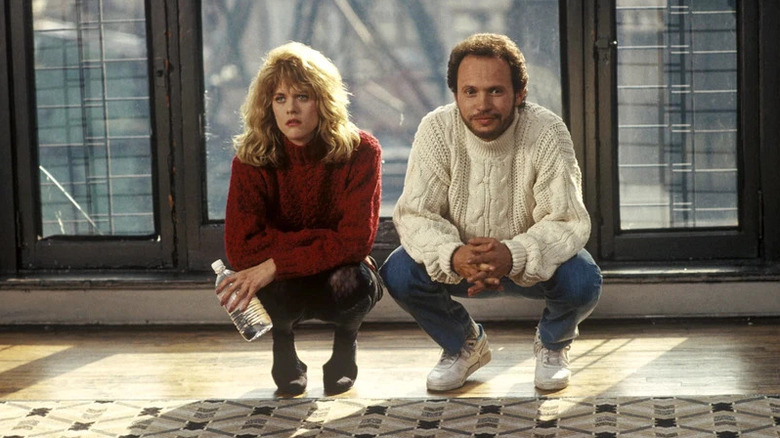
"When Harry Met Sally..." isn't just the best romantic comedy ever made. It's also Rob Reiner's best film and one of the best movies ever made. Telling its story across multiple decades (naturally, the slow burn love romance between Harry Burns — Billy Crystal in an assortment of enviable chunky sweaters — and an incessantly charming Meg Ryan as Sally Albright), "When Harry Met Sally..." is the product of one of the most thrilling writer-director combinations in film history; while Reiner's deft emotional touch steered the movie perfectly, its script was written by Nora Ephron, one of the best writers to ever live. (Ephron passed away in 2012.)
When Harry does meet Sally as they share a car from Chicago to New York after graduating from college, they hate each other — Sally seems way too uptight to Harry, and Sally is understandably grossed out by Harry spitting grape seeds out of the car window. Still, as they keep crossing paths in New York as they get older, the two become friends, and even though the spark is clearly there right from the start, their first romantic encounter happens decades into their friendship and ends in disaster.
"Someone is staring at you in Personal Growth." "Waiter, there is too much pepper on my paprikash." "I came here tonight because when you realize you want to spend the rest of your life with somebody, you want the rest of your life to start as soon as possible." Not only is "When Harry Met Sally..." unbelievably quotable and deeply romantic, it features star supporting turns from Carrie Fisher and Bruno Kirby, and it could make even the most cynical person on Earth believe in love. Reiner was one of the best directors to ever do it. These five movies prove that.