

Stanley Kubrick's A Clockwork Orange Torture Scene Seriously Hurt Malcolm McDowell (Twice)
Stanley Kubrick's 1971 dystopian satire "A Clockwork Orange," based on the novel by Anthony Burgess, stars Malcolm McDowell as Alex DeLarge, the ultimate juvenile delinquent. Although he is only about 15 or 16 years old, he is already lost to sadism and evil. He leads a violent gang of thugs who regularly beat, maim, and sexually assault anyone they want, usually while cackling in glee. Alex then goes home and relaxes in bliss, with no thoughts of remorse or compassion. He is truly evil, the same way a slasher movie villain is evil. He takes drugs, steals cars, hurts people, kills, and is having the time of his life.
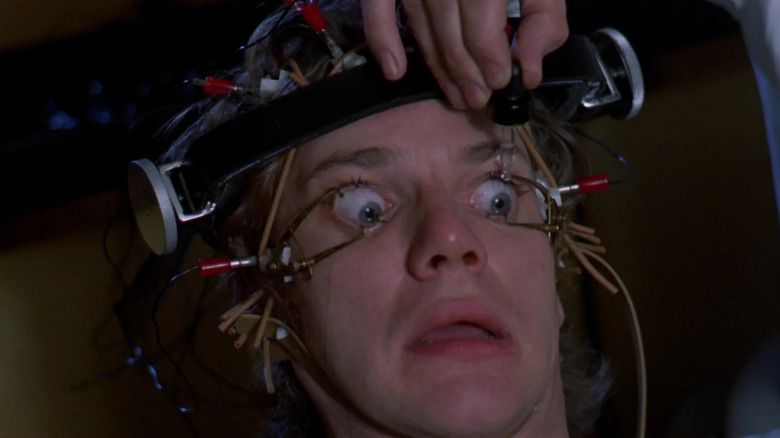
Alex, however, is eventually apprehended for his crimes and sent to prison. While inside, Alex volunteers for a special reconditioning experiment — a radical form of aversion therapy — hoping it will shave some time off of his sentence. The therapy involves strapping Alex to a chair, clamping his eyes open, and forcing him to watch hours and hours of violent imagery. His eyes are moisturized by a nearby eye doctor with an eye dropper. After a while, Alex begins to feel sick to his stomach when he watches violence. It's torture. The aversion therapy, in a dark development, works all too well.
The eye clamps were not simulated for "A Clockwork Orange." McDowell was actually strapped to a chair, and his eyeballs were indeed being moisturized by an on-camera ophthalmologist. McDowell was given some anesthesia before the scene, but it didn't last very long, so McDowell was in incredible pain throughout the eyeball scene. It became especially rough when the clamps slid out of place and began scratching his corneas. McDowell talked about his misery in the most recent issue of Empire Magazine.
The eye clamps in A Clockwork Orange scratched Malcolm McDowell's corneas
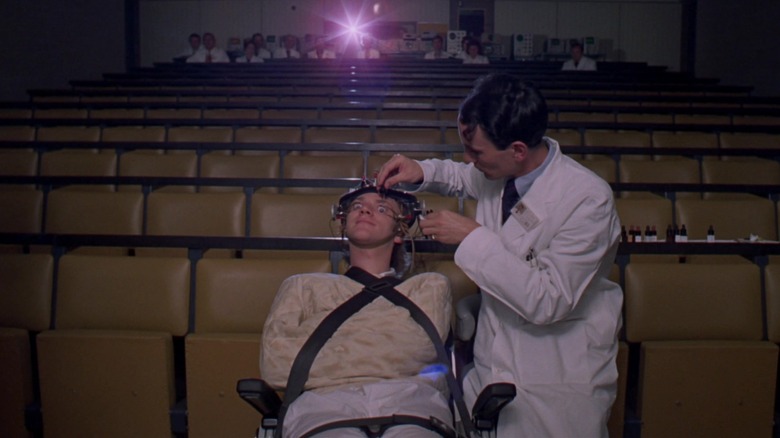
McDowell explained that the theater scene was filmed at Brunel University in London, and that the doctor in question was an actual doctor from the nearby Moorfields Eye Hospital. McDowell doesn't recall his name. He did recall, however, that director Stanley Kubrick, perhaps to appease the visiting ophthalmologist, gave him a line of dialogue. That, it seemed, was the death knell for McDowell's eyeballs. As he related:
"[H]e was more interested in [his lines] than getting those artificial tears into my eyes. Otherwise the corneas dry out and you become blind. He goes, 'Oh dear, [they're] scratched a bit.' By the time I drove home to Notting Hill Gate, the anesthetic had worn off. I've never known pain like that before or since. It was crazy."
McDowell was given a rest after filming the scene, likely to let his eyes — and his soul — recover a little bit. The actor, however, became incensed when Kubrick, a notorious perfectionist, wanted to do even more takes of the eyeball scene. He had to negotiate new terms with his director, saying:
"Kubrick came to me after I went back to work, after I took five days off, and he goes, 'I've seen the dailies. We have to do it one more time.' I said, 'Get a stand-in.' He said, 'Nah, you're known for your eyes.' He made me promise I'd do it at the end of the movie. It scratched them again! Not as badly."
So not only did he have to go back, but the clamp problem wasn't solved. If McDowell looks like he's uncomfortable in the eyeball scene, it's because he very much is. He was devoted to that role more than most actors would have been.