

Ridley Scott's Historical Drama About Christopher Columbus Was A Colossal Flop
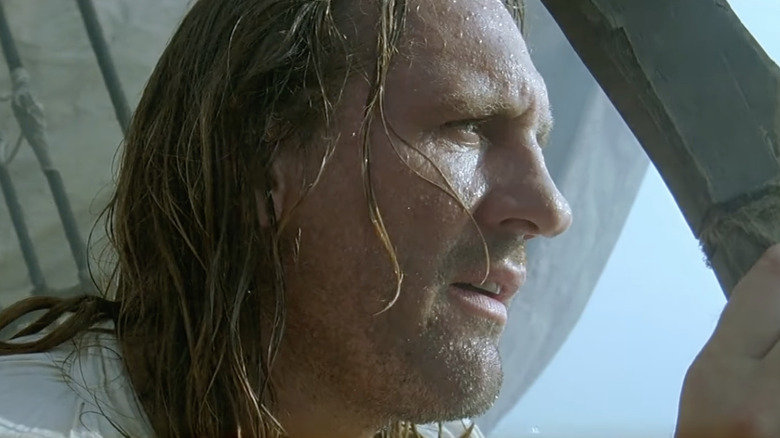
It may be hard to believe, but there were three theatrical Christopher Columbus movies released between August and October of 1992. Any readers outside of the United States should know that American schoolchildren, for generations, were taught that Christopher Columbus, the Italian explorer, "discovered America." He was presented as a vaunted historical figure who was responsible for the very first moments of U.S. history. What he really did was open up a shipping lane that allowed for the brutal colonization/genocide of the Americas, of course, and Columbus has been severely re-litigated in recent decades. We no longer celebrate Columbus Day.
But in 1992, we were still feeling a little wistful about the man, especially since it had been exactly 500 years since his previously noted transatlantic voyage. Several filmmakers felt the need to make epic historical dramas about Columbus' conquest. Two of them were intended to be high-profile Oscar-worthy prestige pictures, and each one boasted a cast of notable celebrities. The third was a spoof of the Columbus myth that was released in between the other two.
The films in question were Ridley Scott's "1492: Conquest of Paradise," John Glen's "Christopher Columbus: The Discovery," and Gerald Thomas' "Carry On, Columbus," the latest in Britain's decades-long "Carry On" comedy series. Perhaps not shocking anyone, all of these movies bombed at the box office. This was especially embarrassing in the case of Scott's film, which only made $7.2 million at the box office against a $47 million budget. Clearly, audiences didn't care about Columbus, though it probably didn't help that Scott's movie was also an abysmal slog that critics roundly hated.
Ridley Scott's 1492: Conquest of Paradise was abysmal
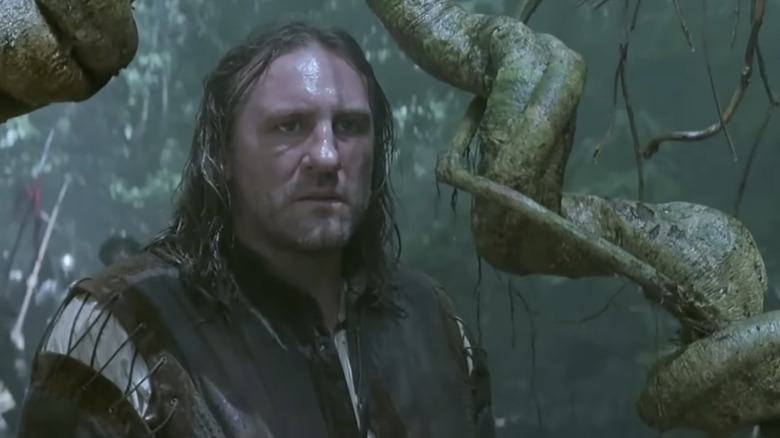
To distinguish between the three films: In Ridley Scott's "1492," Gerad Depardieu played Columbus, and Sigourney Weaver played Queen Isabella. The cast was rounded out by Armand Assante, Frank Langella, Fernando Rey, Tchéky Karyo, and Kevin Dunn. In John Glen's "The Discovery," Georges Corraface played Columbus, and Rachel Ward played Queen Isabella, but the real "get" was Marlon Brando, who played Tomás de Torquemada. Tom Selleck played Ferdinand, and the cast was rounded out by Robert Davi, Catherine Zeta-Jones, and Benicio del Toro. In "Carry On Columbus," Columbus was played by Jim Dale, and the rest of the cast is a who's who of British comedy actors. It should also be noted that the "Carry On" movies are broad spoofs in the Mel Brooks mold and have no pretenses of historical accuracy.
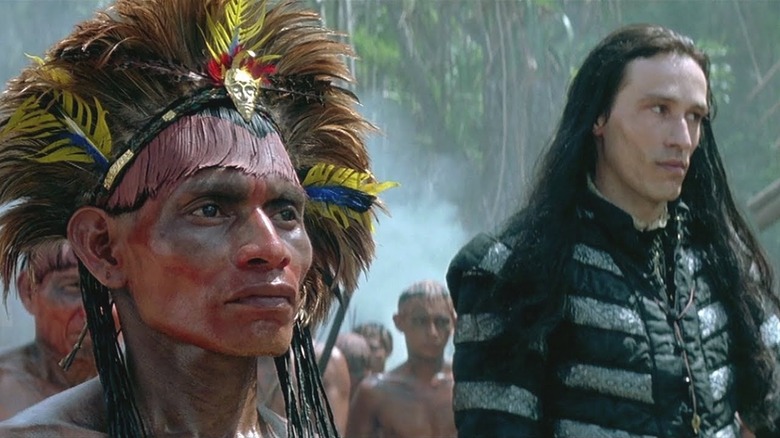
Scott's film was the best-known of this lot, mostly because of how widely panned it was and how badly it bombed. The film followed Columbus as he geared up to make his 1492 voyage across the Atlantic, revealing what happened when he landed in North America and not in Asia as he expected. "1492" mythologized Columbus and even told a story that turned him into a put-upon, unjustly forgotten hero of history. Scott's movie followed Columbus' run-in with Indigenous North Americans, but it pinned his many sins on the Spanish nobleman Adrien de Moxica (Michael Wincott). According to the film, it was Moxica who mistreated the natives and enslaved them in order to mine for gold. In Scott's version of the story, Columbus was blamed for all the evils in the new world, and pilloried. He died an old man, pathetically forgotten by history. It's a pretty terrible narrative.
Every hated 1492: Conquest of Paradise
Critics hated "1492," and the film currently only holds a 30% approval rating on Rotten Tomatoes based on 30 reviews. In his review for Newsweek, David Ansen wrote that it was the least entertaining historical epic he had ever seen. Noting that his one-word review would be "hubris," he observed, Scott doesn't so much [tell] the story of Columbus [...] as hurl it at the audience in a barrage of portentously pumped-up images and sounds: 15th-century Spain thunders by through billows of smoke, murk and noise." (That sounds typical for Ridley Scott.) Elsewhere, writing for The Washington Post, Desson Howe acknowledged that the film's visuals were rich and bombastic, but he found its story dull as dishwater. "Despite Scott's trademark, spectacular imagery, the story's dead in the water," he wrote. "Actually, there's no story. It's all eye-dizzying hyperbole, with astounding camerawork, fancy editing, and a moody flamenco guitar-meets-synthesizer soundtrack by avant-garde musician Vangelis."
Audiences, as mentioned, stayed away in droves. Like many of Scott's productions ("Kingdom of Heaven" being the most infamous example), there was also some controversy surrounding the film's editing. The theatrical version of the movie was 150 minutes long and had been shaved down from Scott's desired cut due to its violence. The version now available has six minutes restored.
In 2021, Scott was interviewed by Games Radar, and he looked back over his career of scant hits and mega-flops, stating he was proud of all of them. Scott added that he still liked "1492" as well, blaming its failure on the film's lack of American actors. American audiences, he argued, "don't hear s*** unless it's from Texas or America, right?" He called it one of his favorite movies. He may be the only person who likes it.