

This '80s Christmas Horror Movie Was So Controversial That Theaters Stopped Showing It
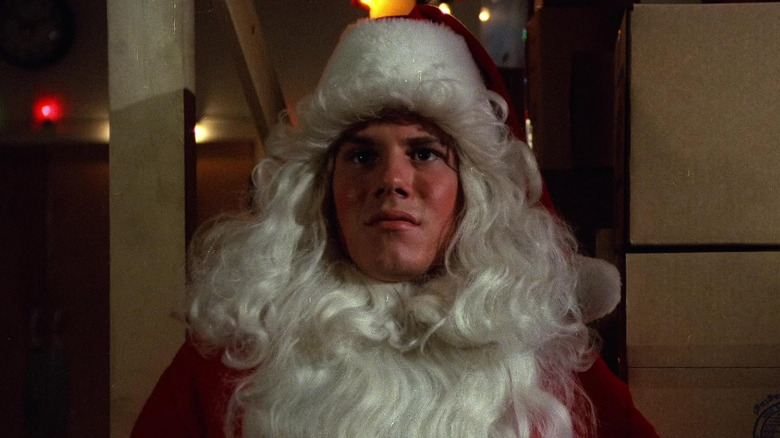
Charles E. Sellier Jr.'s 1984 slasher flick "Silent Night, Deadly Night" is a pretty silly movie. The creatives behind the film clearly started with the idea of a killer in a Santa Claus outfit and then backward-engineered a story as to how a young man might want to commit murders on Christmas Eve. The story goes that a young Billy (Jonathan Best) was visiting his mentally ill grandfather in 1971, at which point his grandfather began raving about how Santa Claus is evil and punishes the naughty. Then, on the drive home, a murderer dressed as Santa (and this is a total coincidence) attacked Billy's family's car, killing his parents.
At age eight (and now played by Danny Wagner) Billy is abused by a vicious nun at a convent orphanage. The Mother Superior (Lilyan Chauvin) tells the orphans that punishment and discipline are good, actually. Fast-forward to the present, and Billy (Robert Brian Wilson) is now 18 and trying to move into the world for the first time. He takes a job at a toy depot at Christmastime, where he's forced to don a Santa suit and talk to kids. Naturally, this affects Billy mentally, prompting him to go on a killing spree to punish all the naughty people of the world.
Billy's story is tragic, but seeing as "Silent Night, Deadly Night" is a trashy horror film, its creatives are more keen to focus on the mayhem and Christmas-themed violence. At one point, someone is strangled by Christmas tree lights, while a topless woman (all-time horror legend Linnea Quigley) is impaled on a mounted elk head.
This caused a minor scandal at the time. Many people found the idea of a killer Santa immensely distasteful, causing TV stations to pull the film's ads and scaring theaters away (per UPI).
Silent Night, Deadly Night is trashy by design
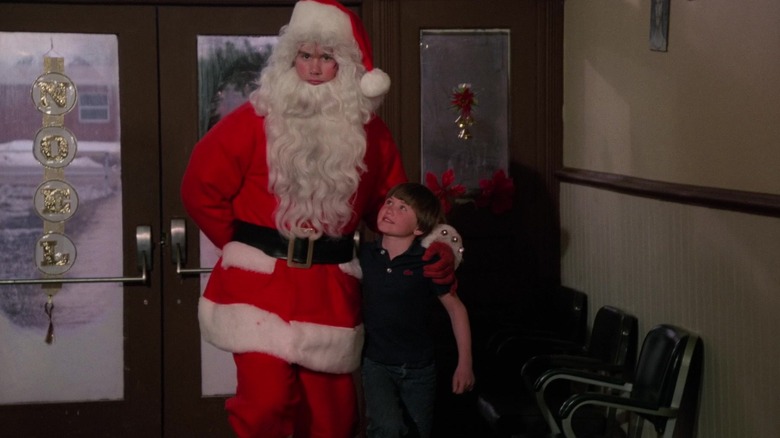
According to UPI, the filmmakers behind "Silent Night, Deadly Night" capitulated to pressure over the movie's TV ads, but they had no intention of meeting every demand of angry protestors. The film's poster was kept unchanged, and it's a good thing. The one-sheet depicts Santa vanishing down a chimney, but only his arm holding an axe is visible. TriStar, which distributed "Silent Night, Deadly Night," didn't pull the film from theaters either, although wide distribution was seemingly stymied by the controversy. Protestors, as the UPI article pointed out, gathered around a few small theaters in Brooklyn to object to the movie. It seems that, for them, Santa Claus was a symbol of peace and goodness, so turning him into a killer was simply not acceptable. For many, "Silent Night, Deadly Night" was simply a bridge too far.
Of course, that was kind of the point. "Silent Night, Deadly Night" is an attempt to take something innocent and make it dangerous. It's the same principle that drives killer toy movies, killer child movies, and even killer clown movies. But that was enough to upset people, and some theater managers, disgusted by the film's content, refused to book it. The former mayor of Norwalk, Connecticut, a man named Thomas O'Connor, was quoted as saying, "I believe in free speech, free expression. But Christmas is sacred. To make one of these killer movies with Christmas, and Santa Claus as the theme — that's going too far." Thus, free speech, it seems, has limits.
Famously, critic Gene Siskel shared the protestor's view, feeling that turning a kiddie icon into a killer was morally irresponsible. Even film actor Mickey Rooney spoke out against the movie. Remember that, as it will be relevant in a moment.
Silent Night, Deadly Night has gotten multiple sequels and remakes
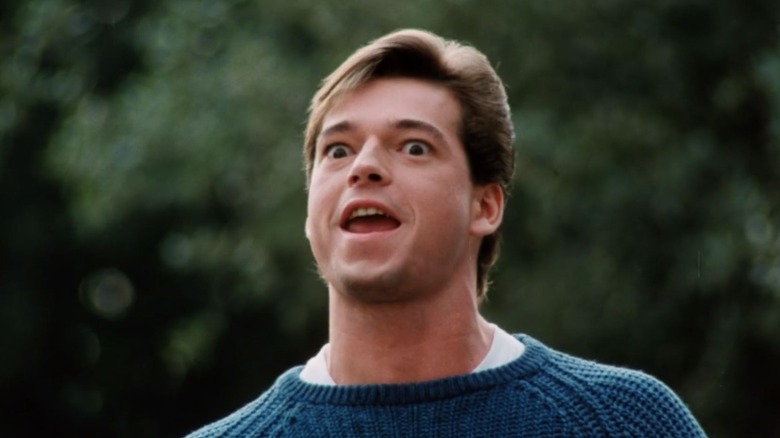
Nowadays, 1984's "Silent Night, Deadly Night" almost seems quaint and is usually watched every Christmas by a particularly ironic group of bloodthirsty cineastes. Despite the protests, the film was a financial success, making about $2.5 million at the box office against a scant $750,000 budget. Naturally, a sequel came to pass, with "Silent Night, Deadly Night Part 2" hitting theaters in 1987. That film follows Billy's younger brother Ricky (Eric Freeman), who proves to be equally — if not more — bloodthirsty, and it reuses a lot of footage from the first movie yet feels, at most, tangentially connected. Indeed, many modern audiences only know the film for its notorious meme-inspiring "Garbage Day" scene.
After that, the "Silent Night, Deadly Night" franchise moved to home media. 1989's "Silent Night, Deadly Night 3: Better Watch Out!" was directed by Monte Hellman and — through a long series of Hollywood connections — may be responsible for Quentin Tarantino's career. 1990's "Silent Night, Deadly Night 4: Initiation" is not even a Christmas movie, focusing instead on a young woman investigating a weird cult that worships cockroaches (with Brian Yuzna directing and Screaming Mad George handling the special effects). It's pretty excellent.
Then, in 1991, Martin Kitrosser wrote and directed "Silent Night, Deadly Night 5: The Toymaker," restaging the story as a Pinocchio-style tale. The Gepetto figure is played by ... Mickey Rooney. He may've been grossed out by the original "Silent Night, Deadly Night," but Rooney was fine taking a paycheck for its fourth sequel.
There have since been a pair of remakes released in 2012 (simply called "Silent Night") and in 2025 (which uses the full title, "Silent Night, Deadly Night"). This franchise has handily outlived the original film's protests.