

Who Is Cosmic Armor Superman? DC's Strongest Version Of The Man Of Steel Explained
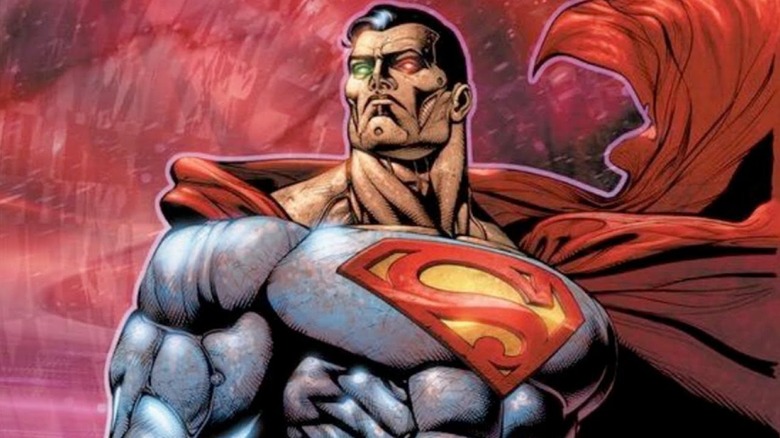
Superman is one of the most powerful entities in all of DC Comics; the paragon of truth and justice, a warrior for a better tomorrow, and a character that doesn't really need power-ups because he's already absurdly strong.
And yet, writers are constantly finding ways of giving Superman even more abilities. Silver Age Superman is leaps and bounds more powerful than Golden Age Superman was, with his initial street-level powerset (leaping tall buildings, running as fast as a locomotive) replaced with the ability to destroy a whole solar system with a single sneeze. Throughout the decades, he was given even more powers and started accomplishing increasingly impossible feats that have made him a tough character to accurately portray in live-action, like moving entire planets with his fists. Granted, James Gunn certainly got quite a lot right in his depiction of the Man of Tomorrow that previous adaptations didn't.
But it isn't just the main continuity writers that came up with wildly powerful new abilities for Superman; there are also plenty of other versions of the Man of Steel from the larger DC multiverse that expand his powerset. Some of these are way more powerful than others, like the version of Superman who lived well into the 853rd century, spending thousands of years at the heart of the sun, and became a godlike being. There's also the reality-altering Super-Boy Prime, or the zombie Superman that nearly destroyed the world. Then there's, without a doubt, the mightiest of all Supermen, known as Cosmic Armor Superman. This is a version of the character so gobsmackingly powerful he could only be conjured by the comics wizard Grant Morrison, and a deity so strong he has only ever shown up once in the comics ... but that was enough to literally save the entire multiverse.
Who is Cosmic Armor Superman?
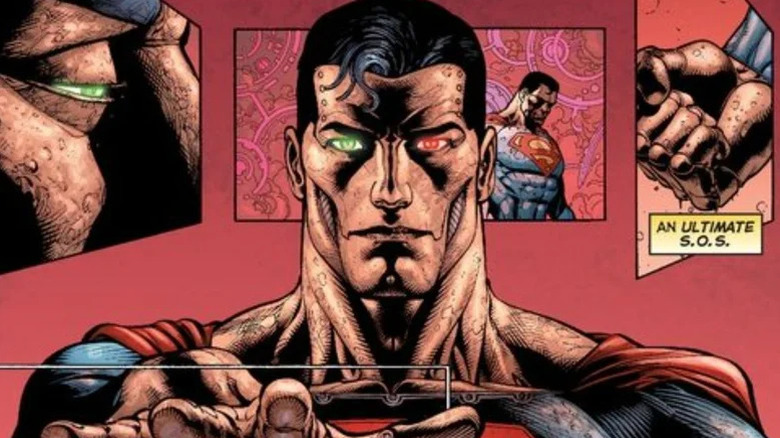
In the middle of the epic 2008 crossover event "Final Crisis," Grant Morrison and artists J.G. Jones, Carlos Pacheco, and Doug Mahnke's Crisis to end all Crisis stories, Morrison also wrote the tie-in "Superman Beyond 3D," drawn by Doug Mahnke. It's a story set when Darkseid has taken over the world, and Superman was sent to Comic Book Limbo — a place outside of reality where those characters that writers forgot about are sent. It is here that Superman is told that the Monitors (DC's version of the Watchers in Marvel) have been collecting Supermen from across the multiverse to save reality from Mandrakk the Dark Monitor, a being who literally can suck the life and joy out of fiction.
To counter Mandrakk — a cosmic vampire and the personification of the ending of all stories — a rather meta being representing writers and editors themselves (bad ones, at least), the Monitors take to Superman because he is the embodiment of heroism and of fiction itself, with all its hope and joy. The Monitors fuse Superman with Ultraman, his counterpart in the Crime Syndicate, to create the Thought Robot known as Cosmic Armor Superman.
Cosmic Armor Superman is quite literally described in the comic as a plot device. He has meta awareness and the actual powers of a writer, able to manipulate his reality and himself to rise up to any occasion. He can hold an entire dimension in his hand and edit the fabric of the multiverse itself. This Superman is a representation of superhero comics, their imagination, and the hope they instill in readers. He's by far the single most powerful being in the entire history of DC.
Could we see Cosmic Armor Superman in the DCU?
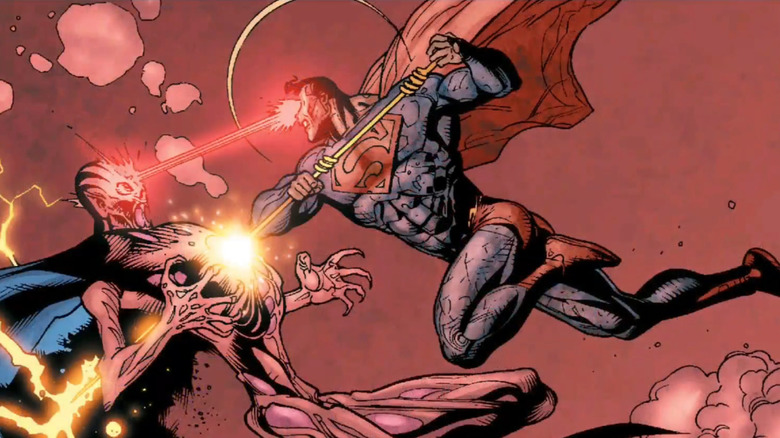
Cosmic Armor Superman is a fascinating character, but one that will probably never be portrayed on the screen. There is simply no way to properly portray his powers, let alone in live-action. Sure, animation may come somewhat close, if it's done like the iconic Chuck Jones animated short "Duck Amuck," wherein Daffy Duck is literally tormented by an animator rewriting Daffy's reality. In a way, Cosmic Armor Superman is similar to another big Superman character, Superboy-Prime, in that he is simultaneously too big to pull off in live action and also a piece of meta commentary that only works in comics.
Indeed, just like Superboy-Prime is the manifestation of the readers themselves, so is Cosmic Armor Superman a manifestation of a meta concept that just doesn't work in a movie. He's a not-at-all subtle allegory for the nature of storytelling and superhero comics. His fight against Mandrakk is a fight against corporatization of art in the hands of company men and editors, not exactly an easy concept to do in a four-quadrant blockbuster.
Grant Morrison is one of the best modern comics writers, but they are so in tune with the medium of comics, always integrating meta commentary on the very nature of comics and storytelling, that to translate it to the screen is to inherently lose the essence of their stories. Cosmic Armor Superman literally reaches out to the reader (thanks to the comic being presented in 3D) in the comic book, and wins by banishing Mandrakk from the book. His existence can only be done as part of an event with as high stakes, with as great a sense of finality as "Final Crisis," so don't expect to see him in James Gunn's DC Universe anytime soon.