

Ghostbusters Actually Gave Egon's Blonde Cartoon Hair An Origin Story
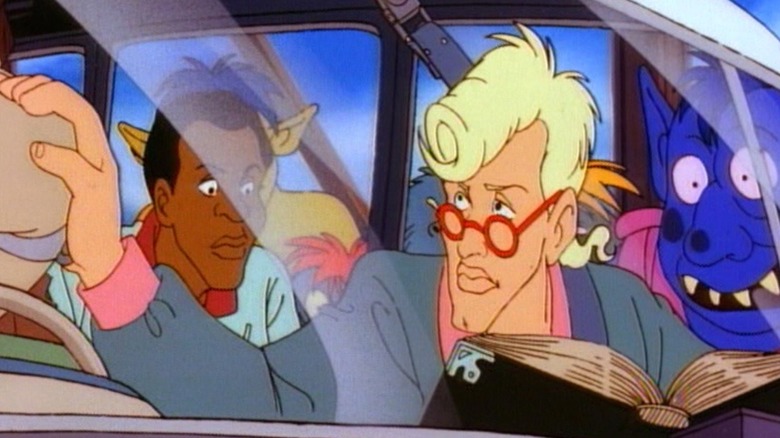
The animated series "The Real Ghostbusters" debuted on September 13, 1986, two full years after the release of Ivan Reitman's film on which it was based. It wasn't poor timing, however, as the popularity of "Ghostbusters" hadn't waned one whit. Indeed, thanks to the film's 1985 release on VHS, it had only proliferated to a wider audience than ever before, allowing its popularity to expand. By 1986, kids tuned in en masse to see the animated exploits of Peter Venkman (Lorenzo Music), Winston Zeddemore (Arsenio Hall), Ray Stantz (Frank Welker), and Egon Spengler (Maurice LaMarche). The series was massively successful, and spawned a line of toy products and a comic book. "The Real Ghostbusters" lasted 140 episodes over its seven seasons. The animated series was just as big a phenom as the film.
Fans immediately noted, however, that the animated Ghostbusters didn't resemble their live-action counterparts. Peter no longer looked like Bill Murray, but had a long, thin face and a large, upswept hairdo. Winston didn't look like Ernie Hudson, lacking his mustache, and also possessing of a long, thin neck and square jaw. Ray no longer looked like Dan Aykroyd, now being a round-faced redhead with a potbelly. And, most dramatically, Egon no longer looked like Harold Ramis, and now sported a striking, Elvis-like blonde pompadour.
It's likely that the four actors wouldn't license their likenesses for the series, explaining why they looked so different. It's also common practice in animation to give characters exaggerated features so their colors and silhouettes are instantly recognizable; there's a reason why the Simpsons always wear the same clothes and have basic shapes for heads. In canon, though, there didn't seem to be an explanation as to why Egon was suddenly blonde.
Until a 1990 "Ghostbusters" comic book explained it all.
Egon was given blonde hair by a ghostly mushroom
Beginning in 1988, Marvel Comics published a series of spinoff "Real Ghostbusters" books in the UK, using the character designs from the animated series. That book proved to be incredibly popular, and ran for an impressive 192 issues before being canceled in September of 1992. That was a full year after "The Real Ghostbusters" animated series had been canceled, so the comic had a life of its own. In 1990, Marvel Comics used a separate imprint of theirs — called NOW Comics — to re-print several issues of the popular UK "Real Ghostbusters" comic in the United States.
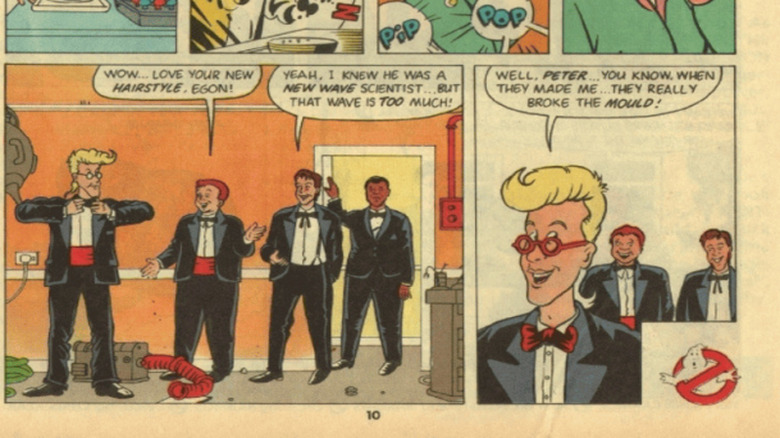
In an issue of "The Real Ghostbusters" comic, in a two-page story called "Hair Today... Egon Tomorrow!," it was finally explained why Egon's hair was so different from the way it appeared in the movie. The story began with Egon, sporting Harold Ramis' usual dark hair, examining a batch of glowing mushrooms he called lumi-fungi. During his examination, Ray entered the room with his dinner: a bowl of mushroom soup. While Egon was distracted, the impish ghost Slimer began manhandling the lumi-fungi. One grows a fanged mouth and nearly bites Slimer, causing him to drop it into Egon's soup. Naturally, the distracted Egon will eat the monster mushroom.
The mushroom causes Ego's hair to become electrified, instantly bleaching it blonde and changing the style to match how it looked in the cartoon. Egon's hair was the result of a magic mushroom. When the other three Ghostbusters saw Egon's new hair, they merely complimented it. One can read the pages on Reddit.
But that was it. There was now a canonical reason to explain the common cartoon practice of exaggerated character design. Blonde Egon now lives on in infamy. Thank you, lumi-fungi.