

The One Shot In The Abyss That James Cameron Says Suffered Because He 'Overreached'
If you've watched the fascinating documentary "Fire and Water: Making the 'Avatar' Films," you know James Cameron will go to astonishing lengths (and spend loads of a studio's money) to realize his vision. He's a perfectionist who insists on getting every detail, no matter how minute, right. After all, this is the man who insisted that every piece of silverware in "Titanic" be stamped with the White Star Line emblem. To say he is exacting is an understatement.
Early in his career, Cameron's imagination often outstripped what could be accomplished with the visual effects technology of the day. He had to get inventive on "The Terminator," which, for an action/sci-fi flick, had a meager budget of $6.4 million; when the production company behind the film refused to approve the exploding of an automobile near the end of the film's shoot, Cameron simply blew up his own car. But after delivering a box office smash for 20th Century Fox with 1986's "Aliens," he discovered that he had the studio wrapped around his finger. So, three years later, Cameron plunged into "The Abyss," a massively complicated production that found its cast and crew frequently submerged in 30 feet of water in a gigantic fresh-water filtered tank.
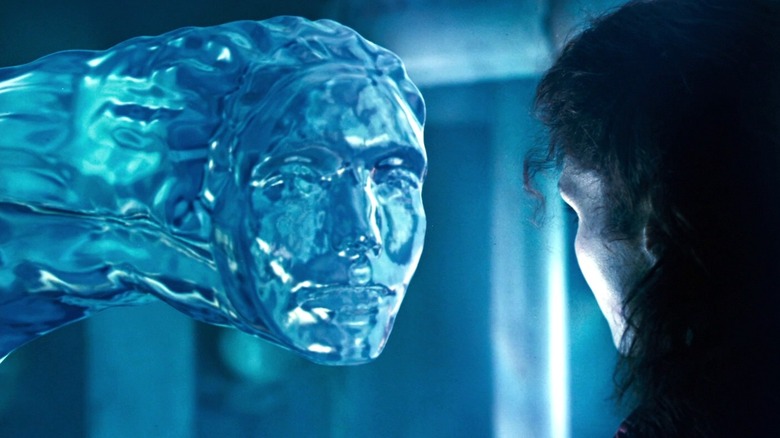
This wasn't enough of a challenge for Cameron. He also tasked Industrial Light & Magic with creating a computer-generated, watery pseudopod that could convincingly glide through the confines of the Deep Core underwater drilling platform. Miraculously, the VFX house pulled it off (and took home the Best Visual Effects Oscar for its artists' groundbreaking efforts). But there was one shot that didn't pass muster for Cameron: the film's climactic tidal wave sequence. He excised this set piece from the theatrical version before adding it back in a subsequent Director's Cut. Even then, he felt he'd "overreached."
The tidal wave sequence in The Abyss didn't meet Cameron's high standards
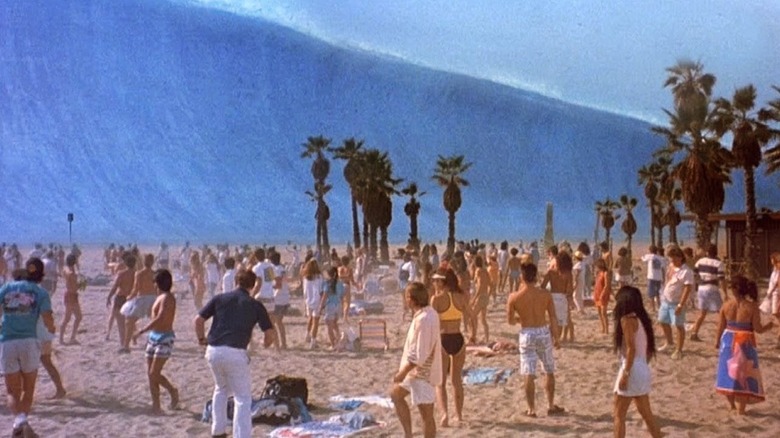
In an interview with Empire Magazine pegged to the release of "Avatar: Fire and Ash," Cameron took responsibility for the botched ending of "The Abyss." The sequence finds the film's underwater aliens generating massive tidal waves that will wipe out every coastal city on the planet unless the world's nuclear powers get rid of all their apocalyptic weaponry. "It's the movies where I had big budgets where I can't let myself off the hook," he explained, "Because then everything is the result of a conscious decision."
The problem, again, is that Cameron's imagination was too big for that era of visual effects when it came to "The Abyss." As he told Empire:
"[I] look at the big wave sequence and the rising of the mothership, which was all practical and miniature effects, and it all suffers. I imagine what that could be like using the CG tools that we have available now — it would be jaw-dropping. That was a little bit of an overreach on my part at the time."
When Cameron's Lightstorm Entertainment inked a $500 million deal with 20th Century Fox in 1991, $500,000 was set aside for ILM to complete the tidal wave sequence with the somewhat more sophisticated CGI technology of the time. I agree that it's unconvincing, but my biggest issue is that Cameron's anti-nuke, "The Day the Earth Stood Still" homage isn't smoothly set up throughout the Director's Cut. This iteration of the movie gets draggy, whereas the theatrical edit winds up being a lovely metaphor about toughing out a rocky marriage. I still think that version of "The Abyss" is the best film Cameron has ever made (though others have different feelings on the matter).