

John Woo's Signature Action Sequences Have An Unexpected Inspiration And Influence
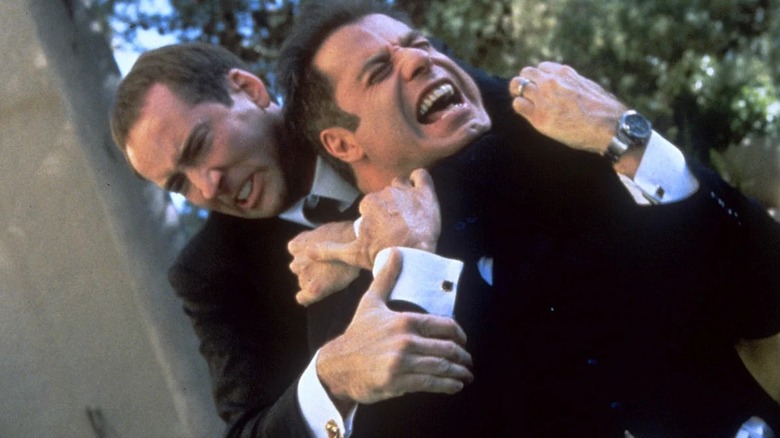
No one does it like John Woo. The influential action film director boasts a singular style, where bullets fly in slow-motion, shoot-outs take on an operatic quality, and multiple cameras hone in on a climactic incident. The enduring image of a John Woo-leading man blasting twin guns mid-leap has shaped the genre since "A Better Tomorrow," the breakout film that launched Chow Yun-fat as an action star. Woo's influences can be traced back to the French New Wave (where films like "Le Samouraï" informed his stylistic flair), along with Eastern filmmaking that incorporated martial arts as the visual centerpiece. Woo's kinetic approach to combat popularized gun-fu, which often sports visceral choreography due to Woo's deep appreciation for high-octane Westerns such as Sam Peckinpah's "The Wild Bunch."
Speaking to Variety, Woo recently looked back at his impressive body of work to underline some of the core influences that shaped his perspective on the genre. While 1970s-80s Hong Kong cinema primarily featured kung-fu, Woo came to appreciate dynamic action via an artistic lens, especially through dance:
"When I'm making an action movie, I don't see it as an action movie. It's like a painting or a poem, sometimes even like a musical. I'm aiming for that kind of feel, because I'm a dreamer. I think that's my style because I always have some kind of beautiful dream in my mind [...] I was a pretty good dancer when I was young. When it comes to the action in a movie, it's all about the beauty of the body movement and the fighting skill."
That sounds about right. Only a dreamer can make the carefully-controlled chaos of "bullet ballet" work, and craft protagonists who are mostly lone wolves, doomed by the enormity of their conflicting desires.
A sense of Romanticism drives John Woo's signature action sequences
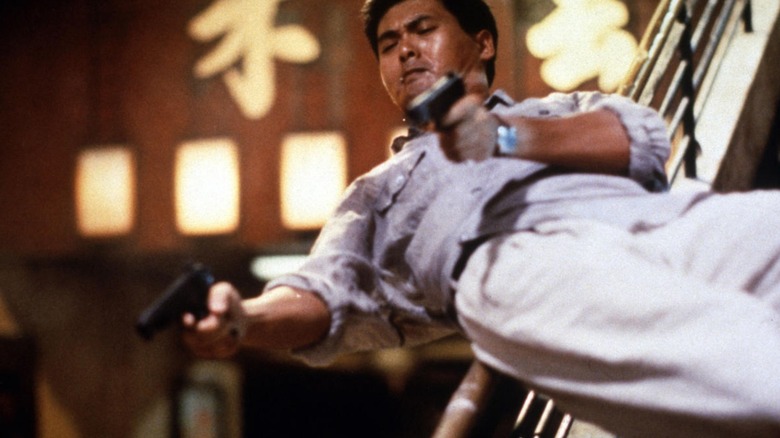
Woo's abovementioned statement might come as a surprise, as one would expect him to highlight French crime thrillers as an influence (especially that of Jean-Pierre Melville, who honed a distinct approach to film noir/neo-noir). From a thematic perspective, Martin Scorsese's "Mean Streets" has also informed a lot of Woo-isms, especially in "The Killer," which takes the act of pointing a gun at another to enthralling extremes. Per Woo, the core of his cinematic sensibilities lies in "romanticism" fostered by European cinema, and he cites Jacques Demy's "The Umbrellas of Cherbourg" as a key influence.
"The Umbrellas of Cherbourg" boasts an astounding legacy, weaving operatic passion with grounded drama to create something stylish and timeless. Woo's love for it makes sense once we peer closer at his tendency to favor dramatic flourishes, along with his ability to elevate mundanity into poetry in motion. Even Woo's established trope of heroes firing dual handguns is rooted in a sense of elegance that complements the gun-wielding character in question, like in "A Better Tomorrow." Woo explains: "If he's [Yun-fat's Mark Lee] a professional killer and he's a true hero, he would never use a machine gun. It's too easy and not elegant."
This instinct to infuse elegance into violence can easily be glimpsed in everything from "Hard Boiled" to "Face/Off," where characters engage in a frenetic tango while exchanging insults and bullets. Even when a shootout is off the table, people glide off surfaces gracefully to give chase or leap sideways to shield an innocent bystander. While the combat-centered "beauty of the body movement" might not always make for a satisfying film (his "Mission: Impossible 2" being a prime example), Woo has had more hits than misses with this uniquely inspired approach.